COMMUNITY INTEGRATION SERVICES PROVIDER IN SOUTH CAROLINA
By Fatumata Kaba · 2025-10-13 · 6 min read
Becoming a Community Integration Services provider in South Carolina requires navigating a rigorous regulatory landscape governed by the Department of Disabilities and Special Needs (DDSN) and the South Carolina Department of Health and Human Services (SCDHHS). These services are essential for facilitating social connection, skill development, and inclusive participation for individuals with disabilities, ensuring they remain active and supported within their local communities.
Understanding the Role of Community Integration Services in South Carolina
Community Integration Services—often referred to as Community Services—are foundational to the Home and Community-Based Services (HCBS) framework. These services are designed to move beyond traditional clinical care by providing individuals with disabilities the support needed to engage meaningfully in everyday life. By participating in social, recreational, educational, and volunteer activities, participants are empowered to build lasting relationships, access public amenities, and develop the necessary skills to navigate their environments with greater autonomy.
In South Carolina, these services are reimbursed through specific Medicaid HCBS waivers, ensuring that the care provided is person-centered and aligned with the participant’s Individual Support Plan (ISP). Providers are responsible for not only facilitating these outings but also ensuring that each activity serves a therapeutic or developmental purpose. This might include assisting an individual in utilizing public transportation, participating in community clubs, or volunteering at local organizations to foster a sense of belonging and contribution.
Navigating the Regulatory Hierarchy and Governing Agencies
The delivery of Community Integration Services is subject to oversight by multiple layers of authority. Understanding this hierarchy is the first step for any agency founder or administrator. The South Carolina Department of Disabilities and Special Needs (DDSN) serves as the primary gateway; it is the entity responsible for authorizing providers to deliver these specific services and conducting ongoing monitoring to ensure compliance with strict state service standards.
Beyond the DDSN, the South Carolina Department of Health and Human Services (SCDHHS) acts as the state’s Medicaid authority, managing the fiscal integrity and reimbursement processes for HCBS programs. At the federal level, the Centers for Medicare & Medicaid Services (CMS) establishes the overarching federal standards. These standards prioritize inclusion, the preservation of participant rights, and the mandate that care remains truly community-based rather than institutional in nature. Providers must remain audit-ready at all times to satisfy the requirements of all three entities.
Establishing Your Agency: Licensing and Provider Enrollment Requirements
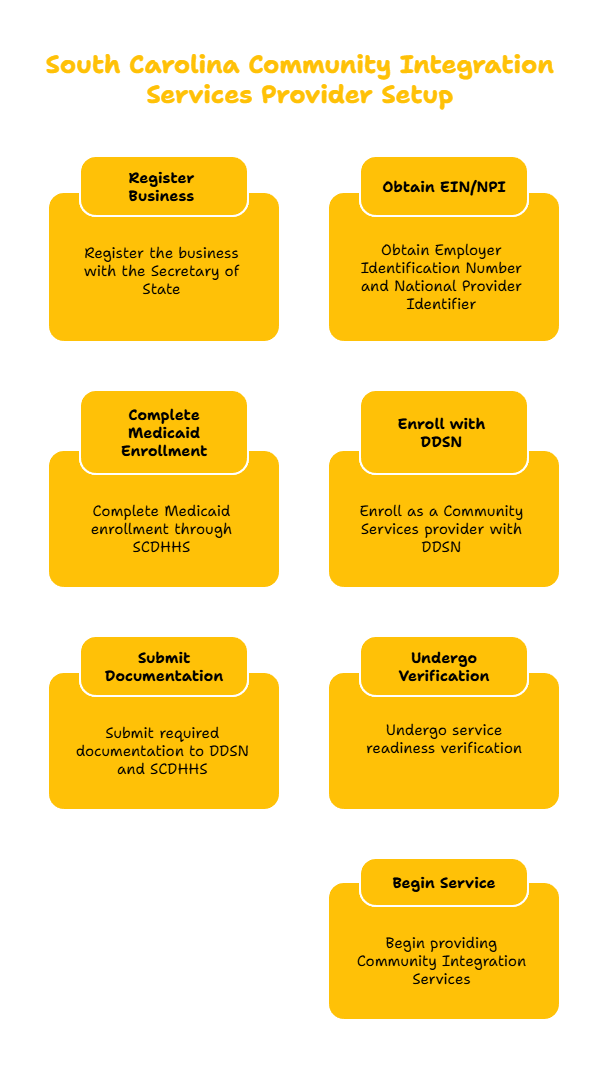
Formalizing your business as a qualified provider is a multi-step process that requires careful attention to detail. Before providing a single hour of service, an organization must complete the foundational business setup, including registering with the South Carolina Secretary of State and securing an Employer Identification Number (EIN) and a Type 2 National Provider Identifier (NPI). These identifiers are non-negotiable for Medicaid billing and administrative compliance.
Following business registration, the enrollment process involves two distinct tracks: securing provider status through the DDSN and completing the Medicaid enrollment through SCDHHS. Prospective providers must be prepared to demonstrate organizational readiness by submitting comprehensive service protocols, staff qualification records, and a robust Policy and Procedure Manual. This manual serves as the operational backbone of the agency, detailing how services will be delivered in accordance with state and federal regulations.
- Register business entity with the South Carolina Secretary of State.
- Obtain official EIN and Type 2 NPI.
- Enroll with the DDSN as an approved Community Services provider.
- Complete the comprehensive SCDHHS Medicaid provider enrollment process.
- Hire and vet Direct Support Professionals (DSPs) according to state standards.
- Develop and implement a compliant Community Integration Services Policy & Procedure Manual.
Operational Standards: Staffing, Training, and Participant Safety
The quality of Community Integration Services is directly tied to the competency of the Direct Support Professionals (DSPs) delivering them. Requirements for these positions include a high school diploma or GED, completion of a criminal background check, and active certification in CPR and First Aid. Beyond these basic requirements, agencies are expected to provide rigorous training in person-centered support, which allows staff to adapt to the unique needs and goals of each individual participant.
Safety and ethics are paramount in community settings. All staff must undergo specialized training in the prevention of abuse and neglect, HIPAA compliance, and the promotion of participant dignity and rights. Furthermore, maintaining high-quality documentation—including activity logs, incident reports, and time-tracking records—is essential for both internal quality assurance and external audits. Utilizing a Program Coordinator to oversee these activities and align staff interventions with the participant's ISP is a best practice for maintaining service consistency.
Utilizing Medicaid Waiver Programs for Service Delivery
Community Integration Services are integrated into various Medicaid waiver programs in South Carolina, each catering to different participant populations. Understanding which waivers your agency will serve is critical to shaping your service delivery model. These programs include the Community Supports Waiver, which is designed for individuals who require part-time assistance, and the ID/RD Waiver, which is tailored for participants needing more structured, comprehensive community support. Additionally, the HASCI Waiver provides specific support for adults dealing with head and spinal cord injuries.
In certain instances, Self-Directed Services programs may allow participants and their families more flexibility in selecting their community providers. By familiarizing your administrative team with the distinct requirements of each waiver, you can better align your agency’s resources with the populations you are authorized to serve. Always ensure that every service rendered is clearly documented as being in direct support of the objectives outlined in the participant's specific ISP.
Frequently Asked Questions
What is the typical timeline for becoming an authorized provider?
The process generally follows a multi-phase schedule. Business setup and policy development typically require 1–2 months. The enrollment process with the DDSN and SCDHHS takes approximately 2–3 months, followed by a 30–60 day period for hiring and staff training. Service activation occurs once final approvals are received and the agency begins accepting referrals.
What must be included in a Community Integration Services Policy & Procedure Manual?
The manual must contain detailed daily activity planning templates, participant consent forms, comprehensive risk assessments, and supervision protocols. It must also include strict policies on HIPAA and participant rights, clear emergency response procedures, and explicit guides for Medicaid billing and internal auditing to ensure ongoing compliance.
Where can I find the official resources for program requirements?
Detailed information regarding state-specific standards and program updates can be found on the official websites for the South Carolina Department of Disabilities and Special Needs (https://ddsn.sc.gov) and the South Carolina Department of Health and Human Services (https://www.scdhhs.gov). Federal regulatory guidance is available through the Centers for Medicare & Medicaid Services (https://www.cms.gov).
Key Takeaway
The successful launch and operation of a Community Integration Services agency in South Carolina depend on meticulous adherence to the regulatory requirements set forth by the DDSN and SCDHHS. By focusing on professional policy development, rigorous staff training, and consistent documentation, providers can effectively support individuals with disabilities in reaching their goals for community inclusion. Success requires a commitment to both administrative excellence and a person-centered approach to care, ensuring that every service provided translates into meaningful outcomes for the participant.
Last verified: October 2023. Disclaimer: This article is for informational purposes only and does not constitute legal or professional consulting advice. Requirements and regulations are subject to change; providers should consult the official South Carolina DDSN and SCDHHS portals for the most current information and policy guidance.