COMMUNITY INTEGRATION SERVICES PROVIDER IN RHODE ISLAND
By Fatumata Kaba · 2025-10-09 · 6 min read
Community Integration Services in Rhode Island serve as a critical component of the state’s Home and Community-Based Services (HCBS) framework, designed to support individuals with intellectual/developmental disabilities (IDD), behavioral health needs, or chronic conditions in achieving meaningful participation in daily life. By facilitating access to social activities, volunteer opportunities, and inclusive community settings, these services are essential to reducing isolation and promoting long-term independence through person-centered support models authorized under the 1115 Global Waiver and BHDDH-specific programs.
Operating as a provider in this sector requires a rigorous commitment to compliance, regulatory alignment, and quality assurance. Agencies must navigate the specific requirements set forth by the Executive Office of Health and Human Services (EOHHS) and the Department of Behavioral Healthcare, Developmental Disabilities & Hospitals (BHDDH) to ensure that service delivery aligns with federal standards for community inclusion and participant choice.
What Governing Agencies Oversee Community Integration Services in Rhode Island?
The delivery of community integration services is governed by a multi-layered regulatory environment. The Rhode Island Executive Office of Health and Human Services (EOHHS) acts as the primary administrator for the state’s Medicaid program, holding the authority to authorize HCBS funding and establish the foundational policies for service reimbursement and program scope.
The Department of Behavioral Healthcare, Developmental Disabilities & Hospitals (BHDDH) maintains a more direct role in the oversight of providers serving the IDD population. BHDDH is responsible for the approval of service providers under DD Waivers, ensuring that all community-based supports meet state-mandated quality standards. Additionally, the Rhode Island Department of Health (RIDOH) may intervene to regulate health-related aspects of service environments, while the Centers for Medicare & Medicaid Services (CMS) provides the overarching federal framework, ensuring all programs adhere to the HCBS Settings Rule and prioritize person-centered planning.
- EOHHS: Administers Medicaid and authorizes HCBS funding for integration services.
- BHDDH: Authorizes Community-Based Supports and oversees provider standards under DD Waivers.
- RIDOH: Regulates health-related aspects of service environments as necessary.
- CMS: Ensures HCBS programs comply with federal settings rules and person-centered planning.
What Are the Core Components of Community Integration Services?
Community integration services are designed to move beyond traditional facility-based models, focusing instead on active participation in the broader community. Providers are expected to assist participants in navigating public spaces, developing social networks, and acquiring the practical skills necessary for daily living. This service model requires a proactive approach to goal setting, where the provider assists the participant in mapping out their interests—such as employment, recreation, or spiritual practice—and translating those interests into actionable steps.
Effective service delivery encompasses skill-building in areas like travel training, financial literacy, and community safety. Providers must also facilitate peer interactions, which serve as the foundation for social coaching and the development of meaningful friendships. By documenting these interactions and ensuring they align with the participant’s Individual Service Plan (ISP), agencies demonstrate the efficacy of the support provided and maintain the integrity of the Medicaid-funded service model.
How Do Providers Navigate the Licensing and Enrollment Process?
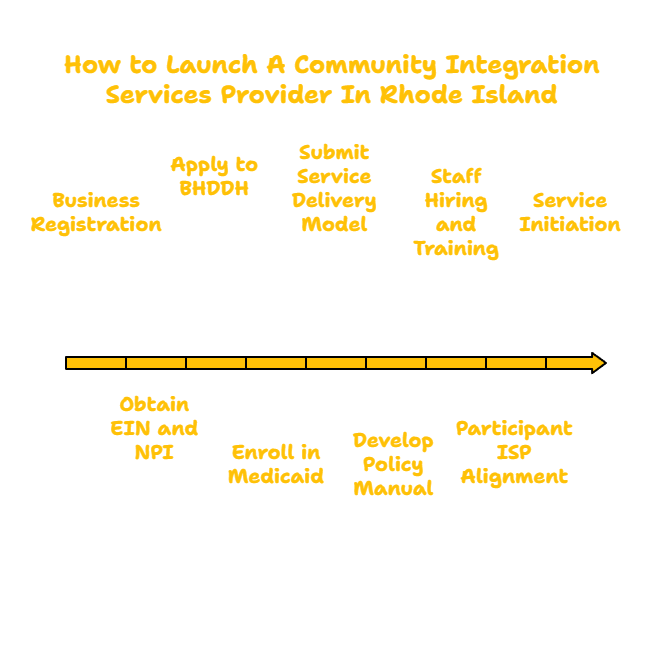
Becoming an approved Medicaid provider in Rhode Island is a sequential process that begins with formal business formation. Prospective agencies must register with the Rhode Island Secretary of State and obtain an Employer Identification Number (EIN) and a Type 2 National Provider Identifier (NPI). These foundational steps are prerequisites for interacting with state agencies and must be completed before pursuing service-specific approvals.
Following business registration, providers must apply to BHDDH for approval as a provider of Community-Based Supports. This stage involves submitting a comprehensive service delivery model, a staffing plan, and documented procedures for community integration activities. Once approved by BHDDH, the organization must enroll in the Medicaid program through the EOHHS provider portal. Throughout this process, it is critical to develop a robust Community Integration Services Policy & Procedure Manual that reflects both the HCBS Settings Rule and the core principle of participant choice.
- Register business, EIN, and Type 2 NPI.
- Apply to BHDDH for approval as a provider of community-based waiver services.
- Submit service delivery model, staffing plan, and integration activity procedures.
- Enroll in Medicaid through the EOHHS portal to receive service authorizations.
What Documentation and Compliance Standards Must Providers Maintain?
Documentation is the primary mechanism for demonstrating compliance during audits. Providers are expected to maintain comprehensive records that detail business operations, personnel qualifications, and participant-specific progress. Central to this is the Policy & Procedure Manual, which must contain specific protocols for ISP-driven goal development, community access, safety procedures, and HIPAA-compliant incident reporting.
Every activity provided must be backed by accurate documentation, including activity logs and progress reports that measure outcomes against the participant's ISP goals. Agencies must also have established procedures for participant satisfaction surveys and transportation coordination. Because these services are Medicaid-funded, the documentation must provide clear evidence that the services rendered were necessary, person-centered, and compliant with both state and federal HCBS standards.
What Are the Essential Staffing and Training Requirements?
The quality of community integration services is directly tied to the competency of the staff. Personnel must possess a baseline of experience in supporting individuals with disabilities, supplemented by mandatory training in person-centered planning, the HCBS Settings Rule, and cultural competence. Support workers and coordinators should be well-versed in risk reduction strategies, community navigation, and the principles of trauma-informed care.
In addition to foundational training, all staff members must complete specialized instruction regarding abuse prevention and incident response. For participants with established behavior plans, agencies may require the involvement of a behavioral consultant to ensure that support strategies are consistently and safely implemented. Regular supervision and ongoing documentation reviews are necessary to ensure that the staff remains aligned with the evolving needs of the participants they serve.
Frequently Asked Questions
What waivers cover Community Integration Services in Rhode Island?
These services are primarily covered under BHDDH DD Waivers for individuals with intellectual and developmental disabilities, the 1115 Global Waiver for broader adult community living supports, and, in specific instances, Self-Directed Supports Waivers where participants manage their own service providers.
How long does the provider enrollment process typically take?
The timeline varies by agency readiness, but typically, business formation and manual creation take 1–2 months, BHDDH and Medicaid enrollment takes 2–3 months, and hiring/training takes an additional 30–60 days before service initiation can occur.
What is the role of the HCBS Settings Rule for new providers?
The HCBS Settings Rule mandates that services be provided in integrated settings that afford participants full access to the benefits of community living. New providers must ensure their service delivery models explicitly foster community inclusion and independence, avoiding any practices that isolate individuals from the broader community.
Key Takeaway: Successfully launching a Community Integration Services agency in Rhode Island requires a disciplined approach to regulatory compliance, meticulous documentation of person-centered service delivery, and strict adherence to the standards set by BHDDH and EOHHS. Providers that prioritize high-quality staffing, clear procedural manuals, and consistent alignment with the HCBS Settings Rule are best positioned to serve their participants and maintain ongoing Medicaid eligibility.
WAIVER CONSULTING GROUP’S START-UP ASSISTANCE SERVICE — RHODE ISLAND COMMUNITY INTEGRATION PROVIDER. WCG supports providers launching integration services focused on empowering individuals to thrive in inclusive community environments. Our scope of work includes BHDDH and Medicaid enrollment guidance, development of a comprehensive Community Integration Policy & Procedure Manual, creation of ISP-aligned service delivery tools, staff training templates, and compliance audits for HCBS Settings Rule alignment.
Last verified: 2024. The information provided in this article is for educational purposes only and does not constitute legal or professional advice. Requirements for Medicaid providers can change based on state and federal updates; always consult directly with the Rhode Island Executive Office of Health and Human Services (EOHHS) and the Department of Behavioral Healthcare, Developmental Disabilities & Hospitals (BHDDH) for the most current policies and application guidance.