COMMUNITY INTEGRATION SERVICES PROVIDER IN PENNSYLVANIA
By Fatumata Kaba · 2025-10-08 · 5 min read
Community Integration Services in Pennsylvania serve as a vital lifeline for individuals with intellectual and developmental disabilities (IDD), facilitating their meaningful inclusion in society through Medicaid-funded supports. These programs, overseen by the Office of Developmental Programs (ODP), empower participants to build natural supports and develop functional skills while engaging in diverse social, recreational, and civic activities.
For prospective provider agencies, establishing a high-quality Community Integration program requires strict adherence to state regulatory standards and a commitment to person-centered service delivery. By navigating the complex landscape of Pennsylvania’s HCBS waivers, agencies can position themselves to provide essential care that transforms the daily lives of individuals within their local communities.
How Do Governing Agencies Regulate Community Integration Services?
The regulatory framework for community-based supports in Pennsylvania involves a multi-tiered oversight system designed to ensure participant safety and service quality. At the federal level, the Centers for Medicare & Medicaid Services (CMS) provides the foundational regulations for all Home and Community-Based Services (HCBS), mandating that these programs promote independence and community access rather than isolation.
Within Pennsylvania, the Department of Human Services (DHS) and its Office of Developmental Programs (ODP) hold the primary authority. These entities set the standards for Community Participation Support (CPS) and in-home habilitation programs. Additionally, local Administrative Entities (AEs) and County Mental Health/Intellectual Disability (MH/ID) offices act as the direct point of contact for providers, managing service authorizations, monitoring ongoing compliance, and coordinating the qualification process at the regional level.
Agencies must also maintain legal standing through the Pennsylvania Department of State, which handles the business registration and entity requirements. Navigating these relationships requires a clear understanding of the hierarchy and maintaining open lines of communication with local AE offices to ensure that all service delivery models align with current state directives.
What Types of Supports Do Approved Providers Deliver?
Community Integration Services are built upon the premise that every individual should have the opportunity to engage with their surroundings in a meaningful, individualized way. Approved providers are responsible for delivering services that move beyond basic supervision, focusing instead on skill acquisition and relationship building in real-world settings.
Providers generally deliver a comprehensive suite of services including:
- In-Home and Community Habilitation: Providing one-on-one or small group support to develop social and functional skills in home and community settings.
- Community Participation Support (CPS): Offering facility-based or community-based activities designed to increase access to and involvement in local community life.
- Social Integration & Life Skills Training: Assisting with the building of relationships, navigating public transportation, and interacting within public spaces.
- Civic & Volunteer Engagement: Supporting participation in volunteerism, religious organizations, and local community leadership opportunities.
- Cultural, Recreational & Educational Access: Accompanying individuals to libraries, parks, fitness centers, museums, and educational classes to foster personal growth.
How Do Agencies Navigate the Provider Enrollment Process?
The path to becoming a qualified provider involves a structured sequence of business and clinical preparations. The process begins with the formal establishment of a business entity, including obtaining a Federal Employer Identification Number (EIN) and a Type 2 National Provider Identifier (NPI). These are foundational requirements for any agency intending to bill Medicaid for waiver-funded services.
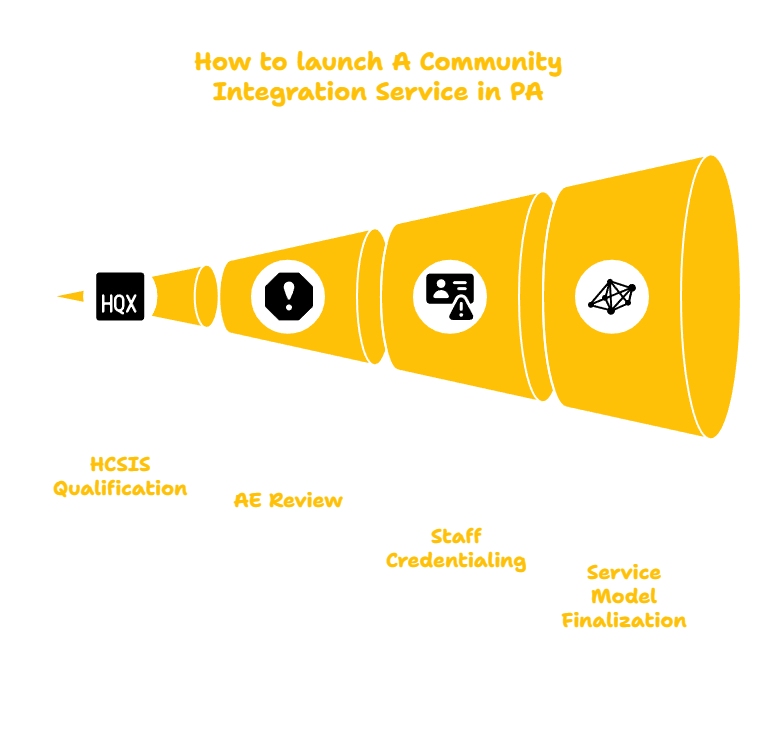
Once the legal framework is established, providers must initiate the qualification process via the HCSIS portal. This involves submitting a detailed service description for their proposed programs, such as CPS or in-home habilitation. During this phase, agencies must demonstrate their capacity to provide these services in accordance with ODP expectations, which includes proving that the agency holds necessary general liability and workers’ compensation insurance.
Finalizing the enrollment requires close collaboration with the local Administrative Entity (AE). Once the AE reviews and approves the agency’s policy manuals, staff credentials, and service models, the provider is officially cleared to receive referrals from Supports Coordinators (SCs). This transition from administrative approval to active service delivery marks the final milestone in the launch phase.
What Are the Essential Documentation and Staffing Standards?
Compliance in the HCBS sector is driven by documentation. Every service delivered, from a trip to the local library to a skill-building session at home, must be meticulously recorded. This includes daily activity logs, service delivery notes, and detailed goal tracking, all of which serve as the primary records for future audits and billing verification. Providers must maintain a robust Community Integration Policy & Procedure Manual that covers everything from HIPAA privacy protections to emergency and incident response protocols.
Staffing requirements are equally rigorous, as Direct Support Professionals (DSPs) are the primary face of the agency. At a minimum, staff must possess a high school diploma and clear all mandatory background checks. Beyond basic credentials, all personnel must undergo comprehensive training in person-centered support, abuse prevention, and the specific documentation procedures required for Medicaid billing. Agencies should also designate a Program Coordinator to manage staff schedules and conduct ongoing reviews of ISP (Individual Support Plan) alignment to ensure that services remain goal-oriented.
Frequently Asked Questions
What waivers authorize Community Integration Services in Pennsylvania?
These services are primarily authorized under the Consolidated Waiver, the Community Living Waiver, and the Person/Family Directed Support (P/FDS) Waiver, each managed by the Office of Developmental Programs (ODP).
How long does the typical launch process take for a new provider?
The timeline varies by region, but generally takes 4–6 months to complete, covering business registration (1–2 months), HCSIS qualification/AE review (2–3 months), and staff onboarding (30–60 days).
What is the primary role of the Administrative Entity (AE)?
The AE acts as the local steward of the waiver program, responsible for provider qualification, ongoing compliance monitoring, and managing the service authorization process for individuals within their specific county.
WAIVER CONSULTING GROUP’S START-UP ASSISTANCE SERVICE — PENNSYLVANIA COMMUNITY INTEGRATION PROVIDER
WCG helps providers create inclusive, compliant, and person-centered Community Integration programs across Pennsylvania. Our support includes:
- Business registration and HCSIS qualification support.
- Policy & Procedure Manual development tailored to ODP requirements.
- Creation of community activity planning tools and safety checklists.
- Staff training logs, orientation packets, and credentialing templates.
- Development of service tracking and ISP progress forms.
- AE partnership support and SC referral development strategies.
- Documentation and billing templates for compliance audits.
Key Takeaway: Establishing a successful Community Integration provider agency in Pennsylvania requires a dual focus on rigorous administrative compliance—such as HCSIS qualification and policy development—and the delivery of high-quality, person-centered supports. By effectively aligning your agency’s operational infrastructure with ODP regulations and local AE requirements, you can build a sustainable program that fosters genuine community inclusion for individuals with disabilities.
Last verified: 2024. The information provided in this article is for educational purposes and does not constitute legal or financial advice. Readers should consult with official Pennsylvania Department of Human Services (DHS) guidance and their local Administrative Entity (AE) for the most current requirements regarding HCBS provider enrollment and service delivery.