COMMUNITY INTEGRATION SERVICES PROVIDER IN OKLAHOMA
By Fatumata Kaba · 2025-09-08 · 6 min read
What Are Community Integration Services in Oklahoma?
Community Integration Services represent a cornerstone of the Oklahoma Home and Community-Based Services (HCBS) waiver landscape, specifically designed to foster independence, self-determination, and social inclusion for individuals with intellectual, developmental, or physical disabilities. These services move beyond traditional care by actively facilitating an individual’s presence and participation in typical, everyday community life. By bridging the gap between home-based support and the broader public sphere, these services effectively reduce social isolation, nurture the development of essential social skills, and support the attainment of personal milestones through meaningful community engagement.
Authorized under several key Medicaid programs, including the DDS Community Waiver, the In-Home Supports Waiver, and the Living Choice Program, these services are governed by a robust framework of state and federal oversight. The primary goal is to ensure that participants are not merely spectators, but active contributors to their local environments—whether through volunteering, recreational engagement, or civic participation. For provider agencies, the delivery of these services requires a commitment to person-centered planning, where every activity is tailored to the unique goals, preferences, and support needs of the individual participant.
How Do Governing Agencies Oversee Community Integration?
The regulatory environment for Community Integration in Oklahoma is defined by a tiered hierarchy of oversight, ensuring that providers maintain high standards of quality and compliance. The Oklahoma Health Care Authority (OHCA) serves as the primary Medicaid agency, holding the responsibility for program enrollment, claims reimbursement, and the overarching financial compliance of community-based services. Providers must demonstrate consistent adherence to the standards set forth by the OHCA to maintain their eligibility for Medicaid billing.
Supporting the OHCA is the Oklahoma Department of Human Services (OKDHS) Developmental Disabilities Services (DDS), which acts as the certifying body. DDS is responsible for reviewing provider applications, monitoring individual service plans, and ensuring that community participation goals are being met with the appropriate level of safety and clinical oversight. Furthermore, all programs must operate in alignment with the federal mandates established by the Centers for Medicare & Medicaid Services (CMS). CMS regulations emphasize the importance of person-centered planning and ensure that services are delivered in settings that integrate individuals into the greater community, rather than segregating them based on disability status.
What Are the Core Responsibilities of an Approved Provider?
Approved providers of Community Integration Services play a vital role in executing the participant's vision of an independent life. Service delivery is highly individualized, requiring providers to facilitate a wide range of activities that align with the specific outcomes outlined in each participant's Medicaid-authorized plan. This includes, but is not limited to, coaching on communication and self-advocacy, identifying volunteer opportunities that match personal interests, and coordinating transportation for outings to civic, spiritual, or recreational events.
Beyond direct support, providers are responsible for the meticulous documentation of all service encounters. Because these services are funded through Medicaid waivers, compliance hinges on the provider's ability to demonstrate progress toward the goals identified in the participant’s plan. This necessitates a well-oiled documentation system that captures participant feedback, monitors safety during outings, and tracks the effectiveness of social skills building. Agencies must be prepared to demonstrate that their staff is not only present with the participant but is actively facilitating the integration goals defined by the service plan.
- Individualized Community Outings: Coordinating shopping, dining, and attendance at community events.
- Volunteering Support: Assisting in identifying and onboarding into meaningful volunteer roles.
- Recreation & Leisure Engagement: Facilitating involvement in fitness, sports, arts, and hobby-based groups.
- Social Skills Building: Providing professional coaching on decision-making, communication, and interpersonal relationships.
- Peer Interaction Facilitation: Creating structured opportunities for building friendships and natural support systems.
- Community Access Planning: Developing long-term goals and identifying inclusive, community-based environments.
- Comprehensive Documentation: Maintaining activity logs, billing records, and goal progress summaries.
What Is the Required Provider Enrollment and Certification Process?
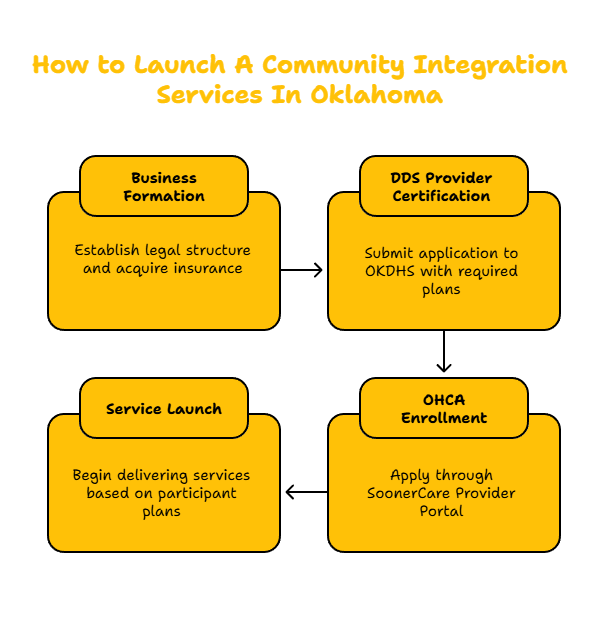
Launching a Community Integration agency requires a phased approach to business and clinical readiness. The initial phase involves foundational business formation, including registering with the Oklahoma Secretary of State, obtaining an Employer Identification Number (EIN), and securing a Type 2 NPI. Following these organizational steps, prospective providers must develop a comprehensive policy and procedure manual that specifically addresses the unique risks and requirements of community-based support, such as transportation safety, incident reporting, and participant rights protocols.
The formal certification and enrollment process begins with the submission of the application to OKDHS DDS. During this review, the agency evaluates the provider’s staff training curriculum, documentation systems, and overall readiness to support individuals with developmental disabilities. Once DDS certification is secured, the provider must then proceed to the OHCA SoonerCare Provider Portal to finalize Medicaid enrollment under the appropriate service category. This sequential process ensures that the provider is fully vetted before the first participant is served.
- Establish legal entity, insurance, and federal tax credentials.
- Develop essential agency infrastructure, including policy manuals and staff training tools.
- Submit certification materials to OKDHS DDS for program compliance review.
- Enroll with the OHCA via the SoonerCare Provider Portal.
- Begin service delivery following authorization from participant case managers.
What Are the Staffing and Training Expectations?
Successful community integration relies on the quality and preparedness of the direct support workforce. A Community Support Specialist or Integration Facilitator must possess a blend of compassion, problem-solving skills, and a solid understanding of disability support protocols. Beyond meeting basic background check requirements and holding current First Aid/CPR certification, these staff members must undergo specialized training mandated by the DDS to ensure they understand the legal and ethical requirements of serving individuals with complex support needs.
Management and supervision staff are equally critical to the agency's success. These individuals are responsible for overseeing the quality of service delivery and ensuring that staff members adhere to the documentation requirements that allow the agency to remain in good standing with Medicaid. Ongoing professional development is a requirement, not an option, as the agency must ensure staff stays current on HIPAA compliance, participant dignity, travel safety, and the evolving goals of the participants they support.
Frequently Asked Questions
What is the typical timeline to launch a new Community Integration program?
The timeline typically ranges from 4 to 8 months. Business setup and policy development usually take 1–2 months, followed by 2–3 months for DDS certification and OHCA enrollment. The final phase, which includes staff training and receiving service plan authorizations, adds another 30–60 days before active service delivery can begin.
Are Community Integration Services available across all Oklahoma Medicaid waivers?
These services are primarily found within the DDS Community Waiver, the In-Home Supports Waiver (for both adults and children), and the Living Choice Program. The ADvantage Waiver may also utilize these services, though their application is often dependent on specific individual goal achievement plans.
What specific documentation is required for Medicaid billing?
Providers must maintain rigorous documentation, including comprehensive service summaries, specific activity logs that link actions to the participant's person-centered plan, and incident reports if necessary. All documentation must demonstrate that the service provided was in accordance with the authorization and contributed to the goals established by the case manager and the individual participant.
Waiver Consulting Group’s Start-Up Assistance
WCG supports new and existing providers in launching compliant Community Integration programs across Oklahoma by offering comprehensive support services. The scope of work includes assistance with business formation, navigation of the OHCA/DDS enrollment process, development of compliant policy manuals, and creation of standardized documentation templates. Furthermore, WCG provides guidance on staff training infrastructure, transportation safety planning, and the implementation of outcome measurement tools designed to ensure both regulatory compliance and meaningful program growth.
Key Takeaway: Successfully operating as a Community Integration Service provider in Oklahoma requires a dual focus on rigorous administrative compliance with OHCA and DDS standards, and a deep commitment to the person-centered principles that empower individuals to participate fully in their communities.
Last verified: 2024. The information provided is for educational purposes only and does not constitute legal or professional advice. Always consult directly with the Oklahoma Health Care Authority (OHCA) and the Oklahoma Department of Human Services (OKDHS) for the most current regulatory guidance and policy updates.