COMMUNITY INTEGRATION SERVICES PROVIDER IN MICHIGAN
By Fatumata Kaba · 2025-07-27 · 5 min read
Community Integration Services in Michigan provide essential support for individuals with disabilities, fostering independence, social engagement, and active community participation through the Michigan Home and Community-Based Services (HCBS) Medicaid Waivers. Operated under the oversight of the Michigan Department of Health and Human Services (MDHHS), these programs are designed to assist participants in accessing community resources, building social skills, and engaging in vocational or recreational activities based on their individualized person-centered plans.
What Are the Governing Frameworks for Community Integration Services?
The delivery of Community Integration Services is governed by a strict hierarchy of regulatory agencies that ensure compliance with federal and state mandates. At the federal level, the Centers for Medicare & Medicaid Services (CMS) provides the overarching regulatory framework for HCBS waiver programs, ensuring that states adhere to guidelines that promote community inclusion and participant rights. Their oversight guarantees that services are provided in the least restrictive settings possible.
At the state level, the Michigan Department of Health and Human Services (MDHHS) acts as the primary authority. The MDHHS is responsible for the administration of Medicaid waivers, overseeing provider enrollment, and ensuring that all agencies maintain strict compliance with state and federal regulations. The Michigan Medicaid Agency works in tandem with the MDHHS to facilitate provider enrollment and manage the reimbursement processes required to maintain the financial viability of community integration programs.
How Do Providers Facilitate Community Engagement and Skill-Building?
Community Integration Services are focused on the practical application of social and functional skills in real-world environments. By leveraging community resources such as libraries, recreational centers, and local volunteer networks, providers help participants navigate the world around them with greater autonomy. These activities are tailored to the specific goals outlined in the participant’s person-centered plan, ensuring that every service delivered is intentional and meaningful.
Approved providers are tasked with a range of responsibilities that go beyond mere supervision. These include:
- Skill-building for community participation, such as mastering public transportation or developing effective social interaction strategies.
- Facilitating peer interactions to reduce social isolation and improve interpersonal communication.
- Assisting with the identification and pursuit of volunteer and employment opportunities within the local community.
- Monitoring the progress of community involvement and meticulously documenting individual achievements to meet state reporting standards.
What Are the Prerequisites for Licensing and Provider Approval?
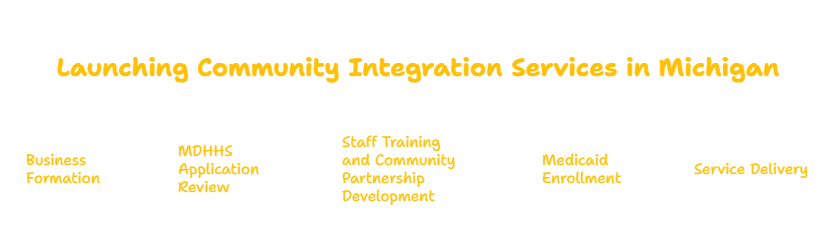
Establishing a service location in Michigan requires rigorous preparation and adherence to both corporate and health-sector requirements. Before initiating the Medicaid enrollment process, a provider must register their business entity with the Michigan Department of Licensing and Regulatory Affairs (LARA). Following business formation, the agency must secure an Employer Identification Number (EIN) from the IRS and a Type 2 National Provider Identifier (NPI) to function within the healthcare billing ecosystem.
Beyond the administrative paperwork, providers must demonstrate operational capacity. This includes maintaining a physical office within the state and developing a comprehensive suite of protocols that address safety, service delivery, and staff conduct. Demonstrating experience in social services or rehabilitation is crucial, as is the commitment to hiring staff who possess the necessary training to provide individualized support while ensuring the health and welfare of all program participants.
How Does the Provider Enrollment Process Function?
The pathway to becoming an enrolled provider involves several distinct phases, beginning with the acquisition of the official application packet from the MDHHS. During the application phase, a provider must submit a robust business plan that articulates how community activities will be facilitated, monitored, and adjusted to meet the evolving needs of the participants. Safety protocols during off-site engagement must be clearly defined in these documents.
Once the initial application is under review, the provider must undergo credentialing and background checks. All staff involved in providing services must be vetted, and their professional qualifications—specifically in social services, community engagement, or rehabilitation—must be verified. The final phase, known as the Program Readiness Review, requires the provider to demonstrate that they possess the infrastructure, documentation systems, and staff training necessary to support participants in various community settings effectively.
What Are the Essential Documentation and Staffing Requirements?
Operational success depends heavily on the quality and completeness of a provider's internal documentation. Agencies must maintain an MDHHS-compliant Policy and Procedure Manual that serves as the foundation for daily operations. This manual must explicitly cover community engagement strategies, safety protocols, and the standardized procedures for tracking client outcomes. Accurate financial logs and service records are mandatory for successful Medicaid audits.
Staffing requirements are equally stringent to ensure high-quality care. Key roles include Community Program Coordinators and Community Support Specialists, both of whom must possess relevant experience in outreach and social work. All staff are required to undergo comprehensive training, including:
- MDHHS orientation and specific training related to the HCBS Waiver programs.
- Annual continuing education focused on community safety, ethical standards, and the protection of client rights.
- Specialized training in social skills development and techniques for handling client interactions in public spaces.
Frequently Asked Questions
Which Medicaid Waivers specifically cover Community Integration Services?
Community Integration Services are authorized under the MI Choice Waiver, the Habilitation Supports Waiver, and the Children’s Waiver Program in Michigan.
How long should a provider anticipate the enrollment process to take?
The timeline varies by phase, but generally, the MDHHS application review and the Medicaid enrollment process each take approximately 60–90 days to complete, not including the time required for business formation and staff training.
What is the primary role of the MDHHS regarding provider oversight?
The MDHHS is the central regulatory body responsible for overseeing provider enrollment, ensuring consistent service authorization, and enforcing Medicaid compliance to maintain the integrity of the state’s HCBS waiver programs.
Key Takeaway
Launching a Community Integration Services provider agency in Michigan requires a disciplined approach to regulatory compliance, staff training, and administrative organization. By strictly adhering to MDHHS and CMS guidelines, maintaining accurate documentation, and focusing on the delivery of person-centered community supports, providers can effectively meet the needs of individuals served under Michigan’s HCBS waiver programs.
Last verified: October 2023. Disclaimer: This article is for informational purposes only and does not constitute legal or professional consulting advice. Regulations regarding Michigan Medicaid and HCBS waiver programs are subject to change. Always consult directly with the Michigan Department of Health and Human Services (MDHHS) for the most current requirements and guidance.