COMMUNITY INTEGRATION SERVICES PROVIDER IN KENTUCKY
By Fatumata Kaba · 2025-07-25 · 5 min read
Community Integration Services in Kentucky are specialized Medicaid supports designed to help individuals with intellectual and developmental disabilities (ID/DD), brain injuries, and complex support needs thrive through active participation in their local communities. By leveraging Home and Community-Based Services (HCBS) waivers, provider agencies deliver person-centered activities that foster independence, social inclusion, and the development of essential life skills outside the traditional home environment.
What is the Role of Kentucky State Agencies in Community Integration?
The delivery of community integration services is governed by a rigorous regulatory framework involving federal, state, and private stakeholders. The Kentucky Cabinet for Health and Family Services (CHFS), through the Department for Medicaid Services (DMS), acts as the primary authority. DMS oversees the critical infrastructure of provider enrollment, service authorization, and the administration of Medicaid reimbursement, ensuring that all providers meet state standards for service delivery.
At the programmatic level, the Kentucky Department for Behavioral Health, Developmental and Intellectual Disabilities (DBHDID) defines the quality standards and clinical outcomes for waiver programs. Furthermore, the Centers for Medicare & Medicaid Services (CMS) enforces federal HCBS regulations, which mandate that all services must be delivered in non-institutional, integrated settings. Finally, Managed Care Organizations (MCOs) function as the day-to-day administrators, responsible for credentialing agencies, approving service authorizations, and monitoring the consistent implementation of Person-Centered Service Plans (PCSP).
How Do Providers Facilitate Meaningful Community Inclusion?
Community Integration Services move beyond basic supervision by focusing on skill development that reflects the participant’s unique interests and preferences. The goal is to bridge the gap between the participant and their local community, transforming the surrounding environment into a space for growth and self-advocacy. By aligning every activity with the participant’s individualized goals, providers ensure that services are not merely "time out" but rather purposeful, goal-oriented engagements.
Authorized activities that support this integration include:
- Accompaniment to community events, social groups, and local volunteer sites.
- Assistance in utilizing public resources, such as libraries, recreation centers, and faith-based organizations.
- Development of essential life skills, including public transportation navigation, money management, and interpersonal communication.
- Support for building community relationships, obtaining memberships, and participating in self-advocacy groups.
- Behavioral support and individualized supervision designed to reduce social isolation and maximize personal independence.
What Are the Essential Steps for Kentucky Provider Enrollment?
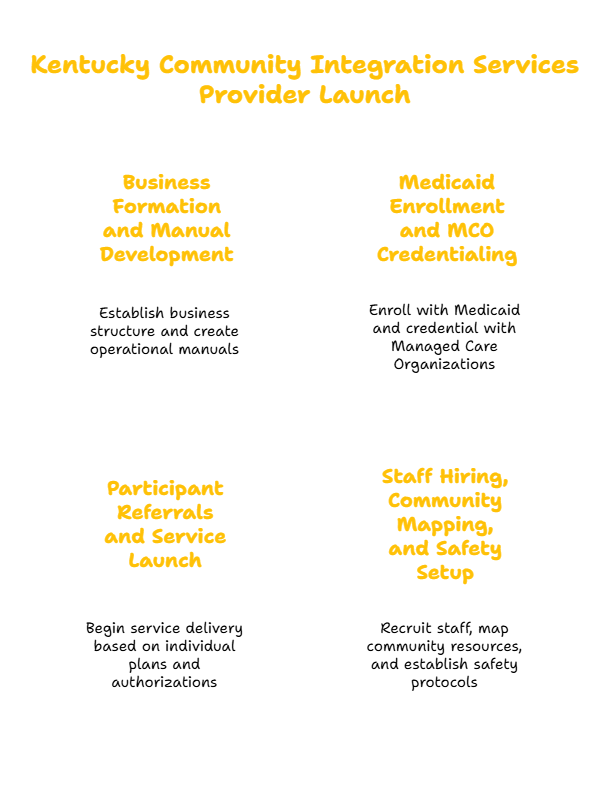
Launching a provider agency requires a structured approach to compliance and operational readiness. The process begins with the legal formation of the business under the Kentucky Secretary of State, followed by the acquisition of an IRS EIN and a Type 2 NPI. Once the entity is established, the provider must utilize the Medicaid Partner Portal Application (MPPA) to enroll under the specific provider type designated for the desired HCBS waiver, such as the Supports for Community Living (SCL), Michelle P. Waiver (MPW), or Acquired Brain Injury (ABI) programs.
The enrollment workflow generally follows a three-phased progression:
- Medicaid Enrollment: Completing the MPPA registration and obtaining credentialing with all MCOs currently serving the provider’s specific Kentucky region.
- Documentation Submission: Compiling and submitting business licenses, insurance certificates (including general liability and workers’ compensation), comprehensive service policies, and detailed staff credentialing data.
- Service Authorization: Coordinating with waiver case managers to finalize the PCSP, ensuring all documentation systems for progress tracking, attendance, and billing are prepared for audit-readiness.
How Must Providers Maintain Documentation and Operational Compliance?
A robust Community Integration Policy & Procedure Manual is the cornerstone of a compliant operation. This manual must demonstrate that the agency is equipped to handle intake, active service delivery, and incident management while adhering to both HIPAA regulations and state Medicaid requirements. Auditors will look for evidence that the provider has established a clear link between the participant's stated goals and the activities performed in the community.
Required documentation systems must be capable of generating:
- Participant intake forms and customized activity planning templates.
- Consistent, goal-tracking sheets that capture progress toward PCSP milestones.
- Incident and safety reporting protocols that are immediately accessible to staff.
- Staff training logs, including evidence of ongoing supervision and community engagement activities.
- Audit-ready Medicaid billing logs and participant consent and rights documentation.
What Are the Staffing and Training Expectations for Community Providers?
The quality of community integration is highly dependent on the competence and training of the staff. A typical support worker must possess at least a high school diploma or equivalent, with experience in ID/DD or ABI populations strongly preferred. Additionally, staff must pass rigorous background checks and, if responsible for transporting participants, maintain a valid driver’s license and appropriate vehicle insurance coverage.
Beyond baseline qualifications, all staff members must complete mandatory training covering the following domains:
- HIPAA compliance and the protection of participant rights.
- Principles of person-centered planning and social inclusion.
- Prevention and reporting of abuse, neglect, and exploitation.
- Community safety protocols, transportation assistance, and incident response procedures.
- Ongoing professional development focused on disability services and effective community integration strategies.
Frequently Asked Questions
Are there restrictions on where Community Integration Services can take place?
Yes. Services must occur in non-institutional, community-based settings that allow for genuine social inclusion. Activities in segregated or institutional environments are strictly prohibited; instead, focus must be placed on public venues, community hubs, and spaces chosen by the participant that foster interaction with the general public.
How long does the provider launch process typically take?
The timeline varies based on operational readiness, but generally, business formation and manual development take 1-2 months. Medicaid enrollment and MCO credentialing typically require 60-90 days, followed by 30-45 days for staff recruitment and community resource mapping before service launch.
What is the role of a Community Engagement Coordinator?
While optional, a Community Engagement Coordinator is often essential for agencies looking to scale. This role focuses on developing formal partnerships with local organizations, creating sustainable activity pathways for participants, and ensuring that all staff activities remain compliant with both the PCSP and state quality standards.
Key Takeaway
Success as a Community Integration Service provider in Kentucky requires a rigorous adherence to the regulatory requirements set forth by the CHFS, DMS, and regional MCOs. By building a foundation rooted in compliant policy documentation, comprehensive staff training, and a genuine commitment to the person-centered planning process, new providers can successfully navigate the enrollment cycle and deliver high-impact services that significantly enhance the lives of individuals with disabilities across the Commonwealth.
Last verified: May 2024. This information is intended for educational purposes only and does not constitute legal or professional consulting advice. Providers are encouraged to verify current Medicaid regulations and state policies directly through the Kentucky Department for Medicaid Services and their respective Managed Care Organizations.