COMMUNITY INTEGRATION SERVICES PROVIDER IN IOWA
By Fatumata Kaba · 2025-07-22 · 5 min read
Community Integration Services in Iowa are essential Medicaid-funded supports designed to help individuals with disabilities navigate their communities, develop social skills, and achieve greater personal autonomy. Authorized under Iowa’s Home and Community-Based Services (HCBS) waiver programs, these services prioritize inclusion by moving support away from institutional or segregated settings and into the participant's natural environment.
For service providers, launching a Community Integration program requires rigorous adherence to state and federal standards, including the CMS HCBS Settings Rule. By facilitating meaningful participation in recreational, educational, and volunteer activities, providers play a critical role in helping participants meet their Individualized Service Plan (ISP) goals while maintaining compliance with Iowa Department of Health and Human Services (Iowa HHS) regulations.
What Are the Governing Agencies and Regulatory Requirements?
The provision of Community Integration Services is a heavily regulated process involving coordination between state and federal authorities. Providers must operate with a deep understanding of the roles played by these agencies to ensure their service delivery models remain in good standing and eligible for Medicaid reimbursement.
The Iowa Department of Health and Human Services (Iowa HHS) serves as the primary oversight body, responsible for administering HCBS waiver programs, managing provider enrollment, and conducting quality assurance reviews. Simultaneously, the Iowa Medicaid Enterprise (IME) manages the financial infrastructure, overseeing billing, claims processing, and provider support. At the federal level, the Centers for Medicare & Medicaid Services (CMS) mandates strict adherence to the HCBS Settings Rule, which dictates that services must be provided in locations that foster genuine community integration.
- Iowa HHS: Manages service authorizations, participant protections, and enrollment standards.
- Iowa Medicaid Enterprise (IME): Oversees the billing system and Medicaid funding protocols.
- CMS: Sets the federal standard for person-centered planning and community-based environments.
How Do You Define and Deliver Community Integration Services?
Community Integration Services focus on the "how" of daily life. The goal is to provide participants with the skills and confidence necessary to exist and thrive in public settings. Rather than merely supervising, providers act as coaches who help participants learn to navigate their local environments effectively and safely.
Approved providers deliver support in real-world settings, such as public libraries, grocery stores, community centers, and volunteer sites. Service delivery is defined by the unique needs listed in each participant’s Individualized Service Plan (ISP). Providers should ensure that all staff members are trained to facilitate autonomy, meaning they should provide just enough support to ensure safety while allowing the participant to exercise decision-making, communication, and problem-solving skills independently.
- Skill Building: Facilitating communication, decision-making, and social problem-solving.
- Community Access: Assisting with public transportation use and navigating retail or service environments.
- Relationship Development: Supporting peer-to-peer engagement and self-advocacy.
- Safety Coaching: Teaching community safety protocols and situational awareness.
What Are the Licensing and Enrollment Steps for Providers?
Establishing an agency as a qualified Medicaid provider is a multi-step process that requires careful documentation. Before submitting an application, prospective providers must complete the foundational business legalities, including registration with the Iowa Secretary of State and obtaining an EIN and NPI (Type 2). These items form the backbone of the provider’s legal and administrative identity.
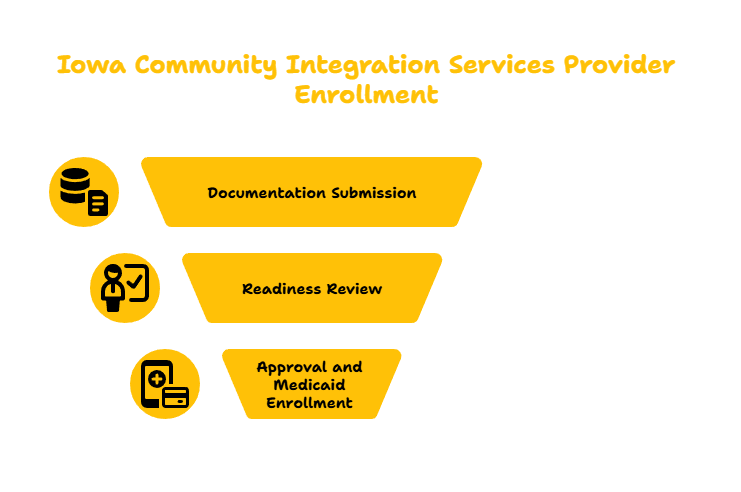
Once the business is legally established, the provider must enroll through the Iowa Medicaid Portal Access (IMPA) system. This stage involves the submission of rigorous policy documentation, proof of liability insurance, and detailed staff credentialing records. Following the submission, the agency will undergo a readiness review by Iowa HHS to verify that the organization has the necessary protocols in place to ensure participant safety and compliance with HCBS standards.
- Register the business entity with the Iowa Secretary of State.
- Obtain an IRS EIN and a Type 2 NPI.
- Develop a comprehensive Policy & Procedure Manual specific to HCBS standards.
- Complete the enrollment application via the Iowa Medicaid Portal Access (IMPA) system.
- Pass the program readiness review, covering participant rights and emergency protocols.
What Are the Essential Documentation and Staffing Standards?
Audit readiness is the hallmark of a successful Medicaid provider. Organizations must maintain a robust record-keeping system that covers everything from initial participant intake to daily progress notes. A strong Policy & Procedure Manual should include detailed sections on HIPAA compliance, incident reporting, emergency preparedness, and the specifics of service tracking that align with ISP goals.
Staffing also follows specific professional criteria. The Program Supervisor must have a background in human services or rehabilitation, while Direct Support Professionals (DSPs) are required to possess at least a high school diploma or GED. All staff must undergo comprehensive background checks and recurring training. This training must cover the nuances of the HCBS Settings Rule, person-centered planning, participant confidentiality, and the specific safety requirements needed when supporting individuals in public environments.
Which Medicaid Waiver Programs Include These Services?
Community Integration Services are not universal; they are specifically authorized under particular Iowa HCBS waiver programs. Providers must verify that their services align with the requirements of the specific waiver under which the participant is enrolled. These programs provide the framework for service delivery, ensuring that funds are utilized to support individuals with specific needs in the most integrated settings possible.
- Intellectual Disability (ID) Waiver: Supporting community inclusion for those with intellectual disabilities.
- Brain Injury (BI) Waiver: Focused on rehabilitation and social integration following brain injury.
- Health and Disability (HD) Waiver: Supporting individuals with chronic health needs.
- Elderly Waiver: Assisting seniors in maintaining community connections.
- Children’s Mental Health (CMH) Waiver: Specialized support for youth, authorized in limited cases.
Frequently Asked Questions
How long does the provider enrollment process typically take?
The timeline for launching a Community Integration service agency generally spans from six months to one year. This includes 1–2 months for business formation, 2–3 months for hiring and program development, 60–90 days for the Iowa HHS readiness review, and 30–45 days for final billing system setup.
What is the role of the HCBS Settings Rule in my service delivery?
The HCBS Settings Rule is a federal requirement that ensures participants have full access to the benefits of community living. As a provider, you must ensure that your service locations are not segregated and that every activity promotes integration with the broader community, rather than limiting the participant to groups consisting solely of other individuals with disabilities.
What documentation is required to ensure I am audit-ready?
Audit-ready documentation includes, at minimum, current business licenses, proof of insurance, a comprehensive Policy & Procedure Manual, staff training logs, and consistent progress notes tied to each participant’s ISP. Every service provided must be documented in a way that proves the activity contributed to the participant’s independence and adhered to their specific service plan.
Key Takeaway
Launching a successful Community Integration Services agency in Iowa requires a proactive approach to regulatory compliance, staff training, and person-centered program design. By focusing on the foundational requirements of the Iowa HHS and maintaining a commitment to the CMS HCBS Settings Rule, providers can effectively support participants in achieving their independence goals while building a sustainable, audit-ready organization.
Last verified: 2024. The information provided is for educational purposes only and does not constitute legal or professional consulting advice. Providers should always reference the latest official handbooks from Iowa HHS and the Centers for Medicare & Medicaid Services (CMS) for specific, up-to-date program requirements.