COMMUNITY INTEGRATION SERVICES PROVIDER IN IDAHO
By Fatumata Kaba · 2025-07-18 · 5 min read
Community Integration Services in Idaho serve as a vital component of the state’s Medicaid Home and Community-Based Services (HCBS) waiver system, designed to facilitate full community participation for individuals with disabilities or aging-related needs. These services empower participants to move beyond traditional care settings, providing the necessary support and skill-building opportunities to engage meaningfully in social, vocational, and recreational life within their local environments.
What is the Purpose and Scope of Community Integration Services?
The core objective of Community Integration Services is to foster independence and inclusion by helping participants bridge the gap between their home environments and the wider community. By focusing on person-centered outcomes, providers assist individuals in accessing resources that match their unique interests, such as public libraries, local clubs, religious organizations, or recreational centers. The goal is to move away from isolated, segregated settings toward active, integrated lifestyles.
Providers are responsible for delivering a wide array of support services that promote autonomy. These activities are not merely about supervision; they are designed as training opportunities where participants learn to navigate public transportation, develop essential social communication skills, and build relationships. Whether it involves supporting a volunteer placement or coaching a participant in civic engagement, the service must remain tightly aligned with the goals established in the participant’s Individualized Service Plan (ISP).
- Identifying and accessing inclusive community activities and social clubs.
- Training for safe use of public transit and community navigation.
- Developing social, communication, and relationship-building skills.
- Providing support for volunteerism, employment exploration, and civic engagement.
- Coaching in the use of public resources and self-advocacy.
How are Community Integration Services Governed and Authorized?
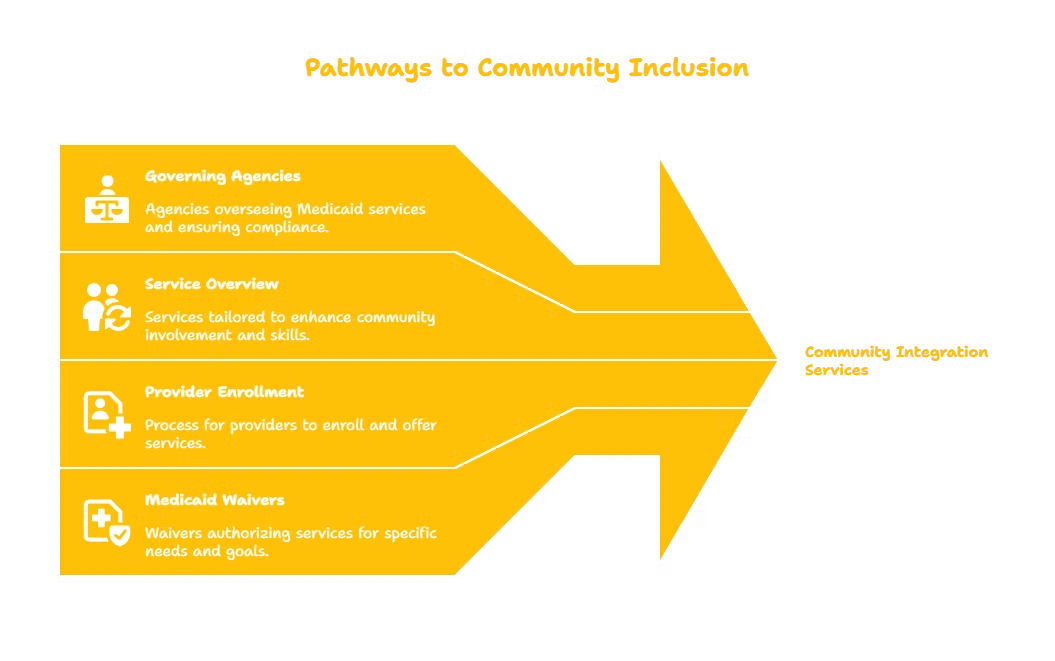
The delivery of these services is strictly regulated to ensure high-quality care that adheres to both state and federal mandates. In Idaho, the Department of Health and Welfare (IDHW) and its Division of Medicaid serve as the primary governing authorities. They are responsible for the oversight of provider enrollment, the authorization of services, and the management of reimbursement processes. Providers must remain in constant compliance with state-specific requirements to maintain their ability to bill for these services.
At the federal level, the Centers for Medicare & Medicaid Services (CMS) provides the overarching framework for HCBS programs. CMS mandates that all services delivered under these waivers must be person-centered and prioritize the participant’s right to integrate fully into the community. This federal oversight ensures that Idaho’s programs remain consistent with national standards for health, safety, and individual rights, requiring providers to maintain rigorous documentation and quality assurance protocols.
What are the Necessary Steps for Provider Enrollment and Readiness?
Launching a service agency requires a structured approach to credentialing and operational readiness. Prospective providers must first formalize their business structure through the Idaho Secretary of State and obtain the necessary federal identifiers, including an Employer Identification Number (EIN) and a Type 2 National Provider Identifier (NPI). These foundational steps are mandatory before initiating the Medicaid enrollment process through the Idaho Medicaid Management Information System (MMIS).
Once registered, the provider must undergo a program readiness review conducted by the IDHW. This stage evaluates the organization’s ability to manage participant safety, maintain accurate billing records, and adhere to HCBS-compliant policies. The review process is comprehensive, requiring evidence of robust operational workflows, including staff background check procedures, incident management, and detailed service tracking templates. Only after demonstrating this level of readiness can an agency receive approval and begin configuring its billing systems for service reimbursement.
- Business formation and registration with the Idaho Secretary of State.
- Acquisition of an EIN and Type 2 NPI for billing purposes.
- Enrollment as an authorized Medicaid provider via the MMIS portal.
- Implementation of comprehensive liability insurance (general and professional).
- Development of a formal policy and procedure manual covering HIPAA, participant rights, and safety.
What Documentation and Staffing Standards Must be Maintained?
Operational success depends on the meticulous maintenance of documentation and the quality of the workforce. Every agency must retain proof of corporate status, insurance coverage, and staff credentials. Furthermore, providers are required to develop a rigorous policy manual that covers everything from the participant intake process to community access safety plans. Each participant’s goals must be clearly documented, with service logs reflecting the progress made toward the outcomes defined in their ISP.
Staffing requirements are equally stringent to ensure the safety and well-being of participants. Agencies must employ a qualified Program Manager or Supervisor to oversee service delivery, while Direct Support Professionals (DSPs) provide the day-to-day community interaction. All staff members must undergo background checks and complete mandatory training modules, including person-centered planning, emergency preparedness, and abuse prevention. Annual refreshers are required to ensure that the staff remains proficient in Medicaid compliance and the principles of effective community support.
Frequently Asked Questions
Which Medicaid waivers cover Community Integration Services in Idaho?
Community Integration Services are primarily authorized under the Developmental Disabilities (DD) Waiver. Additionally, they may be provided under the Aged and Disabled (A&D) Waiver, provided that the participant has clear social inclusion goals identified within their Individualized Service Plan.
What is the typical timeline for launching a service provider agency?
The launch process is divided into several phases. Business formation usually takes 1–2 weeks, followed by a 60–90 day Medicaid provider application and readiness review. Staff hiring and community planning typically require 30–45 days, and final billing system configuration takes 45–60 days.
What are the primary areas of focus for the IDHW readiness review?
The IDHW reviews focus on the agency's ability to provide a safe, person-centered experience. Key areas include risk management, community access strategies, incident reporting, staff competency documentation, and the capacity to accurately manage Medicaid billing claims.
WCG supports community-based organizations, direct support agencies, and disability service providers in launching Medicaid-compliant Community Integration Services under Idaho’s HCBS waiver programs. Our scope of work includes business registration, Medicaid provider enrollment assistance, the development of comprehensive Policy & Procedure Manuals, staff credentialing templates, participant intake/service planning forms, Medicaid billing system setup, and quality assurance programs for service outcomes.
Key takeaway: Success as a Community Integration Services provider in Idaho relies on a firm commitment to regulatory compliance, the adoption of person-centered service delivery, and the maintenance of rigorous, evidence-based documentation to support participant outcomes and Medicaid audit requirements.
Last verified: September 2023. Disclaimer: This article is for informational purposes only and does not constitute legal or professional medical advice. Always consult with the Idaho Department of Health and Welfare (IDHW) and relevant federal guidelines for the most current regulations and requirements.