COMMUNITY INTEGRATION SERVICES PROVIDER IN HAWAII
By Fatumata Kaba · 2025-07-16 · 5 min read
Community Integration Services in Hawaii empower individuals with disabilities, chronic health conditions, or aging-related needs by fostering the skills and supports required for full community participation. These Medicaid Home and Community-Based Services (HCBS) waiver programs are designed to transition participants from institutional settings or isolated environments into active, meaningful roles within their local communities, ultimately enhancing their independence and quality of life.
What Are the Governing Agencies and Regulatory Frameworks?
The delivery of Community Integration Services in Hawaii is governed by a multi-tiered regulatory structure involving state and federal oversight. Each agency ensures that services are provided in accordance with Medicaid standards, emphasizing person-centered care and the protection of participant rights. Compliance with these agencies is mandatory for any organization seeking to bill for these services.
The primary agencies involved include:
- Hawaii Department of Human Services (DHS) — Med-QUEST Division: Responsible for overseeing Medicaid provider enrollment, setting service authorization standards, and managing reimbursement workflows for all participating providers.
- Hawaii Department of Health (DOH) — Developmental Disabilities Division (DDD): Administers HCBS waiver services specifically for individuals with intellectual and developmental disabilities (IDD), ensuring that integration services meet clinical and personal goal requirements.
- Centers for Medicare & Medicaid Services (CMS): Provides the overarching federal framework, ensuring that all state-level community integration services adhere to federal HCBS requirements for integration, autonomy, and participant choice.
How Do Community Integration Services Function?
Community Integration Services are not merely about transporting a participant to a public space; they focus on intentional skill building and community membership. The service model requires that activities align directly with the specific goals outlined in the participant’s Individualized Service Plan (ISP). Providers are tasked with facilitating opportunities that help participants move toward self-sufficiency and genuine social connection.
Approved providers focus on delivering the following core support areas:
- Assistance with identifying, locating, and participating in community activities, including recreational, civic, religious, or volunteer events.
- Direct skills training focused on navigating public infrastructure, such as using public transportation and accessing community resources like libraries or parks.
- Development of social competencies to improve peer-to-peer interactions, team dynamics, and engagement in clubs or interest-based organizations.
- Advocacy training that empowers participants to make informed choices, express personal preferences, and actively shape their own community involvement.
What Are the Licensing and Provider Enrollment Requirements?
Becoming an approved Medicaid provider in Hawaii is a rigorous, multi-step process that demands high standards of administrative and operational readiness. Before initiating services, prospective providers must demonstrate that they have the infrastructure to manage participant safety, maintain clinical documentation, and fulfill Medicaid billing requirements. The foundation of this process is the establishment of a compliant business entity.
Founders must complete several foundational steps to establish eligibility:
- Register the business with the Hawaii Department of Commerce and Consumer Affairs (DCCA).
- Obtain a valid Employer Identification Number (EIN) from the IRS and a Type 2 National Provider Identifier (NPI).
- Enroll as a Medicaid provider through the Med-QUEST Division and complete DDD Provider Certification if intending to serve the IDD population.
- Secure appropriate general and professional liability insurance to protect the agency and the individuals being served.
- Develop comprehensive policies regarding person-centered planning, safety protocols in community settings, and standard operating procedures for participant support.
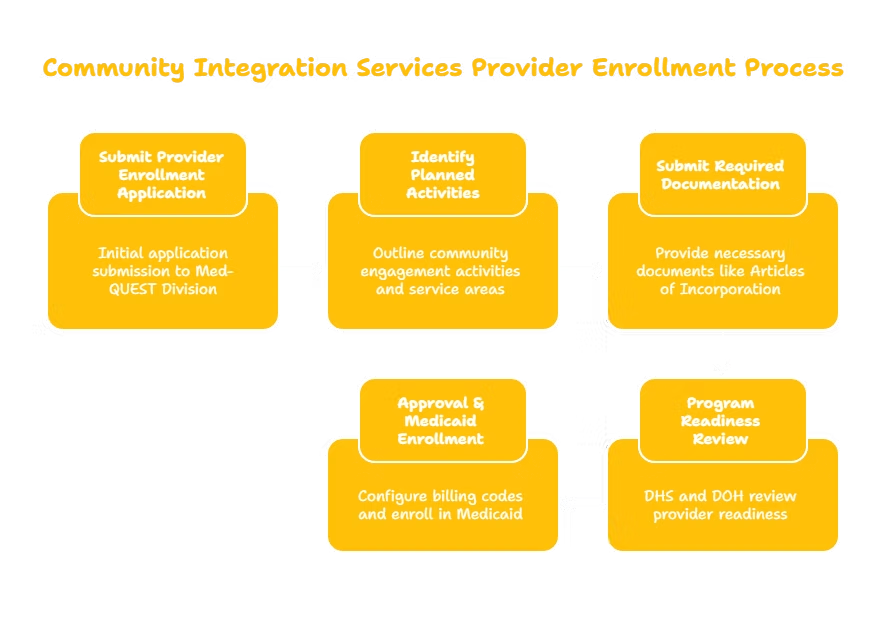
What Steps Are Required for the Med-QUEST Provider Enrollment Process?
The enrollment timeline follows a sequence of preparation, documentation, and review. Providers must begin by submitting an initial application through the Med-QUEST Division, identifying the intended geographic service areas and the specific types of community engagement activities they propose to offer. Accuracy during this phase is critical, as documentation must clearly reflect how the provider will meet the high standards of HCBS delivery.
Following the initial application, providers must navigate the following phases:
- Documentation Submission: Furnish the Med-QUEST Division with Articles of Incorporation, proof of business insurance, detailed operational policies, and intake procedures.
- Program Readiness Review: DHS and DOH officials evaluate the provider's capacity to manage participant safety, implement community engagement strategies, and adhere to Medicaid billing compliance.
- Billing Configuration: Upon final approval, providers must configure their billing systems to match the appropriate hourly or session-based Medicaid codes authorized under their specific waiver program.
How Are Staffing and Training Managed in This Sector?
The success of community integration depends on the competence and professional preparation of the staff. Both the program managers and the Direct Support Professionals (DSPs) must possess the requisite experience to handle the complexities of community-based work. Maintaining a high standard of staff quality is a core expectation of the regulatory bodies overseeing these services.
Essential staffing components include:
- Community Integration Program Manager / Supervisor: Requires professional experience in human services, social work, or recreation therapy, along with mandatory background check clearance.
- Community Support Workers / DSPs: Must possess at least a high school diploma or GED, with CPR/First Aid certification frequently required.
- Mandatory Training: All personnel must complete training in person-centered planning, HIPAA confidentiality, participant rights, abuse prevention, and emergency incident management, supplemented by annual refreshers.
Frequently Asked Questions
What waivers authorize Community Integration Services?
Community Integration Services are primarily authorized under the Developmental Disabilities/Intellectual Disabilities (DD/ID) Waiver and the Community Care Services (CCS) Program, provided the participant’s care plan identifies specific social and community goals.
How long does the provider enrollment process typically take?
The total timeline varies, but generally, business formation takes 1–2 weeks, the Med-QUEST application and readiness review spans 60–90 days, staffing and credentialing require 30–45 days, and final Medicaid billing setup takes 45–60 days.
What documentation is critical for audit readiness?
Providers must maintain organized records, including participant intake assessments, community activity safety/emergency plans, daily service documentation, HIPAA compliance logs, staff credentialing records, and Medicaid billing/audit-ready files.
Strategic Support for Provider Launch
WCG supports community-based organizations, direct support agencies, and inclusion-focused programs in launching Medicaid-compliant Community Integration Services under Hawaii’s HCBS waiver programs. Our assistance spans the full lifecycle of development, including business registration, EIN/NPI setup, Medicaid provider enrollment, and the drafting of comprehensive Policy & Procedure Manuals. We also provide templates for staff credentialing, participant community assessments, and service documentation to ensure operational consistency. Furthermore, our support includes guidance on billing system configuration, participant intake workflows, and the creation of robust quality assurance programs for service delivery and satisfaction tracking.
Key takeaway: Successfully operating as a Community Integration Services provider in Hawaii requires a strict adherence to Medicaid compliance, a commitment to person-centered planning, and a disciplined approach to staff training and operational documentation. By aligning business practices with the requirements of the Med-QUEST Division and the DOH-DDD, agencies can ensure both high-quality service delivery and long-term regulatory success.
Last verified: 2024. The information provided is for educational purposes only and does not constitute legal or financial advice. We recommend consulting with state agencies and professional advisors to ensure full compliance with current Hawaii Medicaid requirements.