COMMUNITY INTEGRATION SERVICES PROVIDER IN DELAWARE
By Fatumata Kaba · 2025-07-07 · 5 min read
PROMOTING INDEPENDENT LIVING, RELATIONSHIP-BUILDING, AND ACTIVE PARTICIPATION IN THE COMMUNITY FOR INDIVIDUALS WITH DISABILITIES
Community Integration Services in Delaware are designed to support individuals with intellectual and developmental disabilities (IDD) in accessing their communities through individualized, goal-driven activities that foster social connections, personal independence, and fulfillment. These services are authorized under the Delaware Lifespan Waiver, administered by the Division of Developmental Disabilities Services (DDDS), and must be delivered in strict alignment with the participant’s Individual Service Plan (ISP) to ensure person-centered outcomes.
Understanding the Governance and Regulatory Framework
The delivery of Community Integration Services is overseen by a structured hierarchy of state and federal agencies. At the state level, the Delaware Division of Developmental Disabilities Services (DDDS) serves as the primary regulatory body responsible for authorizing and monitoring the delivery of these services, ensuring that providers meet the quality standards necessary for participation in the Lifespan Waiver program.
Complementing this, the Delaware Division of Medicaid and Medical Assistance (DMMA) maintains oversight of Medicaid reimbursement processes, ensuring that financial administration remains compliant with state regulations. Furthermore, the Centers for Medicare & Medicaid Services (CMS) provides federal oversight, mandating that Home and Community-Based Services (HCBS) consistently promote social inclusion, community access, and dignity for all participants.
- Delaware Division of Developmental Disabilities Services (DDDS): Authorizes and monitors service delivery via the Lifespan Waiver.
- Delaware Division of Medicaid and Medical Assistance (DMMA): Manages Medicaid reimbursement and program oversight.
- Centers for Medicare & Medicaid Services (CMS): Sets federal standards for HCBS inclusion and person-centered care.
Core Objectives of Community Integration Services
Community Integration Services are intended to move beyond simple supervision, focusing instead on helping individuals build meaningful relationships, utilize local resources, and engage in public life as active members of their community. Because these services are tailored to each participant's unique interests and needs, they are inherently flexible, prioritizing the participant's choice and personal growth.
Providers are responsible for facilitating experiences that align with the goals outlined in the participant’s ISP. This includes supporting the development of social skills, self-advocacy, and the practical knowledge required to navigate public environments safely and confidently. Documentation is a critical component of these services, as it tracks progress toward these personal milestones.
- Support with accessing libraries, recreational centers, and public events.
- Assistance with joining clubs, volunteer groups, or various social organizations.
- Skill-building for navigating public transportation and ensuring community safety.
- Support in developing healthy relationships and fostering self-advocacy.
- Exploration of personal hobbies, wellness activities, and cultural experiences.
- Rigorous documentation of outcomes and progress toward established community goals.
Navigating the Licensing and Provider Approval Process
Establishing a Community Integration Services agency requires careful attention to administrative and legal prerequisites. Before applying to become a provider, the business must be properly registered with the Delaware Division of Corporations, have an Employer Identification Number (EIN) issued by the IRS, and secure a National Provider Identifier (NPI, Type 2). These foundational steps establish the agency as a legitimate entity capable of operating within the Medicaid system.
Once the business is legally established, the prospective provider must apply for approval through the DDDS. This process involves proving that the agency is equipped to employ qualified Direct Support Professionals (DSPs) who are trained in person-centered planning. Additionally, providers must secure general liability insurance and demonstrate strict adherence to HIPAA documentation standards, as they will be handling sensitive participant health information throughout the course of service delivery.
Essential Steps for Provider Enrollment
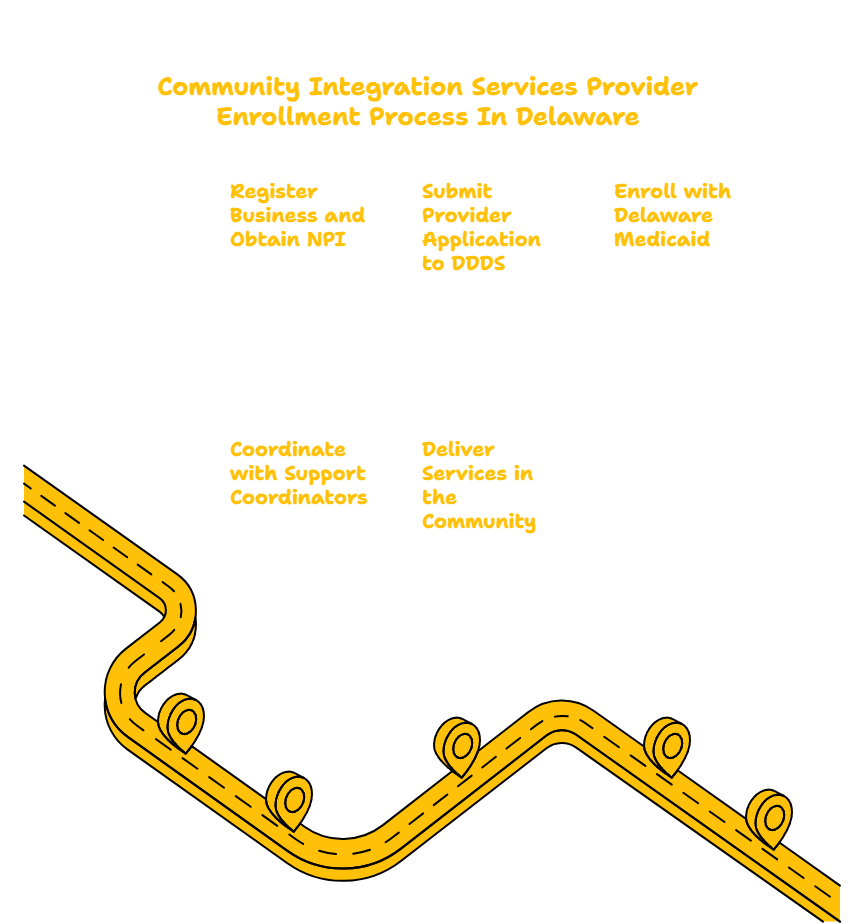
The pathway to becoming an active provider involves a sequential approach to enrollment. First, the business must finalize registration and obtain all necessary identifiers. Second, the agency submits a comprehensive provider application to the DDDS. This application package should include detailed staff resumes, formal service descriptions, internal policies, and samples of the documentation logs that will be used during daily service delivery.
Following DDDS approval, the agency must complete enrollment with Delaware Medicaid (DMAP) to facilitate direct billing for services rendered. The final phase involves active coordination with Support Coordinators, who manage the referrals and ensure that the agency’s services are perfectly aligned with the participant's ISP. Once these administrative hurdles are cleared, the agency can begin service delivery, provided that all ongoing documentation requirements are met.
Staffing, Training, and Operational Requirements
The quality of Community Integration Services is heavily dependent on the caliber of the staff. Direct Support Professionals (DSPs) are required to possess at least a high school diploma or equivalent, a clean background check, and active CPR/First Aid certification. It is preferred that these individuals have prior experience supporting individuals with disabilities in community-based settings. Supervision is handled by a Program Coordinator, who oversees all service planning, staff performance, and documentation quality.
All personnel must undergo comprehensive training to ensure the safety and empowerment of the individuals they serve. This includes training on person-centered planning, participant rights, abuse prevention, and the specific documentation protocols necessary for ISP tracking. Because community settings present unique risks, staff must also be trained in transportation safety and incident reporting to ensure prompt responses to any emergency.
Frequently Asked Questions
What is the timeline for launching a Community Integration program in Delaware?
The timeline typically spans several months. Business formation usually takes 1–2 weeks, followed by a 30–60 day window for DDDS enrollment and a concurrent 30–60 day period for Medicaid (DMAP) enrollment. Referral activation and ongoing service delivery commence once these approvals are finalized.
What documentation must be maintained for compliance?
Providers must maintain a robust policy and procedure manual that includes client intake forms, interest assessments, ISP goal alignment tools, safety protocols, incident reporting systems, and daily/monthly documentation logs. Records must also include HIPAA compliance documentation and staff training verification.
How are these services reimbursed?
Community Integration Services are reimbursed through the Delaware Lifespan Waiver, which is managed by the DDDS. Providers bill for these services through the Delaware Medicaid system once they have successfully completed the required provider enrollment steps and received authorization for their specific service offerings.
WAIVER CONSULTING GROUP'S START-UP ASSISTANCE SERVICE — DELAWARE COMMUNITY INTEGRATION SERVICES PROVIDER
Waiver Consulting Group assists professionals and disability-focused organizations in launching compliant, person-centered Community Integration programs. Our scope of work includes support for business registration, DDDS and Medicaid provider enrollment, policy and procedure development, staff credentialing tools, and client intake system implementation. We also provide templates for activity logs, ISP alignment, and incident reporting to help agencies remain audit-ready. Our Client Portal offers a wealth of resources that you can explore related to various programs and state requirements.
Key takeaway: Becoming a Community Integration Services provider in Delaware requires a commitment to person-centered care, strict adherence to state regulatory requirements, and the establishment of robust, compliant internal policies that prioritize participant safety and community engagement.
Last verified: 2024. Disclaimer: This article is for informational purposes and does not constitute legal or professional medical advice. Always refer to the latest guidance provided by the Delaware Division of Developmental Disabilities Services (DDDS) and the Delaware Division of Medicaid and Medical Assistance (DMMA) when establishing your agency.