COMMUNITY INTEGRATION AND HABILITATION SERVICES PROVIDER IN LOUISIANA
By Fatumata Kaba · 2025-08-12 · 5 min read
Community Integration and Habilitation Services in Louisiana represent a vital component of the Home and Community-Based Services (HCBS) framework, designed to empower individuals with intellectual and developmental disabilities (I/DD) to lead self-directed, meaningful lives. By offering specialized support, these programs facilitate the development of essential life skills and foster deep community engagement, ultimately reducing the need for institutional settings.
For provider agency founders, successfully delivering these services requires a rigorous commitment to person-centered planning, regulatory compliance with the Louisiana Department of Health (LDH), and the development of robust, high-quality care infrastructures. This guide outlines the essential steps, requirements, and operational strategies necessary to establish a compliant and effective service delivery model in the Louisiana market.
What Are the Core Responsibilities and Governing Agencies in Louisiana?
The successful operation of a Community Integration and Habilitation program is contingent upon strict adherence to the standards set by multiple state and federal authorities. The Louisiana Department of Health (LDH), specifically the Office for Citizens with Developmental Disabilities (OCDD), serves as the primary governing body responsible for setting the standards for habilitation and service delivery. These agencies ensure that all support activities align with federal HCBS mandates, which emphasize participant autonomy and community inclusion.
Operational financial success and administrative legitimacy are managed through the Medicaid Management Information System (MMIS) and Molina Medicaid Solutions, which oversee provider enrollment and the reimbursement lifecycle. Furthermore, Managed Care Organizations (MCOs) play a crucial role for participants enrolled in Bayou Health by authorizing services within the individual's Plan of Care (POC). Coordination between these agencies and the provider is the cornerstone of a sustainable, compliant service model.
- Louisiana Department of Health (LDH) / OCDD: Establishes policy, service definitions, and standards for habilitation.
- Molina Medicaid Solutions: Manages the technical aspects of enrollment, billing, and reimbursement.
- Centers for Medicare & Medicaid Services (CMS): Provides the federal framework for HCBS settings, ensuring person-centered mandates are met.
- Managed Care Organizations (MCOs): Coordinate service authorization, billing, and delivery for Bayou Health participants.
How Do You Structure Effective Community Integration and Habilitation Services?
Services must be fundamentally individualized and goal-driven, moving beyond basic supervision to active skill building. The primary objective is to assist the participant in achieving greater independence in daily life. This involves a shift from clinical models to community-based settings where participants can practice navigation, social interaction, and safety management in real-world environments.
Each service plan must be rooted in a Person-Centered Service Plan (PCSP). Providers are responsible for designing activities that reflect the unique interests and aspirations of the participant. Whether it is volunteering at a local nonprofit, mastering public transportation, or learning financial management, the service delivery must demonstrate measurable progress in the participant’s autonomy and integration into their local neighborhood.
- Daily Living Skills: Training in personal health management, budgeting, and routine domestic tasks.
- Community Participation: Facilitating access to recreation, volunteering, and social engagement.
- Navigation and Safety: Education on community safety, traffic awareness, and the use of natural supports.
- Behavioral Support: Providing coaching and interventions in real-world, non-clinical settings.
What Are the Mandatory Licensing and Administrative Prerequisites?
Launching a provider agency in Louisiana requires a methodical approach to business and regulatory compliance. Beyond standard business formation steps—such as registering with the Louisiana Secretary of State and obtaining an IRS EIN and Type 2 NPI—providers must navigate the specific demands of the Medicaid enrollment portal. The regulatory landscape requires that every provider maintain comprehensive liability and workers’ compensation insurance to protect the agency and the individuals served.
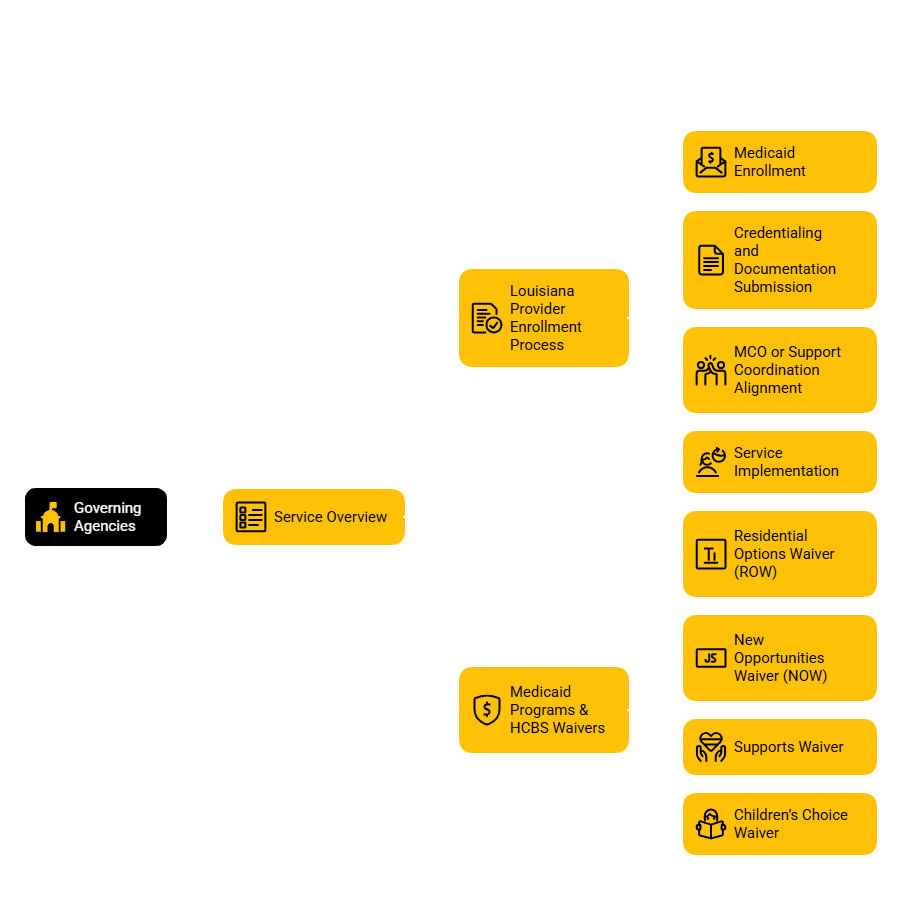
Developing a comprehensive Community Integration & Habilitation Policy & Procedure Manual is a mandatory step that serves as the blueprint for your agency’s operations. This document must satisfy state requirements regarding HIPAA compliance, incident reporting, and service documentation. Once these foundational elements are established, the agency can seek approval to serve participants under specific waivers, such as the New Opportunities Waiver (NOW) or the Residential Options Waiver (ROW).
How Do You Manage Staffing and Training Compliance?
The quality of your service delivery is directly tied to the competence and training of your Direct Support Professionals (DSPs). All staff must meet foundational requirements, including the possession of a high school diploma or GED and the completion of a thorough background check. Beyond these requirements, the agency is responsible for ensuring that all staff are proficient in person-centered practices and understand the specific habilitation goals outlined in each participant's PCSP.
Ongoing education is not merely a recommendation; it is an operational requirement. Staff must be regularly updated on HIPAA regulations, participant rights, and emergency response protocols. By investing in a structured onboarding process and continuous professional development, an agency ensures that its team can effectively facilitate complex community interactions while maintaining the safety and dignity of the participants they support.
- Background Checks: Mandatory clearance for all direct service staff.
- Core Competency Training: HIPAA, participant rights, abuse prevention, and emergency protocols.
- Clinical Documentation: Training on the accurate and timely entry of progress notes and billing logs.
- Ongoing Development: Annual continuing education focused on evolving habilitation techniques and disability support strategies.
WAIVER CONSULTING GROUP’S START-UP ASSISTANCE SERVICE — LOUISIANA COMMUNITY INTEGRATION & HABILITATION PROVIDER
WCG assists disability agencies, nonprofits, and independent providers in launching Medicaid-approved Community Integration and Habilitation programs across Louisiana.
- Medicaid enrollment and waiver credentialing
- Development of Policy & Procedure Manual
- Goal tracking templates, community activity logs, and daily progress note systems
- Staff onboarding materials and DSP training logs
- HIPAA-compliant documentation and billing support
- Outreach strategies to build referral relationships with support coordinators and waiver teams
Frequently Asked Questions
What waivers allow for Community Integration and Habilitation services?
These services are primarily covered under the Residential Options Waiver (ROW), New Opportunities Waiver (NOW), and the Supports Waiver. In specific cases, the Children’s Choice Waiver may also allow for habilitation and family training supports.
What is the typical timeline to go from business formation to service delivery?
The total timeline generally spans 5 to 8 months. Business formation and manual development typically take 1–2 months, followed by a 60–90 day window for Medicaid enrollment and credentialing. Staff hiring and community planning add another 30–45 days before the agency is ready to receive participant referrals.
Are there specific documentation requirements for daily operations?
Yes. Providers must maintain intake and functional assessment forms, PCSP alignment templates, daily progress note logs, monthly summaries, community activity logs, incident reports, and detailed billing logs for audit purposes.
Key Takeaway
Success as a Louisiana Community Integration and Habilitation provider is built on the intersection of administrative rigor and genuine commitment to person-centered care. By carefully navigating the LDH and OCDD enrollment processes, maintaining high standards for staff training, and ensuring every service is documented against a clear, goal-oriented PCSP, providers can build a sustainable organization that significantly improves the quality of life for individuals with developmental and intellectual disabilities.
Last verified: October 2023. This information is for educational purposes only and does not constitute legal or financial advice. Regulations regarding Louisiana Medicaid and HCBS waivers are subject to change. Please consult the official Louisiana Department of Health (LDH) and Office for Citizens with Developmental Disabilities (OCDD) websites for the most current regulatory updates.