COMMUNITY-BASED RESIDENTIAL SERVICES PROVIDER IN CALIFORNIA
By Fatumata Kaba · 2025-07-07 · 5 min read
Community-based residential services in California provide essential 24-hour support and supervision for individuals with developmental disabilities within small, inclusive, home-like settings. These services are authorized by California’s 21 Regional Centers under the Lanterman Act and must strictly adhere to the federal Home and Community-Based Services (HCBS) final rule settings criteria to ensure participants remain fully integrated into their local communities.
Launching a residential care facility in this sector requires a dual-track approach: obtaining a Community Care Facility (CCF) license from the California Department of Social Services (CDSS) and securing vendorization through a local Regional Center. By combining professional oversight with personalized skill-building, these providers create safe environments that foster independence and dignity for some of California’s most vulnerable citizens.
Understanding the Regulatory Landscape and Governing Agencies
Navigating the California developmental disability services system involves coordinating with multiple state and federal entities. The California Department of Developmental Services (DDS) holds primary responsibility for the oversight of residential services, setting the broad policy framework and contracting with Regional Centers. These 21 nonprofit Regional Centers act as the direct point of contact for service coordination, authorizing specific services through an individual’s Individual Program Plan (IPP).
Operational compliance is monitored by the CDSS Community Care Licensing Division (CCLD), which governs the facility's physical environment and ensures adherence to Title 22 regulations. Furthermore, because these services are often funded through Medicaid-supported waiver programs, providers must maintain strict compliance with the Centers for Medicare & Medicaid Services (CMS) HCBS standards. Failure to meet these standards can jeopardize both provider status and client eligibility for federal funding.
Developing the Service Model and Core Facility Offerings
Community-based residential services are designed to house four or fewer individuals, prioritizing a home-like atmosphere over institutional care. The goal is to provide a comprehensive support system that balances personal safety with the opportunity for personal growth. Providers must demonstrate that their program design facilitates active participation in community life, tailored to the unique goals identified in each resident's IPP.
Approved providers are responsible for delivering a wide range of essential services, including:
- Continuous 24-hour supervision and health/safety monitoring.
- Assistance with activities of daily living (ADLs) and instrumental activities of daily living (IADLs).
- Safe medication administration and management, strictly following licensing guidelines.
- Facilitation of community integration, including social, recreational, and educational opportunities.
- Implementation of specific behavioral supports and skill-building goals as defined in the resident's ISP.
- Coordination of complex medical, dental, and mental health appointments.
- Rigorous daily documentation of service delivery, incident reporting, and progress tracking.
The Licensing and Vendorization Roadmap
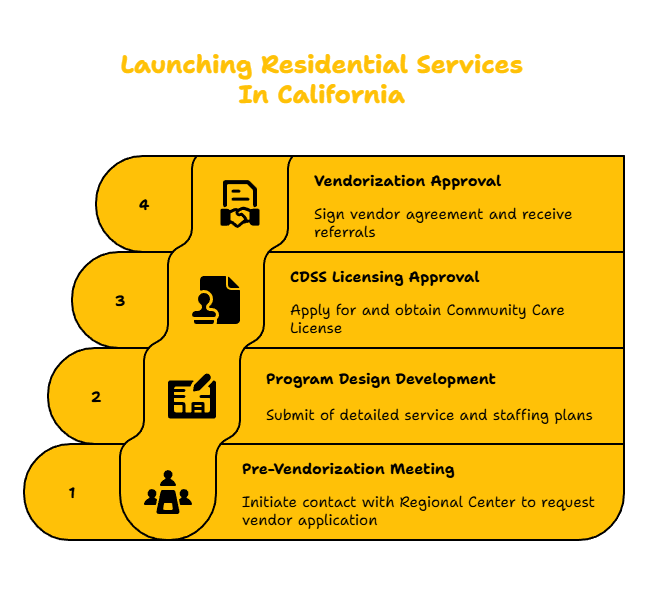
The path to becoming an approved provider begins with establishing the legal foundation of the business, including registration with the California Secretary of State and obtaining an EIN and Type 2 NPI. Once the legal entity is formed, the provider must navigate the CDSS Community Care Licensing (CCL) process to secure a CCF license, such as an Adult Residential Facility (ARF) license. This step involves fire clearance, rigorous background checks for staff, and facility inspections to ensure safety compliance.
Following successful licensure, the provider must initiate vendorization with a local Regional Center. This is the stage where the program's specific service model is vetted for alignment with Regional Center requirements. This process involves a pre-vendorization meeting, the submission of a detailed program design—covering staffing ratios, house routines, and emergency protocols—and final approval of the vendor agreement, which allows the facility to accept client referrals.
Staffing, Credentialing, and Professional Development
Staffing quality is the cornerstone of a successful residential program. The facility administrator must hold current CDSS-approved administrator certification and meet the specific educational and experience requirements outlined in Title 22. All direct support professionals (DSPs) are required to complete DSP I and DSP II certification within one year of their hiring date to ensure they possess the necessary competencies for high-quality care.
Comprehensive training programs are non-negotiable for staff. All employees must maintain current CPR and First Aid certification, as well as clear TB and Live Scan background screenings. Mandatory training modules include:
- Person-centered support practices and ISP goal implementation.
- Standardized medication administration procedures.
- Abuse prevention, detection, and mandated reporter protocols.
- HIPAA-compliant confidentiality and emergency preparedness procedures.
- Ongoing professional development through annual CEUs and in-service refreshers.
Frequently Asked Questions
What is the typical timeline for launching a residential facility?
The process generally takes between 6 and 10 months. Business formation usually takes 1-2 weeks, followed by the CDSS licensing phase (90–120 days) and the Regional Center vendorization process (45–90 days). Facility setup and final staffing alignment typically require an additional 30–60 days.
How does the Regional Center determine if a provider is eligible?
Eligibility is determined by the provider's ability to demonstrate that their program design meets the specific needs of the local population served by the Regional Center. This includes presenting a viable business structure, qualified staffing plans, and comprehensive policies and procedures that ensure health, safety, and HCBS compliance.
Are these services funded primarily through Medicaid?
Yes, community-based residential services are funded through a combination of the HCBS Waiver for individuals with developmental disabilities, Regional Center funding under the Lanterman Act, and potentially State Plan Medi-Cal for individuals with dual diagnosis or specific behavioral health needs.
Essential Documentation and Compliance Maintenance
Success as a provider depends on maintaining meticulous records. Beyond the initial setup documents—such as Articles of Incorporation, NPI, and the CDSS license—providers must maintain an up-to-date policy and procedure manual. This manual serves as the operational guide for the facility and must include clear protocols for client intake and discharge, medication logs, staff schedules, and incident reporting. Consistency in documenting service delivery is vital, as it supports the evidence needed for recurring audits by the Regional Center and state licensing agencies.
Key Takeaway: Establishing a community-based residential service provider in California is a highly regulated undertaking that requires meticulous adherence to both CDSS licensing standards and Regional Center vendorization requirements. Success rests on building a foundation of operational transparency, maintaining rigorous staff training schedules, and ensuring the program consistently meets the person-centered goals of every resident served.
Last verified: October 2023. Disclaimer: This article is intended for informational purposes only and does not constitute legal or professional regulatory advice. Requirements may vary by Regional Center and individual facility classification. Consult directly with the California Department of Developmental Services and your local Regional Center to confirm current mandates for your specific project.