COMMUNITY-BASED EMPLOYMENT SERVICES PROVIDER IN ARKANSAS
By Fatumata Kaba · 2025-07-04 · 5 min read
What Are Community-Based Employment Services in Arkansas?
Community-Based Employment Services in Arkansas represent a vital component of the state’s long-term care infrastructure, designed to assist individuals with developmental disabilities in securing and maintaining competitive, integrated employment. These services, authorized under the Community and Employment Supports (CES) Waiver, prioritize person-centered planning, ensuring that vocational goals align directly with the individual’s unique strengths, interests, and capabilities as outlined in their Individualized Service Plan (ISP).
By shifting the focus from traditional sheltered workshops to integrated work environments, these services facilitate true community inclusion. Providers operate within a framework overseen by the Arkansas Department of Human Services (DHS) Division of Developmental Disabilities Services (DDS), ensuring that every support delivered complies with the federal Centers for Medicare & Medicaid Services (CMS) Home and Community-Based Services (HCBS) Final Rule.
Who Governs and Monitors Employment Providers in Arkansas?
The regulatory landscape for employment services is multifaceted, requiring providers to coordinate with several key agencies to maintain compliance and funding eligibility. The Division of Developmental Disabilities Services (DDS) serves as the primary body responsible for certifying providers and conducting ongoing monitoring of service delivery under the CES Waiver. Their oversight ensures that the care provided remains consistent with state standards and the specific needs of the waiver population.
Simultaneously, the Arkansas Medicaid program, through the Division of Medical Services (DMS), manages the administrative side of provider enrollment and the reimbursement process for all approved services. Finally, because these programs utilize federal funding, all operations must adhere to the mandates set by the Centers for Medicare & Medicaid Services (CMS). CMS provides the regulatory guardrails that emphasize community integration, personal independence, and the protection of rights for individuals receiving HCBS services.
How Do Providers Obtain Approval to Offer Employment Services?
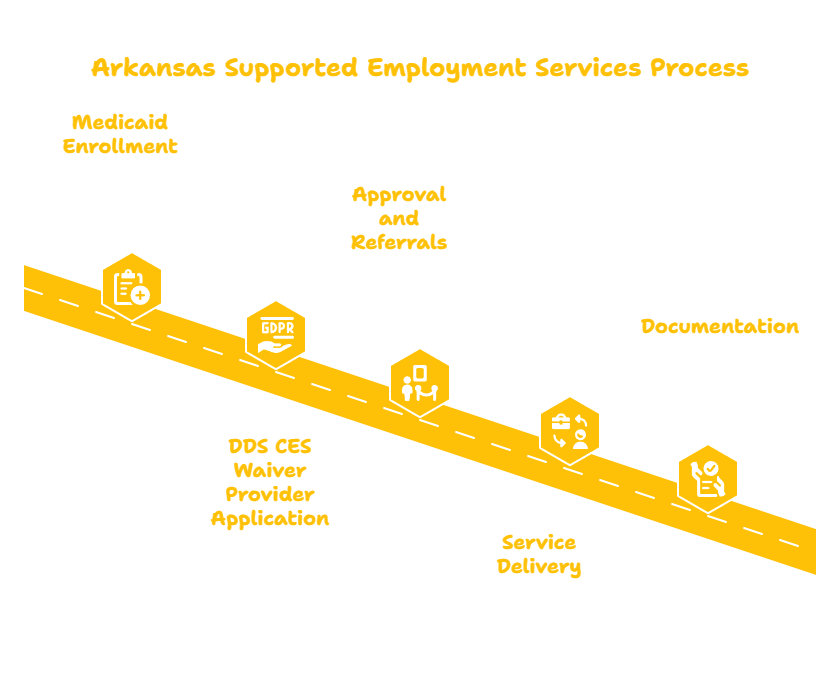
The process for becoming an authorized provider is a structured, multi-step undertaking that begins with establishing the legal business entity. Prospective providers must register their business with the Arkansas Secretary of State, secure an Employer Identification Number (EIN) from the IRS, and obtain a Type 2 National Provider Identifier (NPI). These foundational steps provide the corporate identity necessary to interact with state health systems.
Once the business entity is established, providers must navigate two distinct tracks of approval. First, they must submit a CES Waiver Provider Application to the DDS. Second, they must complete the Medicaid provider enrollment process via the Arkansas Medicaid Portal. This dual-track approach requires a high degree of organizational readiness, including the development of comprehensive policy and procedure manuals that cover service delivery, staff training, and data collection protocols.
- Register business with the Arkansas Secretary of State.
- Obtain EIN from the IRS and NPI (Type 2).
- Submit CES Waiver Provider Application to DDS.
- Complete Medicaid provider enrollment through the Arkansas Medicaid Portal.
- Hire qualified employment specialists or job coaches.
- Maintain general liability insurance and a robust system for tracking employment outcomes.
What Are the Core Service Requirements for Employment Specialists?
Success in this field hinges on the quality of the staff providing direct support. Employment specialists and job coaches serve as the primary link between the participant and the workplace. Consequently, these roles require a blend of vocational expertise and sensitivity to disability-related needs. Staff members must hold at least a high school diploma or GED and undergo rigorous screening, including background checks and clearance through the Adult and Child Maltreatment Registry.
Training is an essential, ongoing mandate for all staff. Providers must ensure their teams are fluent in person-centered employment planning, documentation standards that align with ISP requirements, and the specific ethical obligations required by HCBS regulations. Continuous professional development, including annual training in best practices for job development and workplace accommodation, is necessary to keep staff updated on effective strategies for long-term job retention.
What Documentation Is Required for Ongoing Compliance?
Maintenance of accurate, audit-ready documentation is a hallmark of a compliant provider agency. Beyond basic business licenses and provider agreements, the agency must maintain an extensive policy and procedure manual. This manual serves as the operational blueprint for the organization, outlining everything from job matching and employer outreach strategies to participant intake and goal-setting templates.
Daily operations must be supported by consistent data collection. Providers are required to keep detailed daily logs and employment progress tracking forms that clearly reflect the participant’s trajectory toward their vocational goals. Furthermore, the agency must implement formal systems for crisis management, incident documentation, and the coordination of benefits and wage reporting. HIPAA compliance and strict adherence to the participant's rights must be embedded in every facet of the provider's administrative record-keeping.
Frequently Asked Questions
What is the typical timeline for launching an employment service agency in Arkansas?
The launch process generally spans 4 to 6 months. Business formation takes 1–2 weeks, followed by a 45–90 day period for CES Waiver and Medicaid enrollment. Hiring and credentialing staff typically takes an additional 30–45 days, while the final phase of securing referrals and establishing employer networks usually adds another 2–4 weeks.
What specific roles do job coaches perform under the CES Waiver?
Job coaches provide on-site support to help individuals learn tasks and navigate workplace dynamics. They assist with job exploration, vocational assessments, interview preparation, and ongoing stabilization, ensuring the participant maintains their position and develops the skills necessary for long-term professional independence.
How does the HCBS Final Rule impact employment providers?
The HCBS Final Rule mandates that services be delivered in the most integrated settings possible. Providers must ensure that participants have opportunities for community involvement and that employment services are not delivered in isolated, segregated, or congregate settings that limit the individual’s interaction with the broader community.
Key Takeaway
Launching and managing a Community-Based Employment Services provider in Arkansas requires strict adherence to both DDS and Medicaid regulatory frameworks. Success depends on maintaining detailed documentation, ensuring staff are appropriately trained in person-centered support, and fostering strong professional relationships with both employers and referral sources within the state’s disability service system.
WAIVER CONSULTING GROUP'S START-UP ASSISTANCE SERVICE — ARKANSAS COMMUNITY-BASED EMPLOYMENT SERVICES PROVIDER
We help employment providers, vocational programs, and nonprofits launch Medicaid-compliant Community-Based Employment Services under the CES Waiver. Our services cover the full spectrum of requirements including business registration (LLC, EIN, NPI), CES Waiver and Medicaid enrollment support, and the creation of essential policy and procedure manuals. We also provide templates for job logs, progress tracking, and employer outreach, alongside guidance on staff credentialing and incident reporting systems.
Last verified: October 2023. This content is provided for informational purposes only and does not constitute legal or professional advice. Always consult directly with the Arkansas Department of Human Services and the Division of Medical Services for the most current regulations and guidance regarding Medicaid waiver services.