Colorado Class B vs Class A: The Home Care License That Fits Personal Care
By Fatumata Kaba · 2026-07-08 · 6 min read
Choosing between a Class A and Class B home care license is the fundamental strategic decision for any provider entering the Colorado market. A Class B agency is specifically designed for non-medical personal care services, whereas a Class A license authorizes a broader scope of practice that includes skilled nursing and medical oversight.
Understanding the Core Distinction: Scope of Service
In Colorado, the regulatory framework divides home care agencies based on the clinical complexity of the services provided. The primary distinction centers on the delivery of skilled versus non-skilled support. Understanding this divide is critical for agency founders, as the license you obtain dictates the professional credentials of the staff you must hire and the complexity of the services you can legally bill to payers like Medicaid.
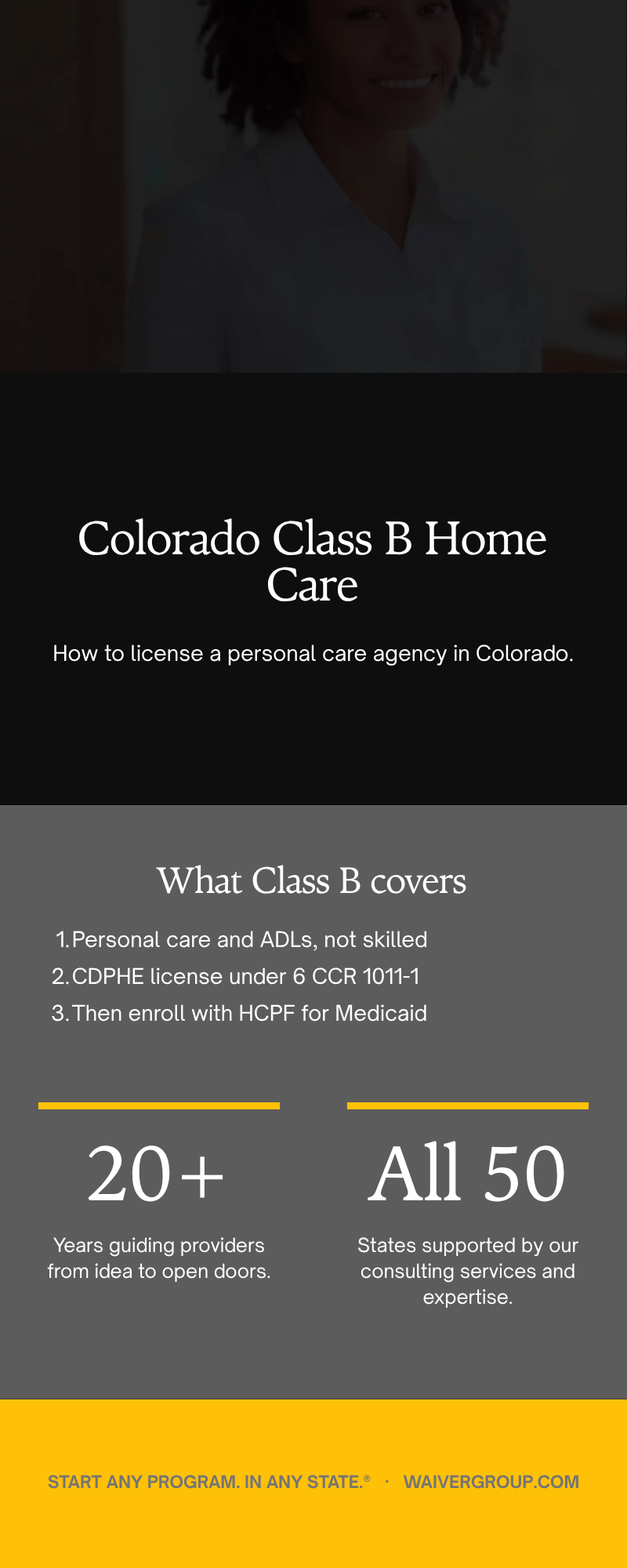
A Class B home care agency is exclusively limited to personal care services. These are non-medical tasks that assist individuals with activities of daily living (ADLs) and instrumental activities of daily living (IADLs). Under state regulations, a Class B agency is prohibited from providing skilled care. This license type is ideal for providers focusing strictly on non-medical home and community-based services (HCBS), such as support for individuals enrolled in various long-term care waiver programs.
Conversely, a Class A license allows for the provision of personal care services in addition to skilled health care services. This includes services provided by registered nurses, licensed practical nurses, or other specialized medical professionals. If your business model includes clinical nursing oversight, wound care, or medication administration beyond simple reminders, a Class A license is a mandatory requirement.
Navigating CDPHE Licensing Regulations
The Colorado Department of Public Health and Environment (CDPHE) serves as the primary regulatory body for home care agency licensing. All home care agencies, regardless of classification, must adhere to the regulations outlined in 6 CCR 1011-1, Chapter 26. This chapter details the minimum standards for the operation of home care agencies, including administrative requirements, personnel policies, and quality of care protocols.
For a Class B applicant, the application process focuses on ensuring the agency has the infrastructure to support non-medical staff and maintain the health, safety, and welfare of clients receiving personal care. The application will require documentation regarding your agency’s operational policies, staff training programs, and incident reporting procedures. Because Class B agencies deal specifically with non-medical care, the oversight focuses heavily on caregiver vetting and supervision.
Licensing is not a one-time event but a continuous commitment to compliance. Agencies must be prepared for periodic surveys and inspections by the CDPHE. Maintaining an active license requires keeping all organizational documents current, ensuring that background checks for employees are consistently documented, and that all training requirements under Chapter 26 are met on schedule.
Mandatory Insurance and Financial Compliance
Colorado establishes strict financial responsibility requirements for home care providers to protect the state and the patients receiving care. These insurance mandates vary based on the license class and the scope of potential liability associated with the services being provided. It is essential to engage with an insurance professional who understands the unique requirements of the Colorado home care industry to ensure your coverage meets or exceeds state mandates.
For a Class B agency, you must carry at least $100,000 per occurrence and $300,000 aggregate in liability insurance. These limits represent the state-mandated minimums, but many agencies choose to carry higher coverage to protect against unforeseen litigation or operational risks. Failure to maintain these minimum limits can result in a lapse of licensure and immediate regulatory action.
- Verify the minimum liability coverage of $100,000 per occurrence.
- Ensure the $300,000 aggregate limit is clearly stated on your Certificate of Insurance (COI).
- Confirm that your policy specifically identifies the agency as a licensed home care entity.
- Review your policy annually to ensure limits are adjusted if you decide to upgrade to a Class A license.
The Relationship Between CDPHE and HCPF
One of the most common misconceptions among new providers is the belief that the CDPHE license grants automatic authority to bill the Medicaid program. In reality, licensing and Medicaid enrollment are distinct, sequential processes managed by two separate government bodies. The CDPHE handles the regulatory license to operate in the state, while the Department of Health Care Policy and Financing (HCPF) manages the Colorado Medicaid program.
You must have your CDPHE license in hand before you can successfully complete the Medicaid provider enrollment process with HCPF. HCPF verifies your licensing status as a foundational requirement for enrollment. Once your license is verified, you will navigate the HCPF enrollment portal, where you will submit documentation regarding your agency’s ownership, location, and the specific HCBS services you intend to provide.
The enrollment timeline can fluctuate based on the volume of applications and the accuracy of your submission. It is professional practice to ensure that every document submitted to HCPF aligns perfectly with the information on file at the CDPHE. Discrepancies in agency names, addresses, or ownership structures between the two agencies often result in significant processing delays.
Strategic Planning for Future Growth
While starting as a Class B agency is a common path for new providers looking to specialize in personal care, many founders eventually consider expanding their scope. Transitioning from a Class B to a Class A license is a significant regulatory step that requires a formal update to your licensure with the CDPHE. This move typically necessitates the hiring of clinical staff, such as a Director of Nursing, to oversee the skilled care component.
When planning for future growth, consider the administrative burden of skilled nursing oversight. A Class A agency is subject to more rigorous clinical audits and must adhere to standards regarding medical record keeping that do not apply to Class B agencies. Before pursuing a license upgrade, ensure your operational structure can support the added complexity of medical management and clinical compliance.
Frequently Asked Questions
Can a Class B agency provide medication reminders?
Yes, Class B agencies may provide medication reminders, which are considered a component of personal care services. However, they cannot perform skilled medication administration or management that requires the intervention of a licensed nurse, as those functions are reserved for Class A agencies.
Is the licensure process for a Class A agency significantly longer than for a Class B?
The duration of the licensing process depends on the completeness of the initial application and the responsiveness of the agency to any requests for information from the CDPHE. While a Class A application requires more detailed documentation regarding clinical policies and personnel credentials, both processes require diligent preparation to avoid delays.
Do I need a separate license for every location if I have multiple offices?
In Colorado, licensing requirements for multiple locations depend on how those sites are structured under your organizational framework. Generally, if you operate multiple distinct physical locations that function as separate agencies, you may be required to maintain individual licenses. It is advisable to consult the specific language in 6 CCR 1011-1 regarding branch offices and separate entities.
Key takeaway: Choose the right license class first — Class B for personal care, Class A if you add skilled care — carry the required insurance, and enroll with HCPF to bill Medicaid.
Last verified: 2024. The information provided is for educational purposes only and does not constitute legal or professional advice. Always verify current regulations directly with the Colorado Department of Public Health and Environment (CDPHE) and the Department of Health Care Policy and Financing (HCPF) before making business decisions. Start Any Program. In Any State.® 20+ years clearing the path in all 50 states — we've done this before, and we'll do it for you. Book a video consultation at waivergroup.com/videoappointment, call 302.888.9172, or email [email protected].