CHORE SERVICES PROVIDER IN MINNESOTA
By Fatumata Kaba · 2025-08-13 · 6 min read
Chore services in Minnesota are essential Home and Community-Based Services (HCBS) designed to help individuals with disabilities, the elderly, or those recovering from illness maintain a safe and sanitary living environment. By providing assistance with critical household maintenance tasks that the individual cannot perform independently, these services prevent institutionalization and support aging in place across the state. Understanding the regulatory landscape, provider enrollment process, and operational requirements is fundamental for any agency founder seeking to deliver high-quality, compliant support under Minnesota’s Medicaid waiver programs.
What Are the Governing Agencies and Regulatory Frameworks?
The delivery of chore services in Minnesota operates under a multi-tiered regulatory structure that ensures service quality, fiscal integrity, and beneficiary safety. At the federal level, the Centers for Medicare & Medicaid Services (CMS) provides oversight, ensuring that Minnesota’s waiver programs adhere to federal mandates and remain in compliance with established Medicaid standards. This federal framework serves as the foundation for how states design and deliver long-term services and supports.
At the state level, the Minnesota Department of Human Services (DHS) acts as the primary administrator for Medicaid programs, including those that authorize chore services under HCBS waivers. Concurrently, the Minnesota Department of Health (MDH) holds responsibility for licensing and regulating the specific home care agencies that provide these services. Providers must navigate the requirements of both departments to maintain a valid license and a status as an approved Medicaid service provider.
- Minnesota Department of Human Services (DHS): Administers Medicaid programs and provides policy oversight for chore services under HCBS Waivers.
- Minnesota Department of Health (MDH): Licenses and regulates home care agencies to ensure professional standards and safety.
- Centers for Medicare & Medicaid Services (CMS): Provides federal oversight and ensures ongoing waiver compliance.
How Does the Chore Services Model Support Clients?
Chore services are explicitly designed to address basic household maintenance tasks that are beyond the physical or cognitive capacity of the individual, yet are necessary for them to continue living independently. These services are never delivered in a vacuum; they must be tailored specifically to the needs identified in the client's Individual Service Plan (ISP) or Person-Centered Plan (PCP). By focusing on essential hygiene and safety, the services help mitigate environmental hazards that could lead to injury or premature nursing home placement.
Service delivery typically encompasses a range of maintenance and sanitation tasks. Providers are responsible for ensuring that workers are equipped to handle these specific duties safely and effectively. The goal is to create a consistent, reliable support system that allows the participant to remain comfortable and safe in their own home.
- Yard work, including seasonal mowing and essential snow removal.
- Basic home repairs and general property maintenance.
- Heavy cleaning, decluttering, and sanitation of living areas.
- Garbage, trash, and debris removal.
- Seasonal tasks such as raking leaves or window cleaning.
- Assistance with simple household organization to improve accessibility.
What Are the Prerequisites for Provider Approval and Enrollment?
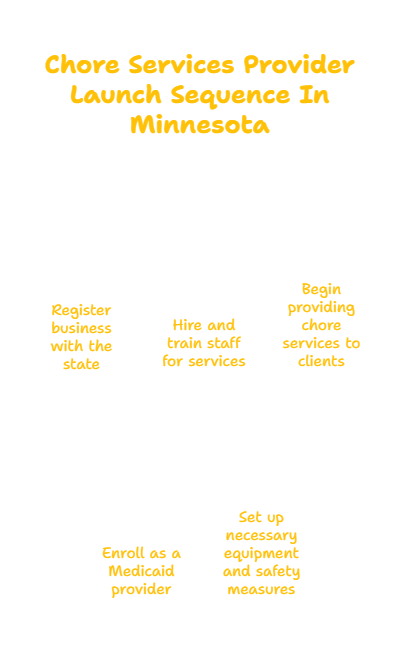
Launching a chore services agency requires rigorous preparation and adherence to state-mandated administrative steps. Before engaging with the Medicaid enrollment system, a provider must establish a formal business entity. This includes registering the business with the Minnesota Secretary of State and securing the necessary federal identifiers, specifically an Employer Identification Number (EIN) from the IRS and a Type 2 National Provider Identifier (NPI).
Beyond basic business registration, prospective providers must prepare for the regulatory vetting process. This involves maintaining comprehensive records, including evidence of liability insurance and clearly defined documentation of staff qualifications. Once the business is established, the agency must initiate the Medicaid provider enrollment process through the Minnesota Department of Human Services and ensure that all necessary licensing is obtained from the Minnesota Department of Health.
- Formal business registration with the Minnesota Secretary of State.
- Obtaining a federal EIN and a Type 2 NPI.
- Enrollment as a recognized Medicaid provider with the Minnesota DHS.
- Securing a Chore Services License through the MDH, if applicable to the scope of service.
- Securing and maintaining professional liability insurance.
How Is the Medicaid Provider Enrollment Process Structured?
The transition from a business entity to an active Medicaid provider follows a structured, multi-phase sequence. The process begins with a pre-application contact with the Minnesota Department of Human Services, where administrators must clarify specific program requirements and receive guidance on the current enrollment criteria for chore services. This initial step is vital to ensure that the agency meets all foundational requirements before formal submission.
Following the pre-application phase, the agency submits a formal application that includes business registration documents, evidence of adequate liability insurance, and detailed service descriptions. Concurrent with this, the provider must verify their licensing status with the MDH. Once the application is reviewed and approved, the provider is officially assigned a Medicaid provider number, which authorizes them to begin delivering services and seeking reimbursement through the state’s billing systems.
What Are the Essential Staffing and Training Requirements?
The quality of service delivery rests on the competence and reliability of the staff. Agencies must appoint a Chore Services Program Manager who possesses sufficient experience in home support services or social services management to oversee daily operations. This individual is responsible for ensuring that the agency remains compliant with service plans and that all staff members are performing tasks according to established protocols.
Direct service staff, or household support aides, must meet basic prerequisites, including a high school diploma or equivalent, successful completion of a background check, and tuberculosis (TB) clearance. Once hired, staff must undergo rigorous training to ensure they can perform tasks safely. Ongoing supervision is necessary to maintain service quality and ensure that all documentation—such as service logs and client feedback—is completed accurately.
- Safety, infection control, and hazardous material management.
- Efficient task management and scheduling protocols.
- Effective client communication and accurate service documentation.
- Emergency response training and professional risk management.
Frequently Asked Questions
Which Medicaid waivers cover chore services?
Chore services are available to eligible participants through several programs, including the 1915(c) HCBS Waiver for the Elderly and Disabled, the Community Access for Disability Inclusion (CADI) Waiver, and the Brain Injury (BI) Waiver.
How long does the provider enrollment process typically take?
While timelines can vary based on individual agency readiness, the Medicaid provider enrollment process typically ranges from 60 to 90 days following the submission of a complete application packet.
What core policies must be included in the agency's procedure manual?
Every agency must maintain a manual covering client intake and needs assessment protocols, safety and hygiene procedures, specific household maintenance guidelines, documentation and service logs, and detailed records for staff training and supervision.
Key Takeaways for Prospective Providers
Operating a chore services agency in Minnesota requires a disciplined approach to both regulatory compliance and administrative management. By prioritizing clear documentation, maintaining strict adherence to DHS and MDH standards, and ensuring that staff are adequately trained to meet the specific requirements of the ISP, providers can build a sustainable organization. Successful providers focus on these foundational systems early in the start-up phase, ensuring that when the Medicaid provider number is issued, the agency is fully prepared to deliver high-quality, compliant care that directly supports the independence of Minnesota residents.
Last verified: October 2023. Disclaimer: This article is for informational purposes only and does not constitute legal or professional advice. Requirements for Medicaid providers may change; please consult directly with the Minnesota Department of Human Services or the Minnesota Department of Health for the most current regulations and policy updates.