Choosing Your Service Lines: Why a Focused Waiver Application Wins
By Fatumata Kaba · 2026-06-18 · 5 min read
Selecting the appropriate service lines is the most consequential strategic decision a new Home and Community-Based Services (HCBS) provider makes, as it dictates the complexity, timeline, and evidentiary burden of the entire waiver application process. Rather than attempting to cast the widest net possible, successful applicants focus on a specialized scope that aligns with existing operational capabilities, regulatory standards, and local market demand. A focused application does not just describe the business; it fundamentally shapes the requirements and compliance hurdles that determine whether an application proceeds to approval or remains stalled in the review phase.
How Does Service Selection Impact the Review Timeline?
In the world of Medicaid HCBS waivers, the application is not merely a formality; it is a demonstration of institutional readiness. Every service category selected triggers a specific set of administrative and clinical requirements that state agencies must verify before granting certification or enrollment. When an applicant selects an excessive number of service lines, they exponentially increase the volume of documentation that must be reviewed and cross-referenced by state staff.
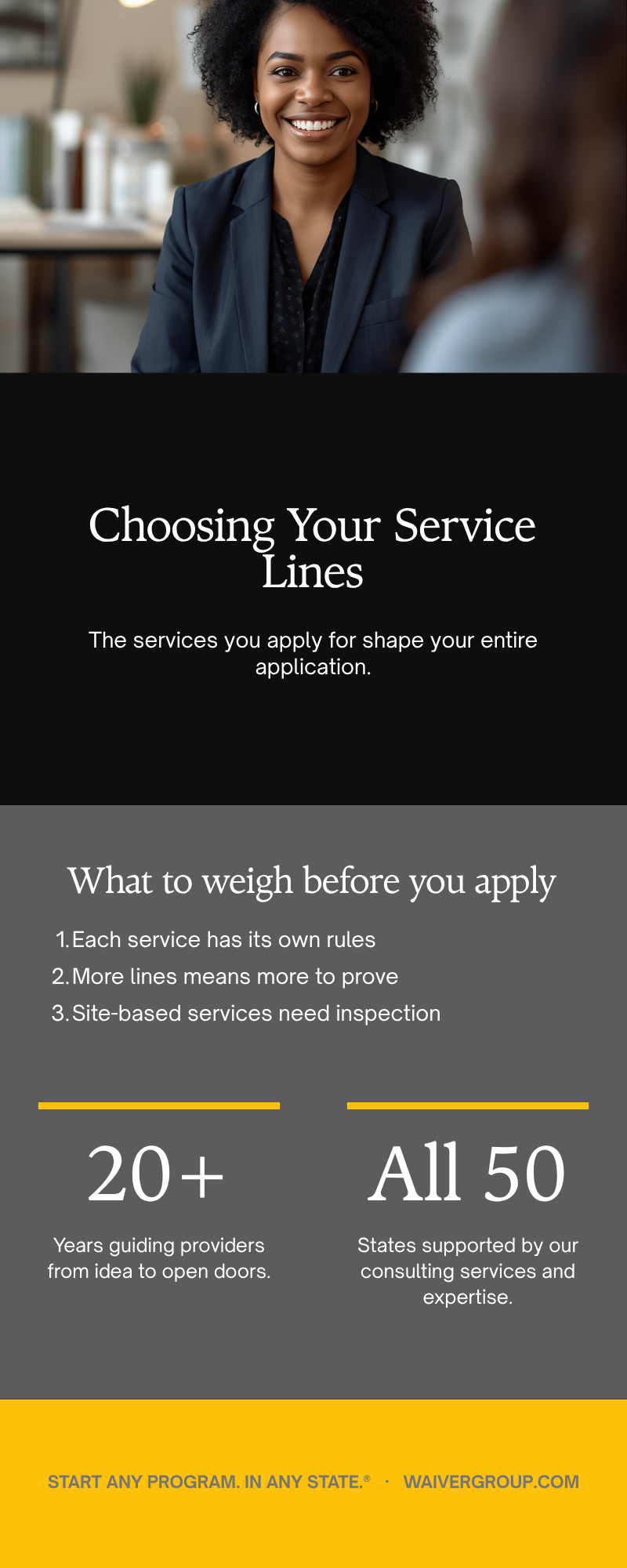
Each additional service creates a new parallel track for approval. If one of those services requires a specific policy, specialized staffing credential, or unique background check protocol that is not perfectly aligned with the others, the entire application can be held back by the slowest component. By narrowing the initial focus, providers can clear the path to enrollment faster and establish a foundation of compliance that makes future expansions significantly smoother.
Why Does Each Service Carry Unique Regulatory Requirements?
HCBS waivers are governed by strict state-specific statutes and federal regulations that ensure participant safety and service quality. It is a common misconception that all waiver services operate under a uniform set of rules. In reality, each service type—whether it be personal care, respite, supported employment, or residential habilitation—often carries distinct mandates regarding staff-to-participant ratios, training curriculum, and incident reporting protocols.
These requirements are not interchangeable. For instance, a service requiring direct clinical oversight under a nurse supervision model demands a different infrastructure than a social-model service focused on community integration. Failing to account for these nuances early can lead to deficiencies during site visits or document reviews. A focused application allows the agency to master the requirements for a select few services before expanding into more complex, highly regulated domains.
- Review the specific service definitions within the state’s provider manual.
- Identify the unique staffing qualifications required for each intended service.
- Evaluate the administrative capacity needed to maintain compliance for each distinct regulatory lane.
The Evidentiary Burden: Proving Operational Capability
State agencies require substantive evidence of operational readiness for every service included in a provider application. This goes beyond submitting policies; it requires proof that the agency has the personnel, financial systems, and reporting mechanisms to execute these services immediately upon approval. When an application lists an extensive range of services, the evidentiary burden becomes heavy and complex.
State reviewers look for consistency across the entire business model. If an agency claims they are capable of delivering a diverse array of services, they must provide documented proof for each one. If the evidence for one service is thin or lacks the required clinical depth, it casts doubt on the entire application. Concentrating on a core competency allows an agency to present a robust, ironclad evidence package for each service, minimizing the likelihood of requests for additional information (RAIs) or application denials.
Navigating the Distinction Between Site-Based and Community-Based Services
One of the most critical factors in application planning is determining whether the chosen services are community-based or facility-based. Site-based services—such as adult day health or group home settings—trigger location-specific inspections, zoning requirements, and fire safety mandates that are entirely absent for mobile, community-based services. Committing to a site-based service too early can trap an agency in a prolonged physical plant approval cycle.
For many startups, the overhead and specialized licensing hurdles associated with facility-based care can be prohibitive. Community-based services generally offer more flexibility during the initial phases of business development. Before committing to a site, consider the following:
- The added capital requirements for securing and upgrading a facility to meet HCBS setting rules.
- The local and state-level life safety codes that must be met prior to occupancy.
- The additional time required for physical site inspections compared to administrative desk reviews.
How to Strategically Plan for Future Service Expansion
A focused application is a starting point, not an end goal. The Medicaid system is designed to allow for provider growth, and most states have clear, standardized processes for adding service lines once an agency has established a record of compliance and performance. By first securing approval for a focused scope, a provider establishes a relationship with the state agency, understands the rhythm of audits and reporting, and builds a sustainable revenue stream.
Once the agency has proven its operational stability, the process of adding new services becomes an exercise in incremental growth rather than a foundational overhaul. This phased approach mitigates risk and ensures that the agency is never "over-promised" relative to its actual internal capacity. Building a strong reputation during the initial phase is the best strategy for gaining easier approval for specialized or high-demand service lines in the future.
Frequently Asked Questions
Can I add more service lines to my contract after I am initially approved?
Yes, most states provide a specific administrative process for adding service lines to an existing provider agreement. This typically involves submitting a modification request, updating your policy and procedure manuals to cover the new service, and providing evidence that you meet the specific requirements for those additions.
Is it harder to get approved if I only apply for one service line?
No, it is often more efficient. States prioritize applicants who demonstrate a clear understanding of the specific requirements for the services they request. A single, well-executed service line application that demonstrates full compliance with all relevant state rules is viewed more favorably than a cluttered, unfocused application that misses requirements for several services.
How do I determine which service lines have the highest demand in my state?
Demand is often reflected in state waiting lists, which are sometimes published in waiver documents or through state Medicaid agency reports. Additionally, researching the current provider landscape and identifying service gaps—where few providers exist for a specific, high-need population—can help determine where your agency can provide the most value upon entry.
Key takeaway: A focused application is usually a faster, stronger application. You can always add service lines later as you grow. Start with a manageable scope to establish compliance, prove your operational capability, and position your agency for long-term expansion on solid, verified footing.
Last verified: February 2025. This content is for informational purposes only and does not constitute legal or professional advice. Always consult with state-specific Medicaid manuals and regulatory agencies to ensure compliance with the most current program requirements.