CASE MANAGEMENT SERVICES PROVIDER IN WYOMING
By Fatumata Kaba · 2026-04-14 · 5 min read
Case management services in Wyoming provide the essential coordination required for individuals with disabilities, chronic illnesses, or long-term care needs to reside safely and independently within their home and community. As a fundamental component of the state’s Home and Community-Based Services (HCBS) ecosystem, these services act as the central point of contact for participants, ensuring that person-centered care plans are effectively implemented, monitored, and compliant with state and federal regulations.
Why Is Case Management Vital to Wyoming's HCBS Waivers?
The primary role of a case manager is to serve as an advocate and guide for participants navigating the complexities of the Wyoming Medicaid waiver system. By bridging the gap between participants and service providers, case managers ensure that care delivery is both individualized and efficient. This coordination is critical for maintaining participant health, safety, and overall quality of life while ensuring that services align with the goals established in the Individualized Plan of Care (IPC).
Within the framework of Wyoming’s Comprehensive and Supports Waivers, as well as the Community Choices Waiver (CCW), case management is not merely a supportive function; it is a required service mandated to maintain program eligibility. Case managers must act as neutral parties, often adhering to strict conflict-of-interest policies to ensure that the services recommended are based solely on the needs and preferences of the participant rather than the financial interests of the provider agency.
What Are the Governing Bodies and Their Roles?
Understanding the administrative hierarchy is essential for any agency aiming to provide case management in Wyoming. The Wyoming Department of Health (WDH) serves as the primary governing authority, specifically through the Developmental Disabilities Division (DDD) and the Division of Healthcare Financing. These entities set the standards for practice, oversee the authorization of services, and conduct regular monitoring to ensure strict provider compliance.
Beyond the Department of Health, other entities play specialized roles in the infrastructure of care:
- Medicaid Provider Services: Manages the logistics of provider enrollment, billing cycles, and reimbursement for authorized case management services.
- Public Health Nursing (PHN): Often serves as a primary provider for the Community Choices Waiver, coordinating care across various community sectors.
- Community-Based Case Management Agencies: Private or non-profit entities contracted to deliver direct case management under state-approved protocols.
What Are the Requirements for Licensing and Provider Approval?
Establishing a case management agency in Wyoming requires a rigorous adherence to administrative and operational prerequisites. Before enrolling as a Medicaid provider, an entity must be fully registered with the Wyoming Secretary of State and possess a Federal Employer Identification Number (EIN) and a Type 2 National Provider Identifier (NPI). This foundational step ensures the legal standing of the business within the state.
Once the legal business structure is in place, the agency must demonstrate its capability to manage complex care plans. This involves the submission of a comprehensive Case Management Policy & Procedure Manual. This document serves as the "blueprint" for the agency, detailing how the provider will handle assessments, IPC development, crisis response, and HIPAA compliance. Furthermore, the agency must verify that all staff meet stringent education and experience requirements, typically requiring a bachelor’s degree in a human services or health-related field and at least one year of professional experience with targeted populations.
How Do You Navigate the Provider Enrollment Process?
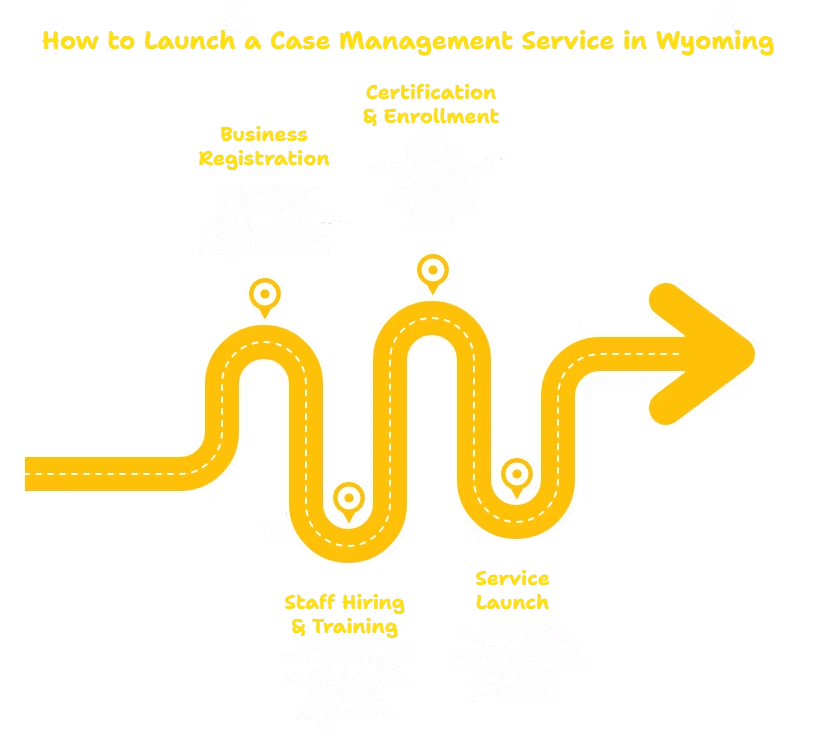
The transition from a business entity to an active Medicaid provider is a structured, multi-phase process that requires patience and meticulous documentation. The journey begins with business registration and proceeds to the formal application for certification through the DDD or the relevant division managing the target waiver. During this stage, prospective providers must prepare to submit staff credentials, detailed organizational policies, and proof of administrative competence.
The following sequence highlights the typical path toward active service delivery:
- Preparation: Register the business, obtain necessary tax IDs, and draft the mandatory Policy & Procedure Manual.
- Certification: Apply for certification as a case management agency through the appropriate Wyoming state division.
- Medicaid Enrollment: Enroll with Medicaid to enable the billing and reimbursement of waiver-based services.
- Staff Readiness: Ensure all staff members complete state-mandated training, orientations, and background checks.
- Activation: Begin accepting participant assignments once the provider is fully authorized and the state has processed the necessary billing credentials.
What Are the Essential Documentation and Staffing Standards?
Documentation is the backbone of audit readiness in the Wyoming HCBS system. Every interaction, assessment, and adjustment to an IPC must be recorded with precision. Case management agencies are required to maintain exhaustive records, including proof of monthly or quarterly contact, evidence of conflict-of-interest mitigation, and detailed satisfaction surveys. Failure to maintain these records in accordance with state guidelines can lead to service denials or the loss of provider certification.
Staffing also follows strict parameters, as the quality of care is directly tied to the competency of the individual case manager. Beyond educational credentials, staff must participate in ongoing training regarding the prevention of abuse, neglect, and exploitation. Because home visits are a standard feature of the role, staff must also be prepared with reliable transportation and a clear understanding of crisis intervention protocols. Continuous professional development, including policy refreshers and HIPAA updates, is required to maintain certification and ensure the safety of the participants served.
Frequently Asked Questions
Can a case management agency also provide direct services like personal care?
No. To ensure unbiased advocacy and avoid conflicts of interest, Wyoming regulations generally prohibit case management agencies from providing direct services to the same individuals they manage. The case manager must remain an independent voice focused on the participant’s needs.
What is the typical timeframe to launch a new case management agency?
The timeline varies based on the completeness of the documentation submitted, but the process generally spans several months. Business registration and manual development typically take 2–3 weeks, followed by 30–60 days for staff hiring and training, and 1–2 months for state certification and Medicaid enrollment.
Are case managers required to hold specific licenses in Wyoming?
While specific state licensure (such as an LCSW or RN) may be required depending on the nature of the tasks or the specific program, the foundational requirement for case managers is a bachelor’s degree in a human services or related field combined with specific state-mandated training on person-centered planning and HCBS policies.
Key Takeaway
Successful operation of a case management agency in Wyoming requires a balanced commitment to administrative rigor, regulatory compliance, and a person-centered approach to care. By meticulously following the established protocols set forth by the Wyoming Department of Health and maintaining audit-ready documentation, providers can effectively support the independence and safety of waiver participants while building a sustainable and compliant service organization.
Waiver Consulting Group (WCG) provides specialized assistance for human services professionals and agencies seeking to establish and optimize their case management operations in Wyoming. From the development of robust Policy & Procedure Manuals to the creation of essential IPC templates and audit-ready record-keeping systems, WCG supports the infrastructure needed to meet state-defined requirements and deliver high-quality care.
Last verified August 2024. This content is provided for informational purposes only and does not constitute legal or professional advice. Always consult directly with the Wyoming Department of Health and the relevant divisions for the most current rules, guidance, and regulatory updates.