CASE MANAGEMENT SERVICES PROVIDER IN WISCONSIN
By Fatumata Kaba · 2026-04-14 · 5 min read
Case management services in Wisconsin serve as the essential link between individuals with long-term care needs and the complex network of Medicaid Home and Community-Based Services (HCBS). These providers play a vital role in coordinating care plans, ensuring service continuity, and advocating for participant goals within programs such as the Children’s Long-Term Support (CLTS) Waiver, Family Care, and the IRIS program.
For organizations and independent practitioners aiming to enter this sector, success depends on a deep understanding of Wisconsin’s decentralized service model. This guide outlines the regulatory framework, enrollment requirements, and operational standards necessary to successfully launch and manage a case management agency within the state's Medicaid landscape.
How Does the Wisconsin Regulatory Hierarchy Impact Provider Operations?
The delivery of case management in Wisconsin is governed by a multi-layered hierarchy that determines how providers are credentialed and paid. At the top level, the Wisconsin Department of Health Services (DHS) establishes the universal standards for service scope, participant eligibility, and monitoring requirements. These regulations ensure that all Medicaid-funded services adhere to federal and state mandates regarding person-centered care and participant rights.
Beneath the DHS, specific oversight varies by program. ForwardHealth acts as the fiscal agent, processing provider enrollments and handling reimbursement for many programs, particularly those rooted in legacy waiver structures. Meanwhile, Managed Care Organizations (MCOs) and IRIS Consultant Agencies (ICAs) serve as the frontline for service coordination in programs like Family Care. In many instances, especially within the CLTS waiver, County Human Services Agencies maintain administrative control, often requiring providers to secure contracts directly with the county to deliver services to local participants.
What Are the Core Responsibilities of a Case Management Provider?
Case management is fundamentally about the development, implementation, and ongoing management of a participant’s Individualized Service Plan (ISP). Providers are responsible for translating the participant's long-term care goals into actionable steps, ensuring that both formal Medicaid services and informal community supports work in harmony to improve health outcomes and maintain community independence.
The daily execution of these responsibilities requires rigorous documentation and a proactive approach to risk management. Providers must maintain a robust framework for delivering the following essential functions:
- Conducting initial, annual, and change-in-condition assessments to identify unmet needs.
- Developing and updating Individualized Service Plans (ISPs) that reflect the participant’s specific goals and preferences.
- Coordinating service delivery between various community providers and monitoring the quality of care received.
- Maintaining comprehensive documentation, including service notes, incident reports, and compliance tracking.
- Engaging in crisis planning and risk mitigation to ensure participant safety and stability in the community.
- Supporting participant advocacy to ensure access to all entitled services and community resources.
What Steps Are Required to Establish a Compliant Provider Agency?
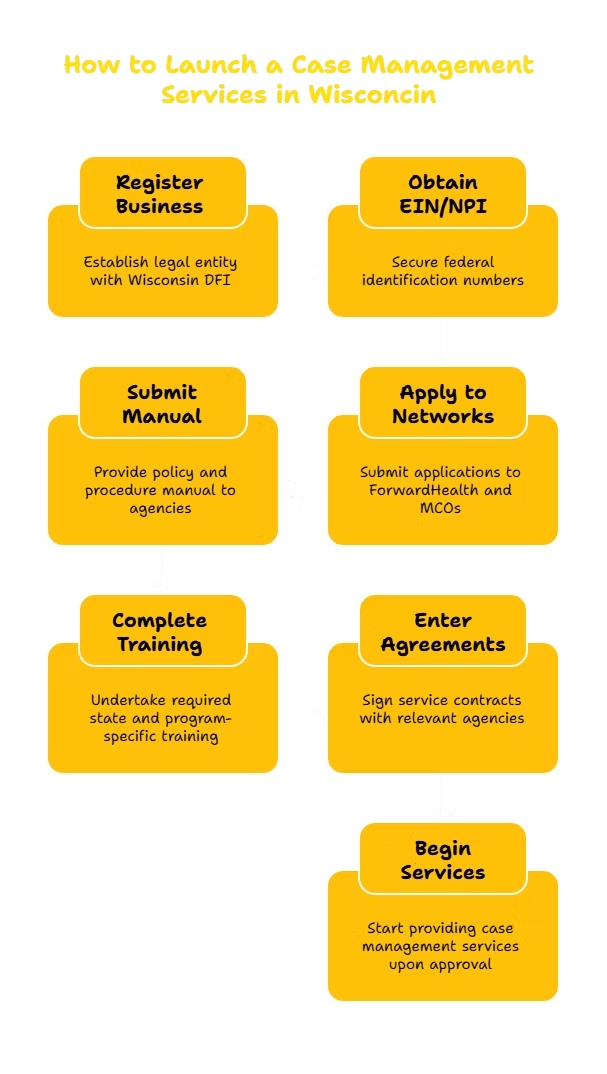
Launching a case management agency involves a transition from standard business registration to specialized Medicaid provider enrollment. Before engaging with the state, an entity must be properly formed under the Wisconsin Department of Financial Institutions (DFI) and possess a valid Federal Employer Identification Number (EIN) and a Type 2 National Provider Identifier (NPI). These foundational elements are the prerequisites for all subsequent state and county contracting.
Once the legal entity is established, the focus must shift to operational infrastructure. Developing a formal Case Management Services Policy & Procedure Manual is the most critical step for demonstrating compliance. This manual must explicitly outline how the agency will handle assessments, ISP updates, HIPAA-compliant record keeping, and conflict resolution. Agencies must also ensure that their internal staff credentialing processes, liability insurance coverage, and background check protocols meet or exceed the requirements set forth by the specific programs in which they intend to participate.
How Does the Enrollment Process Work Across Different Waiver Programs?
Provider enrollment is not a one-size-fits-all process in Wisconsin; it is highly dependent on whether you are seeking to provide services under a county contract, an MCO network, or directly through ForwardHealth. For CLTS and legacy waiver services, the path often involves a rigorous vetting process through local county offices, which may include the submission of a comprehensive provider proposal and an in-person interview or site visit.
For those targeting Managed Care Organizations or IRIS Consultant Agencies, the process involves meeting the specific credentialing standards of each private entity. While the foundational requirements—such as having a strong P&P manual and a team of qualified staff—remain the same, each MCO may have its own preferred documentation templates and submission protocols. It is essential to maintain an organized portfolio of your agency’s qualifications, including resumes for all staff, proof of insurance, and evidence of prior experience in human services, to expedite the contracting phase.
What Are the Staffing and Training Requirements for Case Managers?
The success of a case management agency rests on the qualifications of its staff. Wisconsin generally requires case managers and Support and Service Coordinators (SSCs) to possess at least a Bachelor’s degree in a relevant human services field, such as social work, psychology, or nursing. Beyond educational requirements, agencies must ensure their staff possess the soft skills necessary for person-centered planning, including effective communication, empathy, and a deep understanding of disability advocacy.
Staff development is a continuous obligation. Beyond initial onboarding, agencies must implement a tracking system for mandatory trainings, such as cultural competency, abuse and neglect prevention, and program-specific compliance updates. These training logs are often subject to audit by the DHS or contracted MCOs; therefore, maintaining meticulous records of staff certification, continuing education, and annual background checks is a non-negotiable operational requirement.
Frequently Asked Questions
How long does the provider enrollment process typically take?
The timeline varies significantly based on the program and county, but typically ranges from 1 to 3 months. This includes the time spent on business registration, the development of your internal P&P manual, staff credentialing, and the final review by the MCO or county agency.
Is a separate enrollment required for each Medicaid waiver program?
Yes. While some documentation overlaps, you generally must satisfy the individual contracting or enrollment requirements of each program, such as the CLTS waiver, Family Care, or the specific MCO networks you wish to serve.
What happens if our agency fails to meet documentation standards during a state audit?
Failure to meet documentation standards can lead to corrective action plans, recoupment of payments, or termination of provider agreements. Agencies must proactively audit their own records, including service notes and ISP revisions, to ensure they remain in full compliance with DHS standards at all times.
Key Takeaway: Establishing a successful case management agency in Wisconsin requires a disciplined approach to regulatory compliance, a commitment to person-centered documentation, and a clear understanding of the specific enrollment pathways required by counties, MCOs, and the Department of Health Services. By building a foundation on robust policies, transparent staff credentialing, and consistent service delivery, providers can navigate the complexities of Wisconsin’s Medicaid waiver programs while effectively supporting the independence and health outcomes of their participants.
Last verified: 2024. This information is intended for educational purposes only and does not constitute legal or professional advice. Always consult with the Wisconsin Department of Health Services (DHS) or a qualified consultant to ensure compliance with the most current state regulations and program requirements.