CASE MANAGEMENT SERVICES PROVIDER IN WASHINGTON
By Fatumata Kaba · 2026-04-06 · 5 min read
What Are Case Management Services in Washington State?
Case Management Services in Washington provide ongoing coordination, planning, and monitoring of services for individuals with disabilities, chronic conditions, or complex needs. As the central point of contact for Medicaid waiver participants, Apple Health members, and long-term services and supports (LTSS) recipients, case managers ensure that individuals receive appropriate care while achieving their person-centered goals. This coordination is essential for maintaining health, safety, and community integration for vulnerable populations.
These services are delivered under Home and Community-Based Services (HCBS) waivers administered by the Developmental Disabilities Administration (DDA) and the Aging and Long-Term Support Administration (ALTSA). Funding and reimbursement for these critical support activities are managed through the Washington State Health Care Authority (HCA) via the ProviderOne system, ensuring alignment with both federal Medicaid requirements and specific state-level mandates.
Which Agencies Govern Case Management in Washington?
Navigating the regulatory landscape for HCBS in Washington requires understanding the roles of three primary entities. Each agency maintains distinct oversight responsibilities for different waiver populations and billing requirements.
- Developmental Disabilities Administration (DDA): Responsible for overseeing case management services for individuals enrolled in DDA HCBS waivers, including the Basic Plus, Core, and Individual and Family Services (IFS) waivers.
- Aging and Long-Term Support Administration (ALTSA): Administers case management for elderly individuals and physically disabled adults participating in programs such as the Community Options Program Entry System (COPES), Medicaid Alternative Care (MAC), and Community First Choice (CFC).
- Health Care Authority (HCA): Acts as the state Medicaid agency that administers Apple Health and manages all provider reimbursement through the ProviderOne portal.
What Are the Core Responsibilities of a Case Management Provider?
Case management agencies function as the bridge between individuals and the support systems required for independent living. Providers must strictly adhere to regulations defined in WAC 388-825, WAC 388-106, or relevant DDA policies. The primary duties revolve around proactive planning, consistent monitoring, and robust documentation.
Core responsibilities include performing initial and ongoing assessments to determine support needs, followed by the development and monitoring of a Person-Centered Service Plan (PCSP). Beyond planning, providers must offer ongoing advocacy, coordinate referrals to healthcare, behavioral health, and housing services, and maintain active crisis planning and risk management protocols to ensure client safety.
- Initial and ongoing assessments to determine support needs
- Development and monitoring of the Person-Centered Service Plan (PCSP)
- Service coordination and referrals to healthcare, behavioral health, housing, and waiver supports
- Advocacy on behalf of the individual and family
- Crisis planning and risk management
- Quality assurance and follow-up
- Documentation of services and outcomes
How Do Providers Secure Enrollment and Licensing in Washington?
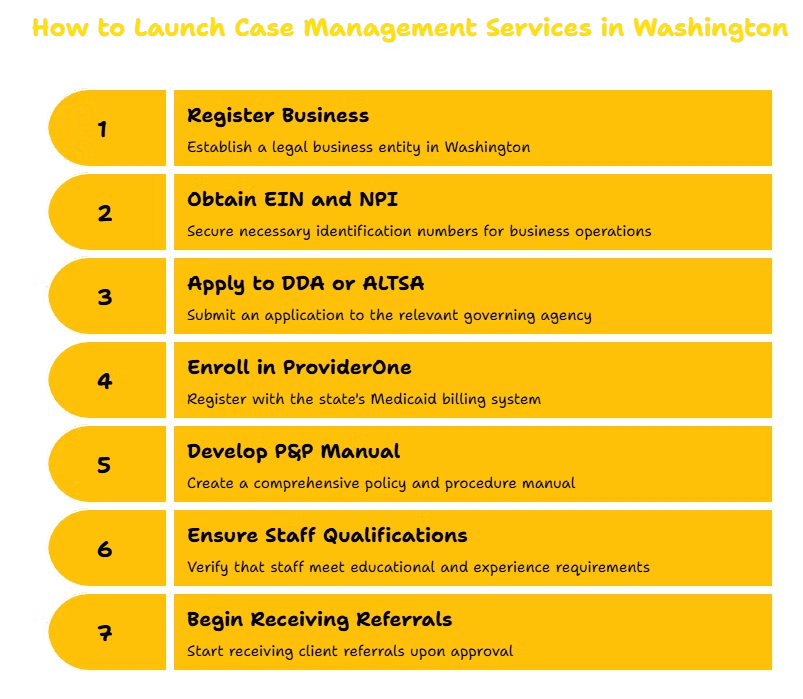
The journey to becoming a qualified case management agency involves a rigorous administrative process. Prospective agencies must first formalize their business structure through the Washington Secretary of State, obtain an Employer Identification Number (EIN), and secure a Type 2 National Provider Identifier (NPI). This foundational step is followed by formal application to either DDA or ALTSA, depending on the target population the agency intends to serve.
After the agency application is accepted, the provider must enroll in the ProviderOne system with the appropriate taxonomy code. Success in this phase requires the development and submission of a comprehensive Policy and Procedure Manual that demonstrates how the agency will handle intake, service authorization, HIPAA compliance, and staff training. Once the documentation is approved and staff have met all credentialing requirements, the agency becomes eligible to receive referrals from state case managers.
Staffing, Training, and Professional Standards
Washington state mandates specific qualifications for staff members to ensure high-quality care. A Case Manager or Service Coordinator must possess at least a bachelor’s degree in social work, human services, or a related field, along with a minimum of one year of experience working with individuals with disabilities or aging adults. Furthermore, they must demonstrate a thorough understanding of Medicaid, HCBS, and person-centered practices, often requiring completion of official DDA or ALTSA training modules.
Agency oversight is equally critical. A Program Supervisor or Lead Case Manager must be appointed to review documentation, ensure regulatory compliance, and provide ongoing staff supervision. All staff members are required to undergo comprehensive training, including HIPAA and client rights protection, abuse prevention and mandatory reporting protocols, and specialized training in the development and implementation of Person-Centered Service Plans.
Frequently Asked Questions
What is the typical timeline for launching a case management agency?
The launch process generally follows a 4-to-6-month trajectory. Business formation and credentialing usually take 2–4 weeks, while the DDA/ALTSA application and ProviderOne enrollment typically require 1–2 months. Developing the necessary P&P manuals and completing staff hiring and training adds another 30–60 days to the process.
What specific documentation must a provider maintain for compliance?
Providers must maintain comprehensive files including, but not limited to, Medicaid enrollment confirmation, the active DDA/ALTSA contract, and a robust P&P manual. Specific records must include PCSP development documents, monthly contact and monitoring logs, documentation of staff supervision, evidence of required continuing education, and formal grievance or incident report files.
Are case management services the same for all Medicaid waivers?
No, the specific requirements and populations vary. DDA waivers (Basic Plus, Core, IFS) focus on developmental disabilities, while ALTSA programs (COPES, CFC, MAC) focus on aging populations and physical disabilities. Additionally, some Apple Health MCOs may integrate care coordination differently, making it vital to confirm specific program mandates before service delivery.
Waiver Consulting Group’s Start-Up Assistance
Waiver Consulting Group provides comprehensive support for professionals and organizations launching Medicaid-eligible case management agencies. The scope of work includes Medicaid and DDA/ALTSA enrollment guidance, the creation of Policy & Procedure Manuals tailored to Washington state standards, and the development of essential templates for PCSPs and contact tracking. Assistance also covers staff credentialing and training documentation, ensuring that agencies are fully prepared to meet referral and service coordination workflows upon launch.
Key Takeaway: Success as a Washington case management provider requires strict adherence to state-specific regulations, proactive maintenance of documentation, and a deep commitment to person-centered service delivery models as defined by DDA, ALTSA, and the HCA.
Last verified: June 2024. This content is for informational purposes only and does not constitute legal or professional advice. Requirements for Medicaid providers are subject to change by state governing agencies; please consult the official DDA, ALTSA, and HCA websites for the most current regulatory guidance.