CASE MANAGEMENT SERVICES PROVIDER IN UTAH
By Fatumata Kaba · 2026-03-31 · 5 min read
Case Management Services in Utah serve as the essential administrative and clinical foundation for participants navigating the state’s Home and Community-Based Services (HCBS) waiver programs. By providing comprehensive planning, coordination, advocacy, and oversight, these providers ensure that individuals with disabilities receive the specific supports they need while remaining integrated within their local communities.
Operating as a Case Management provider in Utah requires strict adherence to both state and federal mandates, particularly regarding conflict-free service delivery. This guide outlines the regulatory framework, provider enrollment pathways, and operational requirements necessary to establish and maintain a compliant Case Management agency in the Utah HCBS ecosystem.
How Are Case Management Services Regulated in Utah?
Case management services are authorized under Utah’s 1915(c) HCBS waiver programs, which are administered by the Utah Department of Health and Human Services (DHHS). Within the DHHS, the Division of Services for People with Disabilities (DSPD) serves as the primary oversight body responsible for training, enrollment, monitoring, and quality assurance. This structure ensures that all services provided under the waiver adhere to state-specific quality standards and participant health and safety protocols.
Furthermore, providers must operate in alignment with Centers for Medicare & Medicaid Services (CMS) mandates. A core component of these federal regulations is the requirement for "conflict-free" case management. This prevents any inherent bias in the support planning process by prohibiting agencies that provide direct services—such as residential supports or day programs—from also providing case management to the same individuals. Maintaining this professional firewall is a prerequisite for all entities seeking to operate as a case management agency in the state.
What Are the Core Functions of a Case Management Provider?
The primary mandate of a Case Manager is to serve as the central point of contact for individuals, their families, and the broader healthcare team. By facilitating access to medical, behavioral, educational, and social services, the case manager ensures that the participant’s Individual Support Plan (ISP) is not just a document, but a living guide that evolves with the participant’s changing needs. This role is fundamental to maximizing the impact of waiver services and ensuring participant autonomy.
Specific responsibilities of the Case Management provider include:
- Conducting thorough needs assessments to identify service gaps and strengths.
- Developing, monitoring, and revising ISPs to ensure alignment with goals.
- Facilitating participant choice and promoting self-determination in all care decisions.
- Identifying and coordinating both waiver and community-based resources.
- Monitoring service quality, ensuring health and safety, and managing risk.
- Addressing systemic barriers to service access.
- Maintaining rigorous documentation, ensuring billing accuracy, and upholding compliance with waiver guidelines.
How Do You Navigate the Utah Provider Enrollment Process?
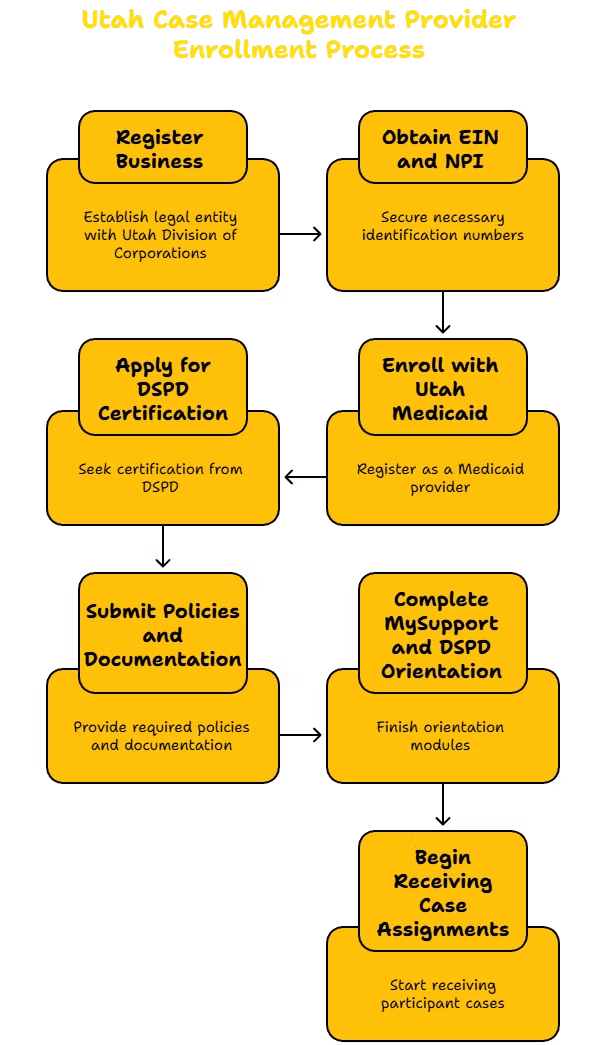
The path to becoming a certified Case Management provider involves a sequence of administrative steps focused on business entity establishment and regulatory qualification. Prospective providers must first formalize their business structure, secure an Employer Identification Number (EIN), and obtain a Type 2 National Provider Identifier (NPI). This foundational work ensures the agency is recognized as a legal entity capable of contracting with the state.
Once the business is legally established, the provider must enroll with Utah Medicaid as a case management provider. This is followed by a specific certification process through the DSPD. During this stage, applicants must demonstrate compliance with conflict-free policies, submit comprehensive documentation regarding their proposed service delivery models, and complete mandatory orientations, such as the MySupport training modules. Only after successfully completing these milestones can an agency begin the process of receiving participant case assignments.
What Documentation Is Required for Compliance and Audit Readiness?
Maintaining regulatory compliance is a continuous process that requires a robust internal documentation system. Because Case Management involves public funding and the oversight of vulnerable populations, agencies must maintain a comprehensive Policy and Procedure Manual. This manual serves as the operational blueprint for the agency and is often the first point of review during state audits.
Required documentation and policy framework elements include:
- Proof of business entity status, including Articles of Incorporation, EIN, and NPI.
- Signed Conflict-Free Assurance Attestations.
- Protocols for person-centered planning and participant rights.
- Standardized procedures for ISP development, regular review, and service revision.
- Specific forms for monthly monitoring, contact logs, and incident tracking.
- Established protocols for critical incident response and participant transition or discharge.
- Internal quality assurance logs and staff training documentation.
What Are the Staffing and Training Prerequisites?
The quality of case management is inherently tied to the expertise of the staff. Case Managers are generally required to hold a bachelor’s degree in a relevant field—such as social work, psychology, or nursing—along with documented experience in supporting individuals with disabilities. For agencies handling high volumes of complex cases, employing or contracting a Clinical Supervisor with a master’s degree or professional licensure in a human services field is highly recommended to provide necessary oversight.
Beyond formal education, all staff members must complete mandatory training modules to ensure service quality and legal compliance. These requirements typically include HIPAA compliance, Abuse, Neglect, and Exploitation Prevention (ANEP), Person-Centered Planning (PCP) methodology, and specific DSPD MySupport modules. Regular, ongoing training regarding emergency preparedness and evolving waiver updates is also essential for maintaining staff competency.
Frequently Asked Questions
Which Medicaid waiver programs require case management services?
Case management is a mandatory and reimbursable service across several key Utah programs, including the Community Supports Waiver (CSW), Acquired Brain Injury (ABI) Waiver, Physical Disabilities Waiver (PDW), Medically Complex Children’s Waiver (MCCW), and the New Choices Waiver (NCW) for individuals transitioning from institutional settings.
What is the typical timeline for launching a new agency?
The timeline varies based on organizational readiness, but generally, business formation and policy development take 1–2 months, Medicaid and DSPD enrollment takes 2–3 months, and staffing/training takes an additional 30–45 days. Service delivery commences once the agency is fully certified and participant cases are assigned.
How does conflict-free case management impact agency operations?
Conflict-free mandates mean that a Case Management provider cannot offer direct services like therapy, personal care, or residential supports to their own caseload. Agencies must focus exclusively on the planning, coordination, and monitoring aspects of care, ensuring the participant’s interests remain the sole priority without the risk of vested financial interest in specific service providers.
Key Takeaways
Establishing a Case Management agency in Utah requires a disciplined approach to regulatory compliance, meticulous documentation of participant care, and a firm commitment to the conflict-free model. By carefully navigating the requirements of the DHHS and DSPD, and ensuring that staff are well-trained in person-centered planning, agencies can build a sustainable and impactful operation that serves as a vital resource for participants navigating Utah’s HCBS landscape.
Last verified: 2024. This information is provided for educational purposes and does not constitute legal or professional consulting advice. Prospective providers should consult directly with the Utah Department of Health and Human Services (DHHS) and the Division of Services for People with Disabilities (DSPD) for the most current regulatory requirements and policy updates.