CASE MANAGEMENT SERVICES PROVIDER IN TEXAS
By Fatumata Kaba · 2026-03-30 · 5 min read
Case Management services, also referred to as Service Coordination, act as the foundational support system for Medicaid waiver participants in Texas. By bridging the gap between clinical needs, community resources, and long-term care goals, these providers ensure that individuals with disabilities and chronic conditions receive consistent, person-centered assistance in the most integrated settings possible.
Operating as a Case Management agency requires adherence to stringent state and federal regulations, particularly regarding conflict-free service delivery. This guide outlines the essential requirements, administrative pathways, and operational standards necessary for agencies looking to provide these vital services under Texas 1915(c) Home and Community-Based Services (HCBS) waivers.
How Does the Texas Regulatory Framework Function for Case Management?
In Texas, the administration of Medicaid waiver programs is managed by the Texas Health and Human Services Commission (HHSC). The HHSC serves as the primary regulatory body, establishing the rules, contract requirements, and oversight mechanisms for all providers, including those focused exclusively on case management and service coordination.
At the federal level, the Centers for Medicare & Medicaid Services (CMS) mandates that Texas waiver programs maintain high standards of clinical oversight and participant protection. A cornerstone of this federal requirement is "conflict-free case management." This mandate ensures that the entity responsible for coordinating a participant’s care does not have a financial interest in the direct services (such as residential care or therapy) provided to that same individual, preventing potential bias in service planning.
What Are the Key Activities of a Case Management Provider?
Case Management providers serve as the primary link between the participant and their care network. Their daily responsibilities revolve around advocacy, assessment, and meticulous documentation to ensure that every participant’s Individual Plan of Care (IPC) or Person-Directed Plan (PDP) remains aligned with their evolving needs and personal goals.
Core operational responsibilities include:
- Conducting comprehensive initial assessments and recurring reassessments.
- Developing and updating the IPC or PDP to reflect person-centered goals.
- Coordinating a diverse range of waiver and non-waiver services, including housing, employment, and behavioral health support.
- Monitoring participant health, safety, and overall satisfaction through consistent contact.
- Managing crises and responding to service interruptions to maintain continuity of care.
- Facilitating critical life transitions, such as moving from a hospital to home or transitioning from school to adult service systems.
- Ensuring all clinical and administrative documentation meets state audit standards.
How Do Agencies Meet Licensing and Enrollment Prerequisites?
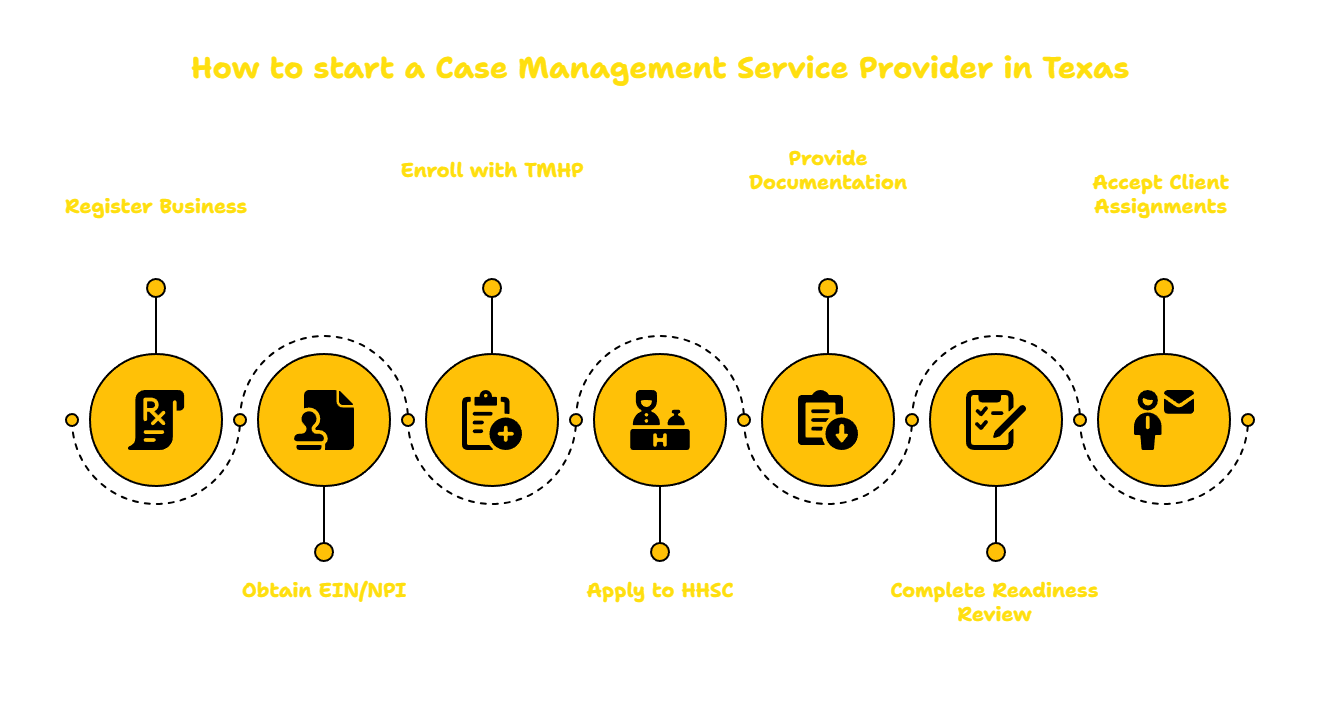
The path to becoming a recognized provider is a structured administrative process that begins with formal business entity registration. Prospective agencies must be registered with the Texas Secretary of State and secure both an Employer Identification Number (EIN) and a Type 2 National Provider Identifier (NPI) to be recognized within the healthcare system.
Following business formation, the agency must enroll as a Medicaid provider through the Texas Medicaid & Healthcare Partnership (TMHP). Once enrolled with TMHP, the agency must then apply for a formal contract with HHSC for specific waiver programs. This phase requires the submission of robust internal documentation, including a comprehensive Policy & Procedure Manual that details how the agency will handle HIPAA compliance, service authorization, incident reporting, and the maintenance of participant records.
What Are the Staffing and Training Expectations?
The quality of case management is heavily dependent on the qualifications and training of the staff. Generally, a Service Coordinator or Case Manager must hold a bachelor’s degree in a human services field, such as social work, psychology, or health, and demonstrate professional experience in coordinating disability services. For certain waiver programs, HHSC may require oversight from a Clinical Supervisor, which often necessitates advanced professional licensure, such as an LMSW or LPC.
Beyond baseline qualifications, agencies must implement a rigorous training program for all staff members. This curriculum must cover:
- HHSC-specific waiver program protocols.
- Person-centered planning methodologies and Medicaid documentation accuracy.
- Mandatory training in HIPAA, participant rights, and abuse prevention.
- Standardized emergency planning and risk mitigation strategies.
- Ongoing quality monitoring techniques to track participant outcomes effectively.
Which Medicaid Waiver Programs Include These Services?
Case management services are essential across several distinct Texas Medicaid waiver programs. Each program caters to specific populations, ranging from children with medical dependencies to adults with complex intellectual or developmental disabilities. Understanding these programs is critical for any agency seeking to contract with the state.
Primary programs requiring robust case management include:
- CLASS (Community Living Assistance & Support Services)
- HCS (Home and Community-Based Services)
- TxHmL (Texas Home Living)
- DBMD (Deaf Blind with Multiple Disabilities)
- MDCP (Medically Dependent Children Program)
- YES Waiver (Youth Empowerment Services)
Frequently Asked Questions
How long does the provider enrollment process typically take?
The timeline varies based on the agency's preparedness, but the process is generally divided into phases. Business formation and manual creation typically take 1–2 months, while TMHP enrollment and the HHSC contract application usually require 2–3 months. Subsequent staff onboarding and readiness reviews may add an additional 30–60 days before the agency is cleared to accept participant assignments.
What does "conflict-free" status mean for my agency?
Conflict-free status is a federal requirement ensuring that an agency providing case management services does not also provide direct services (like home health or residential support) to the same participant. This separation prevents potential conflicts of interest, ensuring that the care coordinator’s primary obligation is to advocate for the participant’s needs rather than the agency’s business interests.
What is the role of the Policy & Procedure Manual?
The Policy & Procedure Manual is the foundational document for your agency. It must detail your protocols for person-centered assessments, contact schedules, incident reporting, risk identification, and audit readiness. HHSC reviews this manual to confirm that your agency has the administrative infrastructure to protect participant health and safety according to state standards.
Key Takeaway
Successfully establishing a Case Management agency in Texas requires meticulous alignment with HHSC and TMHP requirements, a deep commitment to person-centered planning, and strict adherence to conflict-free service delivery models. By prioritizing comprehensive policy development, professional staff training, and rigorous documentation standards, new providers can ensure they remain compliant and effective in supporting the diverse needs of Texas Medicaid waiver participants.
Last verified: October 2023. Disclaimer: This article is for informational purposes only and does not constitute legal or professional advice. Requirements for Medicaid waiver programs are subject to change; always refer to official Texas Health and Human Services Commission (HHSC) and Centers for Medicare & Medicaid Services (CMS) publications for the most current regulatory guidelines.