CASE MANAGEMENT SERVICES PROVIDER IN TENNESSEE
By Fatumata Kaba · 2025-10-22 · 6 min read
Understanding the Role of Case Management Services in Tennessee
Case Management Services in Tennessee function as the backbone of Medicaid home and community-based services (HCBS), providing the essential link between vulnerable individuals and the support systems they require to remain integrated within their communities. These services, often referred to as Support Coordination, are designed to empower participants with intellectual, developmental, and medical needs by facilitating personalized access to resources, clinical supports, and community integration. By acting as advocates, case managers ensure that every aspect of a participant's care is meticulously planned, monitored, and adjusted to meet their evolving needs.
The provision of these services is strictly governed by a regulatory framework established by TennCare (Tennessee Medicaid), the Department of Intellectual and Developmental Disabilities (DIDD), and the Centers for Medicare & Medicaid Services (CMS). Agencies operating within this sector must strictly adhere to conflict-free case management principles, ensuring that their role remains focused on objective advocacy and service coordination rather than the direct delivery of other HCBS services. Maintaining compliance with these state and federal mandates is not only a requirement for reimbursement but is fundamental to upholding the rights and safety of the individuals receiving support under the ECF CHOICES and 1915(c) waiver programs.
How Are Case Management Agencies Regulated and Governed?
The regulatory landscape for Case Management in Tennessee involves a multi-tiered oversight system. TennCare, as the state’s Medicaid agency, sets the overarching performance standards and oversees the reimbursement mechanisms that sustain these services. Their role ensures that public funds are utilized effectively and that providers are held accountable for delivering high-quality, person-centered coordination. Concurrently, the Department of Intellectual and Developmental Disabilities (DIDD) serves as the primary entity for approving and monitoring Support Coordinators and Case Management agencies involved in specific waiver programs such as ECF CHOICES and the 1915(c) waivers.
At the federal level, the Centers for Medicare & Medicaid Services (CMS) establishes the foundational regulations that all states must follow, particularly regarding participant rights and the necessity of conflict-free care coordination. These agencies work in tandem to ensure that the following core functions are maintained across all provider organizations:
- Comprehensive needs assessments to determine the appropriate level of care.
- The development and maintenance of the Individual Support Plan (ISP) to reflect the participant's goals.
- Continuous monitoring of service delivery and ongoing assessment of participant satisfaction.
- Coordination of crisis and incident response to protect participant health and safety.
- Transition planning to assist individuals moving between school, hospitals, or institutional settings and the community.
- Resource linkage to bridge gaps in housing, employment, specialized therapy, and transportation.
What Are the Prerequisites for Licensing and Provider Enrollment?
Launching a case management agency in Tennessee requires a structured approach to legal and operational compliance. Prospective providers must first establish a formal business entity registered with the Tennessee Secretary of State and secure necessary identifiers, including an Employer Identification Number (EIN) and a Type 2 National Provider Identifier (NPI). This foundational step is followed by the formal enrollment process with TennCare and/or DIDD, which evaluates the applicant's capacity to serve the target population safely and effectively.
Beyond the basic business requirements, agencies must demonstrate a commitment to operational integrity. A critical element of this is the development of a comprehensive Case Management Services Policy & Procedure Manual, which must detail how the organization manages sensitive health information, internal quality control, and compliance with Medicaid standards. Agencies must also prove their conflict-free status, verifying that they do not deliver direct HCBS services to the same individuals they support through case management. This separation of duties is a cornerstone of Tennessee’s regulatory approach to protecting participant independence.
What Is the Typical Timeline for Launching an Agency?
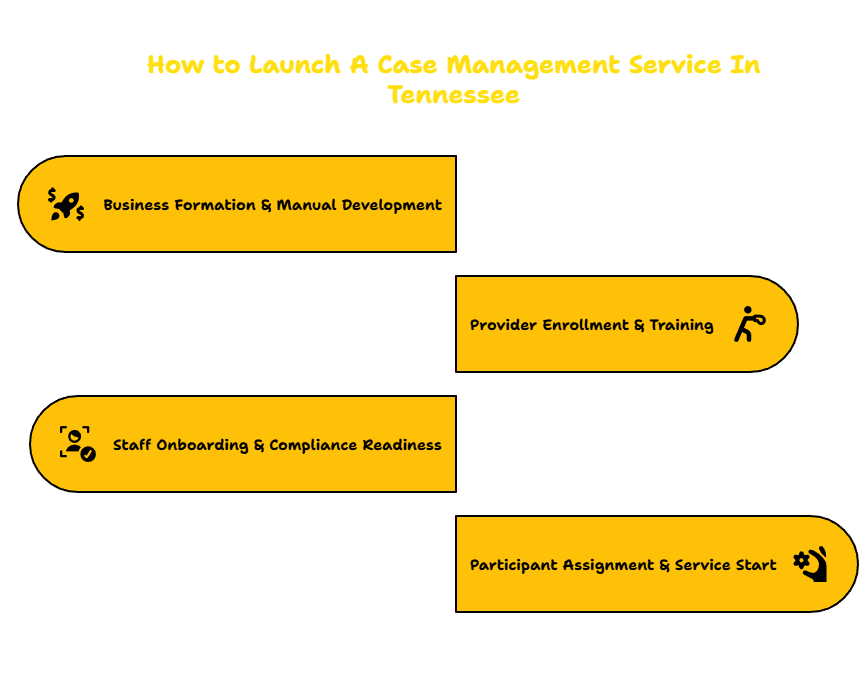
The path from conceptualization to receiving the first participant referral is a multi-phase endeavor that typically spans several months. The initial phase involves business formation and the creation of essential governing documents, which generally requires one to two months. During this period, the focus is on drafting policy manuals and establishing the infrastructure necessary for data security and HIPAA compliance. Once the foundational documents are prepared, the provider enters the enrollment and training phase, which typically takes two to three months as the agency navigates the specific application requirements of DIDD or TennCare.
Following successful enrollment, the agency must dedicate 30 to 60 days to staff onboarding and readiness verification. This ensures that every team member is fully trained in ISP protocols, incident management, and person-centered planning before interacting with participants. The final phase, which leads to the commencement of services, occurs upon the official approval of ISPs and the receipt of service authorizations from the relevant oversight bodies. Throughout this timeline, strict adherence to state-prescribed protocols is mandatory to ensure a smooth transition to an operational state.
How Do You Meet Staffing and Documentation Standards?
Staffing requirements are rigorous to ensure that case managers and support coordinators are well-equipped to handle the complex needs of the individuals they serve. Typically, a case manager is required to hold a bachelor’s or master’s degree in social work, psychology, or a related field, with a preference for prior experience in HCBS or behavioral health. For agencies looking to provide high-level clinical oversight, the inclusion of a master’s-level clinical supervisor, such as an LCSW or LPC, is highly recommended to guide plan development and monitor outcomes.
Documentation is the primary vehicle for proving compliance and ensuring quality of care. Agencies are expected to maintain comprehensive records for every participant, including detailed progress notes, visit logs, and periodic monitoring forms. Furthermore, the agency's Policy & Procedure Manual must explicitly cover the following areas to meet audit standards:
- Assessment tools and standardized eligibility documentation.
- Protocols for ISP development and ongoing planning.
- Procedures for crisis planning and proactive risk mitigation.
- Clear grievance procedures and informed consent documentation for participants.
- Incident reporting mechanisms and quality improvement loops.
Frequently Asked Questions
What is the difference between ECF CHOICES and 1915(c) waivers?
ECF CHOICES is specifically tailored for individuals with intellectual and developmental disabilities who require person-centered service coordination in a community setting. 1915(c) waivers are a broader category of Medicaid programs that provide targeted case management as a critical component for individuals requiring various home and community-based services to avoid institutionalization.
Is clinical supervision mandatory for all case management agencies?
While the specific requirements may vary by the program or contract, the use of a master’s-level clinical supervisor is a recommended best practice. These professionals provide essential guidance and oversight for complex cases, ensuring that the services provided are both clinically sound and fully aligned with the participant’s evolving needs.
How does an agency ensure conflict-free case management?
Conflict-free case management is ensured by maintaining a strict separation between the agency providing the support coordination and any agency providing direct HCBS services. Providers must demonstrate that their operational structure prevents any financial or organizational bias, ensuring that the case manager’s sole loyalty is to the participant’s best interest during service planning.
Key Takeaway
Successfully operating as a Case Management Services Provider in Tennessee requires a rigorous adherence to the regulatory standards set by TennCare and the Department of Intellectual and Developmental Disabilities. From obtaining the correct NPI and business registration to developing robust, compliant policy manuals and training staff in person-centered planning, the process demands precise attention to detail and a commitment to protecting participant rights. By following the established state and federal guidelines, agencies can effectively navigate the enrollment process and contribute to the vital support network that enables participants to thrive in their communities.
Last verified: September 2024. This information is intended for educational purposes for prospective and current Medicaid providers and does not constitute legal or professional advice. Always refer to the official TennCare, DIDD, and CMS websites for the most current policy updates and state regulations.