CASE MANAGEMENT SERVICES PROVIDER IN SOUTH DAKOTA
By Fatumata Kaba · 2025-10-15 · 5 min read
GUIDING INDIVIDUALS AND FAMILIES THROUGH PERSONALIZED CARE COORDINATION, GOAL PLANNING, AND COMMUNITY SUPPORT ACCESS
Case management services in South Dakota serve as a vital link for individuals with disabilities and complex medical needs, ensuring they successfully navigate their support systems and maintain stability in community settings. As a provider, your role involves acting as a key liaison between participants, service providers, and state agencies, ensuring that all care coordination aligns with both the individual’s personal goals and strict Medicaid regulatory requirements.
These professional services are authorized under key state programs, including the CHOICES Waiver, the Family Support 360 (FS360) Waiver, the Medically Fragile Waiver, and various Long-Term Services and Supports (LTSS) initiatives. By facilitating person-centered planning, case managers empower participants to access necessary medical, behavioral, and community resources, ultimately promoting independence and improved health outcomes across the state.
Who Governs and Oversees Case Management Services in South Dakota?
The regulatory framework for case management in South Dakota is divided between two primary state agencies, both of which operate under the federal oversight of the Centers for Medicare & Medicaid Services (CMS). CMS sets the baseline for person-centered planning, documentation integrity, and the overall management of Home and Community-Based Services (HCBS), requiring providers to strictly adhere to federal quality standards.
The South Dakota Department of Human Services (DHS), specifically the Division of Developmental Disabilities (DDD), serves as the primary governing body for waiver-based case management, particularly for the CHOICES and FS360 programs. Simultaneously, the South Dakota Department of Social Services (DSS), through its Division of LTSS, manages oversight for older adults and individuals categorized as medically fragile. Understanding the specific jurisdiction of these agencies is the first step toward achieving compliance and maintaining long-term authorization.
What Are the Core Responsibilities of a Case Management Provider?
Case management is a highly structured, targeted support service that focuses on the continuous lifecycle of a participant’s care. Beyond simple administrative tasks, providers are tasked with active monitoring, advocacy, and clinical-style planning. You are expected to serve as the primary navigator for a participant's support team, ensuring that every service authorized is both necessary and effective for the individual’s unique circumstances.
Core responsibilities include the following:
- Performing initial assessments and mandatory periodic reassessments.
- Developing, implementing, and regularly updating the Individualized Service Plan (ISP).
- Submitting service authorization requests and tracking utilization.
- Facilitating referrals and direct linkages to medical, behavioral, and community-based services.
- Executing crisis prevention and intervention planning to ensure participant safety.
- Maintaining robust documentation, progress tracking, and facilitating interdisciplinary team meetings.
How Do Agencies Obtain Licensing and Provider Approval?
Becoming an approved Medicaid case management provider in South Dakota requires a systematic approach to business and clinical readiness. Before an agency can accept its first referral, it must meet several foundational requirements, starting with the formal registration of the business entity with the South Dakota Secretary of State and the acquisition of a federal Employer Identification Number (EIN) and a Type 2 National Provider Identifier (NPI).
Beyond these business prerequisites, applicants must demonstrate operational readiness to the DHS-DDD or the DSS. This includes developing a comprehensive Case Management Services Policy & Procedure Manual that covers every aspect of service delivery, from intake procedures to critical incident reporting. Agencies must also provide proof of adequate liability and professional insurance coverage, as well as evidence that their staff meet all specific education and experience requirements established by the state.
What Are the Requirements for Staffing and Training?
The quality of service delivery is directly tied to the qualifications of the case managers employed by the agency. Generally, a case manager or service coordinator must hold at least a bachelor’s degree in a human services or related field. Furthermore, they are typically required to have a minimum of one year of experience working with disability services, though this requirement may fluctuate depending on the specific program or waiver being serviced.
In addition to educational credentials, all staff members must pass rigorous background checks and hold a valid driver’s license. Once hired, staff must complete comprehensive training programs before engaging with participants. This includes mandatory instruction on person-centered planning, HIPAA regulations, participant confidentiality, and Medicaid-specific billing and documentation procedures. Ongoing professional development, including annual training refreshers and quality assurance reviews, is essential to remain in good standing with state regulators.
What Is the Typical Timeline for Launching Operations?
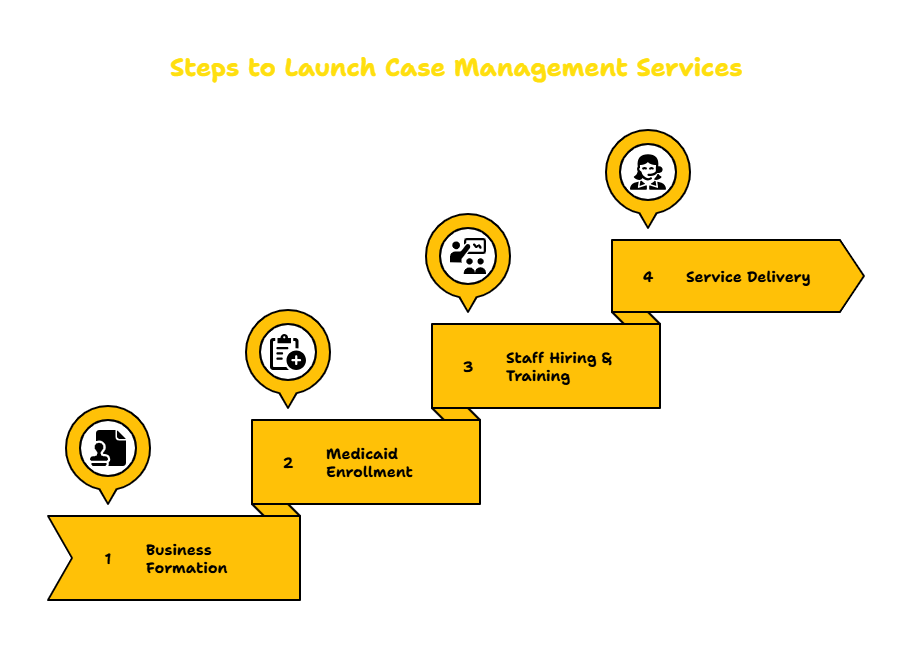
Launching a case management agency in South Dakota is a deliberate process that typically spans several months. The first phase, focused on business formation, obtaining tax documentation, and securing initial staffing, usually requires 1 to 2 months. This period is critical for setting the structural foundation of your agency, ensuring that your organization is legally and administratively prepared for state-level scrutiny.
The subsequent phases involve the following:
- Medicaid Provider Enrollment & Manual Development: 2–3 months.
- Case Manager Hiring & Training: 30–60 days.
- Service Delivery Commencement: Occurs only after final provider approval and the receipt of official service referrals.
Adhering to this timeline is critical, as shortcuts in policy development or staff training can lead to significant delays in the state’s provider enrollment process.
Frequently Asked Questions
Can one agency provide case management for both CHOICES and LTSS?
Yes, providers may seek enrollment for multiple programs. However, because each program falls under different departmental oversight—DHS-DDD for CHOICES/FS360 and DSS for LTSS—agencies must ensure they meet the specific documentation and enrollment criteria for each division.
What is the most critical component of the Policy & Procedure Manual?
While all sections are vital, state auditors place significant emphasis on the procedures for person-centered planning, critical incident reporting, and HIPAA compliance. Your manual must clearly define how you document these processes to ensure they remain consistent with state and federal standards.
Are there ongoing monitoring requirements for providers?
Yes, the state performs periodic audits and compliance readiness reviews. Providers are expected to maintain meticulous records of all participant interactions, ISP revisions, and team meeting documentation, as these are the primary items reviewed during quality assurance checks.
Waiver Consulting Group provides specialized assistance for agencies navigating the South Dakota Medicaid waiver landscape. Services include support with Medicaid enrollment for CHOICES, FS360, and LTSS, the development of comprehensive Policy & Procedure Manuals, and the creation of compliant ISP templates and staff orientation guides. These services are designed to help agencies launch and maintain person-centered operations that align with state-specific requirements.
Key takeaway: Success as a case management provider in South Dakota requires a deep understanding of the division between DHS and DSS oversight, a commitment to rigorous documentation, and a focus on maintaining high-quality, person-centered services through well-trained staff.
Last verified: October 2023. This information is intended for educational purposes only and does not constitute legal or professional advice. Always verify current state regulations directly with the South Dakota Department of Human Services or the Department of Social Services before making business decisions.