CASE MANAGEMENT SERVICES PROVIDER IN SOUTH CAROLINA
By Fatumata Kaba · 2025-10-13 · 5 min read
Case Management services in South Carolina represent the backbone of the Medicaid Home and Community-Based Services (HCBS) framework, ensuring that vulnerable populations receive coordinated, person-centered support. Becoming a provider in this space requires navigating rigorous regulatory standards established by the South Carolina Department of Health and Human Services (SCDHHS) and the Department of Disabilities and Special Needs (DDSN) to deliver essential assessment, advocacy, and monitoring functions.
Understanding the Role of Case Management in South Carolina Medicaid
Case Management—often referred to as Service Coordination or Support Coordination—is a professional service designed to assist Medicaid beneficiaries in accessing the medical, social, educational, and other services they require to live safely and independently in the community. By functioning as the primary point of contact, a Case Manager ensures that the various threads of a participant's care plan are woven together effectively, preventing service fragmentation and ensuring that the participant’s unique needs are met.
The scope of this role encompasses far more than simple scheduling; it involves comprehensive needs assessments, the development of individualized service plans (ISPs), and ongoing monitoring to ensure service delivery aligns with state and federal regulations. For provider agencies, this means maintaining a deep understanding of the regulatory landscape mandated by the Centers for Medicare & Medicaid Services (CMS), particularly regarding conflict-free case management principles that protect participant autonomy.
Who are the Governing Agencies and What Do They Require?
Operating a case management agency in South Carolina requires compliance with multiple governing entities. The South Carolina Department of Health and Human Services (SCDHHS) serves as the primary Medicaid agency, responsible for defining provider qualifications, managing waiver programs, and handling reimbursements. Simultaneously, the Department of Disabilities and Special Needs (DDSN) provides critical oversight for service coordination specifically related to individuals with intellectual and developmental disabilities (IDD), ensuring that the quality of care remains high and consistent with state policy.
In addition to these state-level bodies, providers must remain aligned with federal guidelines set forth by the Centers for Medicare & Medicaid Services (CMS). CMS mandates that case management services prioritize participant-directed planning and remain free from conflicts of interest, meaning that those who manage a participant’s care must remain distinct from those who provide direct service delivery, whenever required by the specific waiver type.
Developing the Infrastructure for a Case Management Agency
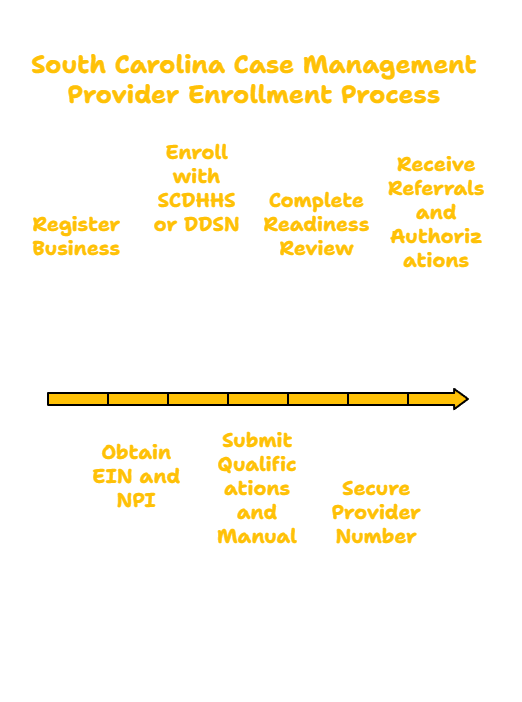
Before an agency can begin receiving referrals, it must establish a robust operational foundation. This begins with standard business registration through the South Carolina Secretary of State, followed by the procurement of an Employer Identification Number (EIN) and a Type 2 National Provider Identifier (NPI). These are the prerequisites for any entity seeking to engage in the Medicaid billing ecosystem.
Beyond basic business licensing, a prospective provider must develop a comprehensive Policy & Procedure Manual. This document is the cornerstone of your operational compliance and must explicitly detail how the agency handles intake, person-centered planning, documentation, HIPAA compliance, and critical incident reporting. Agencies are often evaluated on the quality and completeness of these documents during the enrollment review process.
- Intake and Assessment: Protocols for evaluating participant strengths, social determinants of health, and medical or behavioral requirements.
- Service Planning: Guidelines for creating ISPs that reflect the participant’s personal goals and documented needs.
- Documentation Standards: Requirements for maintaining clinical notes, contact logs, and evidence of service delivery.
- Compliance and Risk Management: Procedures for managing HIPAA regulations, participant rights, and the mandatory reporting of critical incidents.
Navigating the Provider Enrollment Process
The enrollment journey is a multi-step process that requires patience and meticulous attention to detail. Initially, an organization must secure its administrative credentials, including liability insurance, before applying through the appropriate portal. For agencies focusing on the IDD population, the DDSN Provider Portal is the primary point of entry, while other waiver programs are managed through the broader SCDHHS systems.
Once an application is submitted, the agency will undergo a review of its internal policies, staff qualifications, and sample service plans. This phase often involves a readiness review where regulators verify that the agency is prepared to manage caseloads effectively. Following successful verification, the agency is assigned a provider number, which unlocks the ability to receive referrals from waiver program leads and submit claims for authorized services.
Staffing and Professional Competency Standards
The efficacy of your agency rests entirely on the quality of your Case Managers. Because this role requires high levels of clinical judgment and interpersonal skill, South Carolina mandates specific educational and experiential benchmarks. Generally, a Case Manager must hold a bachelor’s degree in a human services field, such as psychology, social work, or counseling, and demonstrate experience in working with the specific Medicaid-eligible populations they intend to serve.
Furthermore, all personnel—including any clinical supervisors tasked with quality assurance—must undergo rigorous training. This includes foundational knowledge of person-centered planning, Medicaid billing compliance, and confidentiality requirements. Because documentation is the primary evidence of care, training on accurate, timely, and compliant contact logging is essential to prevent audit failures and ensure consistent revenue cycle management.
Frequently Asked Questions
What is the difference between Case Management and Service Coordination in South Carolina?
While the terms are often used interchangeably, "Service Coordination" is the specific terminology frequently utilized within the DDSN system for individuals with intellectual and developmental disabilities, whereas "Case Management" is the broader term often applied to other Medicaid waiver populations and aging services. Both roles involve the same fundamental tasks of assessing needs, linking to services, and monitoring progress.
What is the purpose of the Case Management Policy & Procedure Manual?
The manual acts as the governing document for your agency's operations. It is a mandatory submission for state enrollment that proves to regulators that you have established processes for every aspect of care, from initial intake and assessment to crisis intervention and the reporting of critical incidents, ensuring that every employee adheres to a uniform standard of care.
How does conflict-free case management affect my agency?
Conflict-free case management is a federal requirement designed to ensure that the individual assessing a participant's needs and creating their plan is not also the individual or agency profiting from providing the direct services outlined in that plan. This separation ensures the participant's interests remain the primary driver of service decisions.
Key Takeaway
Establishing a successful Case Management agency in South Carolina is a significant professional undertaking that requires strict adherence to the regulatory mandates set by SCDHHS and DDSN. By prioritizing robust policy development, rigorous staff training, and a participant-centered philosophy, new providers can build a sustainable organization capable of delivering high-quality advocacy and support to South Carolina’s most vulnerable citizens.
Waiver Consulting Group (WCG) provides comprehensive start-up assistance for agencies seeking to enter the South Carolina Medicaid market. Our scope of work includes support for Medicaid and DDSN provider enrollment, the development of customized Policy & Procedure Manuals, creation of intake and person-centered planning forms, and the establishment of quality assurance, documentation, and billing compliance systems.
Last verified: October 2023. Disclaimer: This article is for informational purposes only and does not constitute legal or professional medical advice. Always refer to the official South Carolina Department of Health and Human Services (SCDHHS) and Department of Disabilities and Special Needs (DDSN) provider manuals and communications for the most current regulatory requirements.