CASE MANAGEMENT SERVICES PROVIDER IN RHODE ISLAND
By Fatumata Kaba · 2025-10-09 · 6 min read
Coordinating Individualized Care Plans, Supports, and Resources to Promote Holistic Well-being and Independent Living.
Case Management Services in Rhode Island serve as the essential connective tissue between Medicaid-funded supports and the individuals who rely on them to maintain health, independence, and community integration. As a Medicaid-funded service, case management facilitates access to a complex array of medical, behavioral, and social services, ensuring that participants—particularly those with disabilities, chronic illnesses, or aging-related needs—receive care that is strictly person-centered and aligned with their unique goals. These services are authorized and operationalized through key federal and state structures, including the 1115 Global Waiver, BHDDH Developmental Disability (DD) Waivers, the Katie Beckett/TEFRA program, and various Medicaid State Plan provisions.
What Are the Governing Bodies and Their Regulatory Roles?
Navigating the Rhode Island healthcare landscape requires a clear understanding of the hierarchy of oversight. The Rhode Island Executive Office of Health and Human Services (EOHHS) serves as the primary Medicaid agency, holding the responsibility for overarching policy, provider enrollment, and the maintenance of service delivery standards across the state’s Medicaid landscape.
Specific populations are further governed by specialized departments. The Department of Behavioral Healthcare, Developmental Disabilities & Hospitals (BHDDH) is the central authority for approving and monitoring case managers who support individuals with developmental disabilities. Meanwhile, the Rhode Island Department of Health (RIDOH) may provide additional regulatory oversight for case managers operating in clinical or medical capacities, such as Registered Nurse (RN) case managers. At the federal level, the Centers for Medicare & Medicaid Services (CMS) establishes the foundational requirements that states must follow to receive federal matching funds for Home and Community-Based Services (HCBS) waiver programs.
What Is the Scope of Case Management Service Delivery?
Case management is designed to be a participant-directed service that builds robust support systems. A qualified case manager acts as a navigator, assisting individuals in the assessment of their needs, the creation of comprehensive care teams, and the ongoing monitoring of services to ensure that supports remain effective as a participant’s needs evolve. This role spans across multiple critical domains, including housing, employment, medical care, and mental health services.
Providers authorized to deliver these services generally engage in the following core activities:
- Assessment & Planning: Conducting comprehensive person-centered assessments to inform the development of Individualized Service Plans (ISPs).
- Referral Coordination: Linking participants to necessary community supports, medical specialists, and mental health resources.
- Care Monitoring: Periodically reviewing service delivery to verify that it meets the criteria established in the ISP.
- Service Authorization: Preparing and submitting essential documentation to state agencies to secure approval for specific waiver-funded supports.
- Crisis & Risk Management: Proactively identifying health or safety risks and facilitating immediate interventions when crises occur.
- Documentation: Maintaining rigorous records, including visit logs, quarterly progress reviews, and incident reports.
How Do Agencies Meet Licensing and Provider Approval Requirements?
Launching a case management agency in Rhode Island involves a multi-step compliance process. Before an agency can begin billing for services, it must satisfy specific foundational requirements, starting with business entity registration through the Rhode Island Secretary of State. Once the business is established, it must secure an Employer Identification Number (EIN) and a Type 2 National Provider Identifier (NPI) for organizational billing.
The provider must then formally enroll with the EOHHS through their designated portal. If the agency intends to serve the intellectual and developmental disabilities (IDD) population, they must also complete the specialized provider qualification process through BHDDH. A critical component of this phase is the development of a comprehensive Case Management Services Policy & Procedure Manual. This internal document must detail the agency's methodology for person-centered planning, clinical compliance, and documentation protocols, ensuring that all operations align with state and federal regulations.
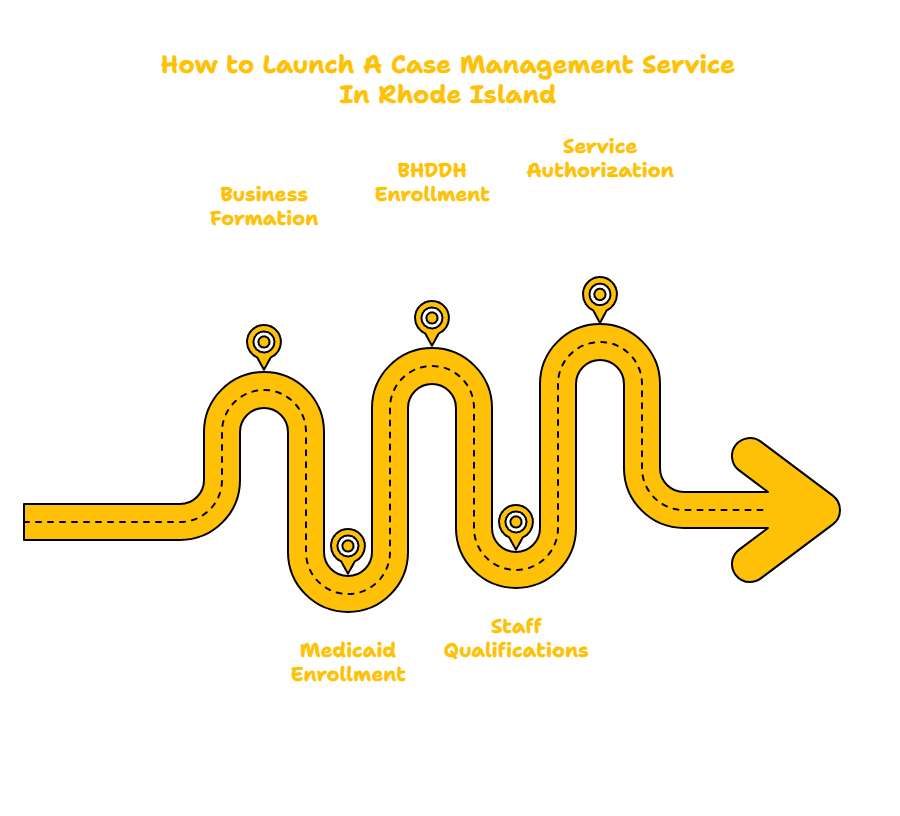
What Does the Provider Enrollment and Staffing Pathway Look Like?
The provider enrollment journey is a sequenced effort that demands meticulous attention to detail. Initially, an agency must form its business entity and secure necessary identifiers (EIN/NPI). Following this, the agency submits its Medicaid provider application to EOHHS. Agencies serving the IDD population follow an additional, distinct application track through BHDDH. Throughout this process, the agency will be required to submit staff qualification documents, detailed service models, and examples of care plans to demonstrate organizational competency.
Staffing requirements are equally stringent to ensure high-quality care. A standard Case Manager generally must hold a degree in human services, social work, or a related clinical field. If the agency serves participants with complex medical needs, an RN case manager with an active Rhode Island license is often required. Oversight is provided by a Case Management Supervisor or Program Director who manages the quality assurance and compliance aspects of the practice. Furthermore, all staff must undergo training in HIPAA compliance, abuse prevention, crisis de-escalation, cultural competence, and the nuances of the HCBS Settings Rule.
Which Medicaid Waiver Programs Authorize Case Management?
Case management services in Rhode Island are not a singular offering but are instead authorized across several specific Medicaid pathways. The 1115 Global Waiver (HCBS) covers a broad range of individuals requiring long-term support to remain in their homes rather than institutional settings. The BHDDH DD Waivers offer a more intensive level of case management specifically tailored to the needs of adults living with intellectual or developmental disabilities.
For children, the Katie Beckett/TEFRA program provides a specialized channel for case coordination for those with significant medical or developmental needs. Additionally, the Medicaid State Plan provides for specific medical case management services, such as those related to hospital discharges or disease management. Understanding which program applies to a participant is essential for ensuring that service delivery and billing practices remain within the allowed scope of the specific waiver or state plan.
Frequently Asked Questions
What is the typical timeline for launching a case management agency?
The timeline generally spans several months. Business formation and the creation of a comprehensive Policy & Procedure Manual typically take 1–2 months, followed by 2–3 months for Medicaid and BHDDH enrollment. Hiring and staff training generally occur over a 30–60 day period before the agency begins receiving referrals.
What documentation is essential for maintaining compliance?
Agencies must maintain detailed records, including business registration, NPI confirmation, and insurance coverage. Staff records, including licensure and background checks, are mandatory. Furthermore, the agency must maintain an up-to-date Policy & Procedure Manual covering ISP development templates, referral workflows, risk management protocols, and HIPAA compliance documentation.
How does the Agency obtain referrals for services?
Referrals are generally issued once the provider is fully enrolled and authorized by EOHHS or BHDDH. The agency must ensure its service models and staffing qualifications are aligned with the specific requirements of the program under which the participant is receiving care, as these agencies act as the primary clearinghouse for directing participants to qualified providers.
Key Takeaway: Establishing a Medicaid-funded Case Management agency in Rhode Island requires a disciplined approach to regulatory compliance, encompassing rigorous adherence to EOHHS and BHDDH enrollment standards, specialized staff training, and the development of robust, person-centered documentation systems that ensure participant safety and high-quality outcomes across all waiver programs.
Last verified: 2024. The information provided herein is for general educational purposes and does not constitute legal or professional consulting advice. Prospective providers should consult directly with the Rhode Island Executive Office of Health and Human Services (EOHHS) and the Department of Behavioral Healthcare, Developmental Disabilities & Hospitals (BHDDH) for the most current regulatory requirements.