CASE MANAGEMENT SERVICES PROVIDER IN PENNSYLVANIA
By Fatumata Kaba · 2025-10-08 · 5 min read
Coordinating care, services, and supports to help individuals navigate Medicaid systems and live safely in their communities, case management services are essential pillars of the Pennsylvania Home and Community-Based Services (HCBS) ecosystem. These services facilitate access to long-term care by linking eligible individuals with vital resources, managing person-centered service plans, and providing ongoing monitoring to ensure quality and compliance.
What Are Case Management Services and Who Governs Them?
Case management—often referred to as Supports Coordination or Service Coordination—acts as the bridge between individuals with disabilities, chronic illnesses, or aging-related needs and the Medicaid-funded supports they require. These services are designed to improve quality of life and prevent unnecessary institutionalization by ensuring that care is delivered in the most integrated setting appropriate to the individual’s needs.
The regulatory landscape is managed by several key entities. The Pennsylvania Department of Human Services (DHS) oversees the Office of Long-Term Living (OLTL) and the Office of Developmental Programs (ODP), which establish standards and fund services under HCBS waivers. Additionally, Community HealthChoices (CHC) Managed Care Organizations (MCOs) contract with Service Coordination Entities (SCEs) to manage care for CHC members, while the Centers for Medicare & Medicaid Services (CMS) provides the overarching federal framework for 1915(c) and Managed Long-Term Services and Supports (MLTSS) programs.
Providers must navigate these regulatory layers, alongside requirements from the Pennsylvania Department of State for general business registration. Compliance requires maintaining strict adherence to state-mandated standards for care coordination, documentation, and reporting to ensure continued eligibility for Medicaid reimbursement.
What Core Functions Do Case Management Agencies Perform?
Approved providers are responsible for a comprehensive range of activities that ensure a participant’s needs are met consistently and effectively. This begins with comprehensive assessments, where the coordinator evaluates functional needs, strengths, risks, and personal preferences to establish a baseline for care. These findings serve as the foundation for developing and implementing an Individual Support Plan (ISP) or a Person-Centered Service Plan (PCSP).
Beyond planning, case managers are responsible for ongoing coordination, monitoring, and crisis intervention. They connect individuals with essential services such as housing, medical, behavioral health, and transportation. Continuous follow-up is required to ensure plan compliance and timely delivery of services. Furthermore, providers must maintain rigorous documentation, including case notes, contact logs, ISP updates, and critical incident reports to meet both Medicaid billing requirements and quality assurance standards.
- Comprehensive Assessments: Evaluating functional needs, strengths, risks, and preferences.
- Service Planning: Developing, revising, and implementing Individual Support Plans (ISP) or Person-Centered Service Plans (PCSP).
- Coordination & Referrals: Connecting individuals with housing, medical, behavioral, transportation, and social services.
- Monitoring & Follow-Up: Ensuring timely service delivery, health and safety oversight, and plan compliance.
- Crisis Intervention: Addressing emergent issues and coordinating supports during hospitalization or service interruption.
- Documentation: Case notes, contact logs, ISP updates, critical incident reports, and Medicaid billing records.
How Can Organizations Become Approved Medicaid Providers?
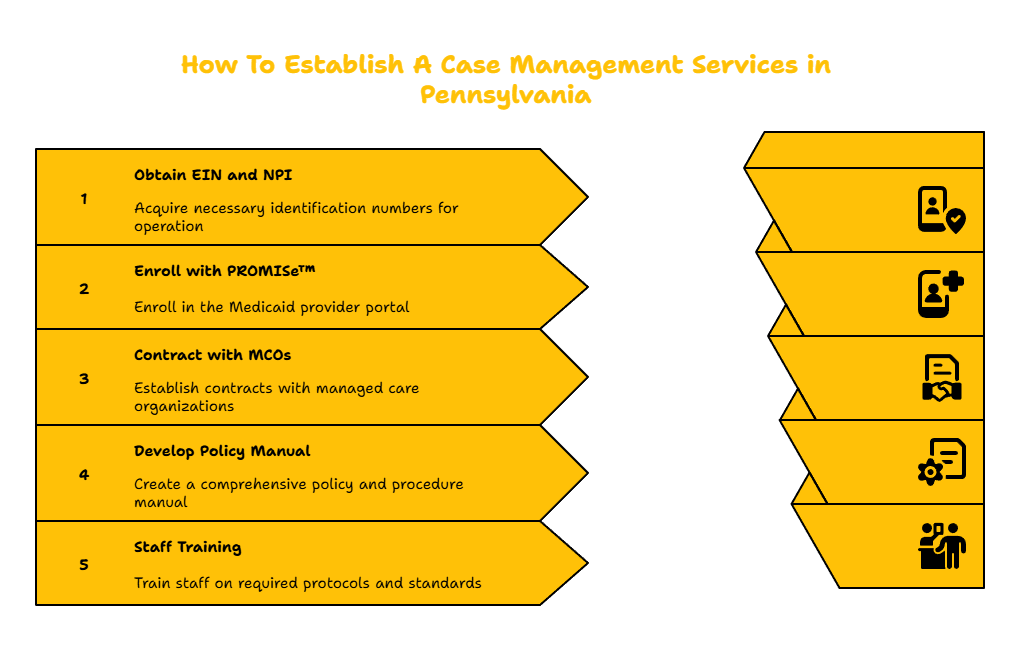
Becoming an approved Service Coordination Entity (SCE) or Supports Coordination Organization (SCO) is a multi-step process that requires formal business registration and enrollment within the state’s healthcare systems. Entities must first register with the Pennsylvania Department of State and obtain an Employer Identification Number (EIN) and a Type 2 National Provider Identifier (NPI). Proper insurance coverage, including general liability, professional liability, and workers’ compensation, is mandatory.
Once the legal foundation is established, the entity must enroll with PROMISe™ as a Service Coordination Entity or Supports Coordination Organization. This is followed by contracting with specific CHC MCOs (such as UPMC, PA Health & Wellness, or Keystone First) or ODP Administrative Entities. A cornerstone of this process is the development of a formal Case Management Services Policy & Procedure Manual that aligns strictly with DHS and CMS standards.
The provider enrollment process follows a logical sequence: register the business, submit provider qualification applications through the HCSIS portal (for ODP) or relevant CHC/OLTL pathways, and upload all required staffing plans, supervision protocols, and organizational policies. Once contracting is finalized and the agency is onboarded, the organization can begin receiving referrals and authorizations to conduct assessments and coordinate services.
What Are the Essential Staffing and Training Requirements?
A successful case management agency relies on qualified, well-trained personnel to manage caseloads and ensure participant safety. A typical agency structure includes Supports or Service Coordinators who hold at least a Bachelor’s degree in social work, human services, or a related field. These staff members must demonstrate strong documentation, advocacy, and interpersonal skills to effectively manage participant care.
Supervisory roles require at least two years of relevant experience, along with formal supervisory training to ensure quality control across the caseload. Optional roles, such as Intake Specialists, may be used to handle initial screenings and eligibility documentation. Regardless of the role, all personnel must undergo rigorous training, covering mandatory reporter requirements, abuse prevention, HIPAA compliance, person-centered planning, and crisis response protocols.
Consistent staff development is a compliance mandate. Agencies must ensure that employees participate in annual refresher courses and regular performance evaluations. Maintaining accurate training records is vital for audit preparedness, as the state frequently reviews staff credentials and evidence of ongoing education as part of the oversight process.
Frequently Asked Questions
What is the typical timeline for launching a case management agency?
The timeline varies based on organizational readiness, but typically ranges from six to nine months. This includes one to two months for business registration and manual development, two to three months for provider enrollment and contracting, and thirty to sixty days for staff hiring and credentialing. Referral activation occurs only after successful onboarding with an Administrative Entity or CHC MCO.
What documentation must an agency maintain for compliance?
Agencies must maintain a comprehensive Policy & Procedure Manual that covers intake and eligibility screening, service planning, monitoring protocols, and critical incident management. Additionally, the agency must keep detailed participant records, including contact logs, ISP/PCSP documentation, and evidence of staff training, supervision, and Medicaid billing compliance.
Are case management services only available through Medicaid waivers?
While most case management services are funded through Medicaid waivers—including CHC, the Independence, OBRA, and Aging Waivers (OLTL), and the ODP Consolidated, Community Living, and P/FDS waivers—there are exceptions. The Act 150 Program provides state-funded case management for adults who require long-term services but are not yet eligible for Medical Assistance.
Key Takeaways for Provider Success
Establishing a case management agency in Pennsylvania requires a deep understanding of the regulatory environment governed by DHS, ODP, and OLTL. Success depends on meticulous preparation—ranging from business entity registration and PROMISe™ enrollment to the creation of robust policy manuals and the hiring of qualified, trained staff. By prioritizing person-centered planning and maintaining transparent, accurate documentation, providers can effectively support individuals within the HCBS system while meeting the stringent requirements set by state and federal oversight agencies. Utilizing available resources from the HCSIS provider portal and maintaining clear communication with MCO partners are essential for long-term operational success.
Last verified: September 2024. The information provided herein is for general educational purposes only and does not constitute legal or professional consulting advice. Requirements for Medicaid provider enrollment and program compliance are subject to change. Prospective providers should consult official Pennsylvania Department of Human Services documentation and applicable state regulations before initiating the provider enrollment process.