CASE MANAGEMENT SERVICES PROVIDER IN OREGON
By Fatumata Kaba · 2025-10-06 · 6 min read
Coordinating Individualized Supports to Help Oregonians Navigate Medicaid Waiver Services and Achieve Their Personal Goals
Case Management Services in Oregon are specialized, Medicaid-funded supports designed to assist individuals with disabilities, chronic conditions, and aging-related needs in accessing, coordinating, and monitoring their Home and Community-Based Services (HCBS). By serving as a central hub for person-centered planning, service referrals, and care oversight, case managers ensure that participants receive the right care at the right time. These services are foundational to the efficacy of Oregon’s Medicaid landscape, including the Oregon Health Plan (OHP), the K Plan, and various HCBS Waivers.
Understanding the Governing Agency Landscape
The delivery of case management in Oregon is governed by a multi-layered regulatory framework. At the state level, the Oregon Department of Human Services (ODHS)—specifically the Aging and People with Disabilities (APD) and Developmental Disabilities Services (DDS) divisions—holds primary responsibility for authorizing and overseeing case management functions. This is executed through a network of local entities, including Area Agencies on Aging (AAAs), Community Developmental Disabilities Programs (CDDPs), and private brokerage organizations.
The Oregon Health Authority (OHA) operates in tandem with ODHS to administer Medicaid enrollment, manage quality monitoring, and oversee the broader care coordination systems within the Oregon Health Plan. Simultaneously, the Centers for Medicare & Medicaid Services (CMS) provides federal oversight, ensuring that all services adhere to the requirements of 1915(c) and 1915(k) waiver authorities. Additionally, prospective providers must satisfy the Oregon Secretary of State (SOS) requirements regarding business registration and legal entity formation before operating within the state’s healthcare network.
Core Responsibilities of a Case Management Provider
Case Management is fundamentally designed to help participants navigate the complexities of their healthcare options, ensuring they remain safely supported in their homes or chosen community settings. Providers must deliver services through a person-centered lens, maintaining consistent communication with participants, their families, and the broader interdisciplinary care team. This role requires a balance of administrative precision and compassionate advocacy to achieve positive health outcomes.
Approved providers are tasked with a comprehensive suite of functions, including:
- Assessment & Eligibility Determination: Conducting functional needs assessments and gathering documentation to verify ongoing eligibility.
- Individual Support Plan (ISP) Development: Collaborating with participants to create, implement, and periodically update person-centered service plans.
- Service Authorization & Referral: Identifying and connecting individuals to appropriate HCBS providers and ensuring that all necessary authorizations are active.
- Monitoring & Follow-Up: Maintaining regular contact with the participant to verify service effectiveness, health, and safety.
- Crisis Planning & Problem-Solving: Responding to urgent needs and coordinating temporary, stabilization-focused interventions.
- Record-Keeping & Reporting: Managing meticulous case notes, progress updates, and documentation compliant with Medicaid audit standards.
Navigating Licensing and Operational Prerequisites
Establishing a case management agency in Oregon requires a rigorous, structured approach to compliance. Before providing services, an entity must establish its legal and regulatory foundation. This process begins with registering the business with the Oregon Secretary of State and obtaining a federal Employer Identification Number (EIN) and a Type 2 National Provider Identifier (NPI). These are the prerequisites for enrollment in the state’s Medicaid provider system.
Beyond basic business filings, the provider must demonstrate operational readiness. This involves securing comprehensive professional liability and workers’ compensation insurance to protect the organization and its participants. Furthermore, every agency must develop a formal Case Management Policy & Procedure Manual. This manual serves as the operational blueprint, detailing how the organization will maintain alignment with Oregon Administrative Rules (OARs) and CMS guidance in areas such as participant rights, grievance procedures, and incident reporting.
The Provider Enrollment and Certification Workflow
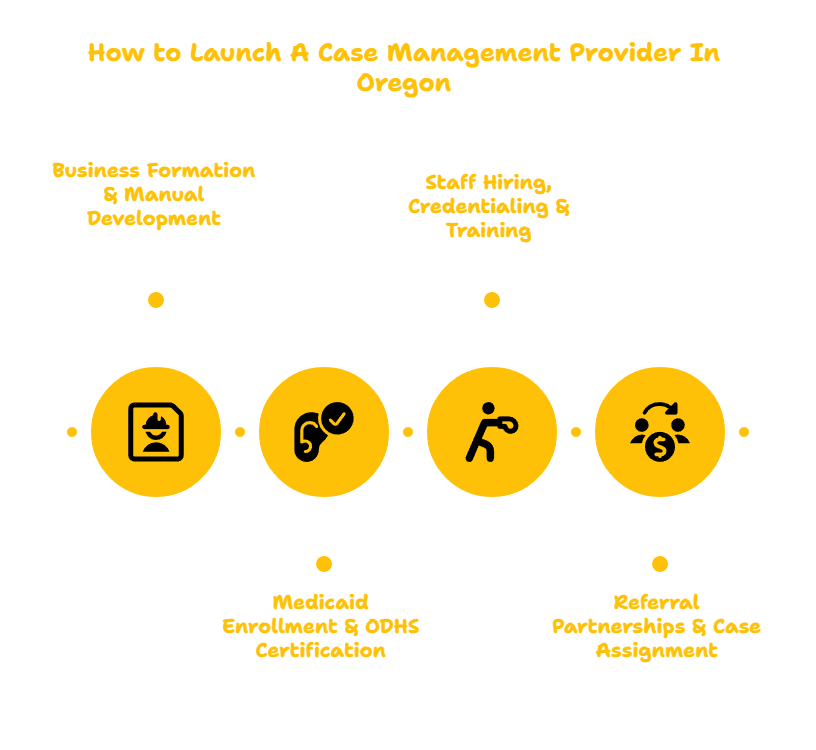
The path to becoming an active Medicaid case management provider involves a sequenced series of steps. After the initial business registration and procurement of an NPI, the entity must formally enroll as a Medicaid provider through the OHA Provider Portal. Following this, the entity must apply for specific certification as a case management provider through either the ODHS-DD or APD divisions, depending on the target population. This phase often involves a review of the organization’s capacity to serve specific Medicaid cohorts.
Once certification is secured, the organization must focus on human capital and administrative readiness. The provider must submit current credentials, resumes, and comprehensive training records for all qualified staff members. After the regulatory bodies approve these submissions, the provider is officially eligible to begin receiving service referrals or entering into formal service coordination contracts with local agencies. The entire timeline for this process generally spans from four to seven months, accounting for business formation, state enrollment, and staffing.
Staffing Requirements and Ongoing Training
Success as a case management provider depends heavily on the quality and qualifications of the staff. Case managers—often referred to as service coordinators—typically must hold at least a Bachelor’s degree in social work, human services, or a closely related field, along with a demonstrated understanding of person-centered planning and Medicaid protocols. Background checks are a non-negotiable requirement for all personnel entering private homes or interacting with vulnerable populations.
To ensure consistent care delivery, agencies must also employ or contract program supervisors or quality coordinators. These individuals are responsible for managing caseload distribution, conducting internal audits of documentation, and overseeing staff performance. All staff members must complete a rigorous training regimen, including:
- ODHS-required core training for service coordinators.
- HIPAA and participant confidentiality compliance modules.
- Person-centered planning and standardized documentation protocols.
- Mandatory reporter and abuse prevention training.
- Annual continuing education and mandatory supervisory performance evaluations.
Frequently Asked Questions
What is the primary difference between a CDDP and a Brokerage in Oregon?
Community Developmental Disabilities Programs (CDDPs) are typically county-based entities that provide case management services to individuals with intellectual and developmental disabilities. Brokerages are private, non-profit entities that specifically provide case management for adults with developmental disabilities who have chosen to self-direct their services. Both are overseen by ODHS but serve different functions within the IDD support system.
What documentation is critical for Medicaid audits?
Medicaid audits focus on the "no documentation, no service" principle. Critical records include signed and dated Individual Support Plans (ISPs), clear evidence of functional eligibility assessments, timely service authorizations, and case notes that reflect the specific actions taken to monitor the participant’s health, safety, and goal progress. Consistent and error-free record-keeping is the most effective way to avoid claim recoupment.
Can a new provider specialize in only one waiver program?
While an organization can focus its business model on specific populations—such as the Children’s DD Waiver or the APD HCBS Waivers for older adults—the certification process and operational requirements are generally population-specific. An agency must meet the distinct regulatory criteria set forth by either the DD or APD divisions of ODHS to be authorized to provide case management within those specific waiver frameworks.
Key Takeaways for Prospective Providers
Launching a case management agency in Oregon is a high-stakes, highly regulated endeavor that requires strict adherence to ODHS and OHA standards. Success is predicated on a strong infrastructure, including a robust Policy & Procedure Manual, a commitment to rigorous staff training, and the ability to maintain documentation that withstands Medicaid oversight. By aligning with state and federal regulations from the onset, agencies can effectively support Oregon’s most vulnerable populations while maintaining long-term sustainability.
Last verified: 2024. The information provided in this article is for educational purposes only and does not constitute legal or professional advice. Always consult with the Oregon Department of Human Services (ODHS) or the Oregon Health Authority (OHA) for the most current regulatory requirements, as Medicaid rules and state policies are subject to change.