CASE MANAGEMENT SERVICES PROVIDER IN OKLAHOMA
By Fatumata Kaba · 2025-09-08 · 6 min read
Becoming a Case Management Services provider in Oklahoma requires navigating a rigorous regulatory framework overseen by the Oklahoma Health Care Authority (OHCA) and the Oklahoma Department of Human Services (OKDHS). As a specialized service provider, your agency acts as a vital bridge between Medicaid-funded Home and Community-Based Services (HCBS) waivers and the participants who rely on them to maintain independence in their own homes.
This guide outlines the operational, clinical, and administrative requirements for launching and maintaining a certified case management agency in the Sooner State. By adhering to federal CMS standards and state-specific mandates, provider agencies ensure that participants receive person-centered care that aligns with their individualized goals and functional needs.
What Are the Governing Bodies for Oklahoma Case Management Services?
The Oklahoma Medicaid landscape is bifurcated between the financial administration of services and the programmatic oversight of provider quality. Understanding the distinct roles of these agencies is the first step in successful program administration. The Oklahoma Health Care Authority (OHCA) functions as the state’s single Medicaid agency, managing the SoonerCare program, overseeing provider enrollment, and establishing the complex billing policies that determine how services are reimbursed.
Complementing OHCA, the Oklahoma Department of Human Services (OKDHS) acts as the primary certifier for case management providers. Within OKDHS, the Aging Services and Developmental Disabilities Services (DDS) divisions maintain direct oversight of care coordination practices. Finally, all operations must comply with the Centers for Medicare & Medicaid Services (CMS) mandates, which ensure that HCBS waivers consistently provide person-centered planning and equitable access to necessary supports.
What Core Services Must a Case Management Agency Provide?
Case management agencies are responsible for the holistic coordination of a participant's life within the community. This begins with comprehensive needs assessments, where the case manager identifies a participant's unique strengths, functional risks, personal preferences, and clinical support requirements. These findings serve as the foundation for the Individualized Service Plan (ISP), a living document that guides all subsequent care activities.
Beyond planning, agencies are tasked with active provider coordination and advocacy. If a participant’s condition changes or an urgent need arises, the case manager must facilitate a pivot in care, acting as the participant's primary advocate to ensure service gaps are closed. Successful delivery of these services requires rigorous documentation, including progress notes, reassessment records, and meticulous tracking of service delivery for SoonerCare billing purposes.
- Comprehensive Needs Assessments: Evaluating strengths, risks, and preferences.
- Service Planning: Developing and maintaining the Individualized Service Plan (ISP).
- Provider Coordination: Linking participants to waiver and community-based resources.
- Crisis Management: Responding to urgent needs and advocating for appropriate supports.
- Monitoring & Follow-Up: Reviewing service quality and ISP implementation.
- Eligibility Assistance: Guiding individuals through SoonerCare and waiver enrollment.
How Do You Meet Licensing and Provider Approval Requirements?
The path to becoming a certified provider is highly structured. You must first establish your business as a legal entity in Oklahoma, securing an Employer Identification Number (EIN) and a Type 2 National Provider Identifier (NPI). Once the business is established, you must draft a comprehensive Case Management Policy & Procedure Manual. This manual is not merely a formality; it must clearly articulate your agency’s workflows regarding intake, HIPAA compliance, emergency response, and quality assurance.
Professional liability insurance is a non-negotiable prerequisite, as is the commitment to staff training. OKDHS requires that all personnel meet specific educational and background check standards before they are permitted to handle a caseload. Once your internal policies and operational capacity are verified, you will apply for certification through the relevant OKDHS division and finalize your SoonerCare provider enrollment through the OHCA portal.
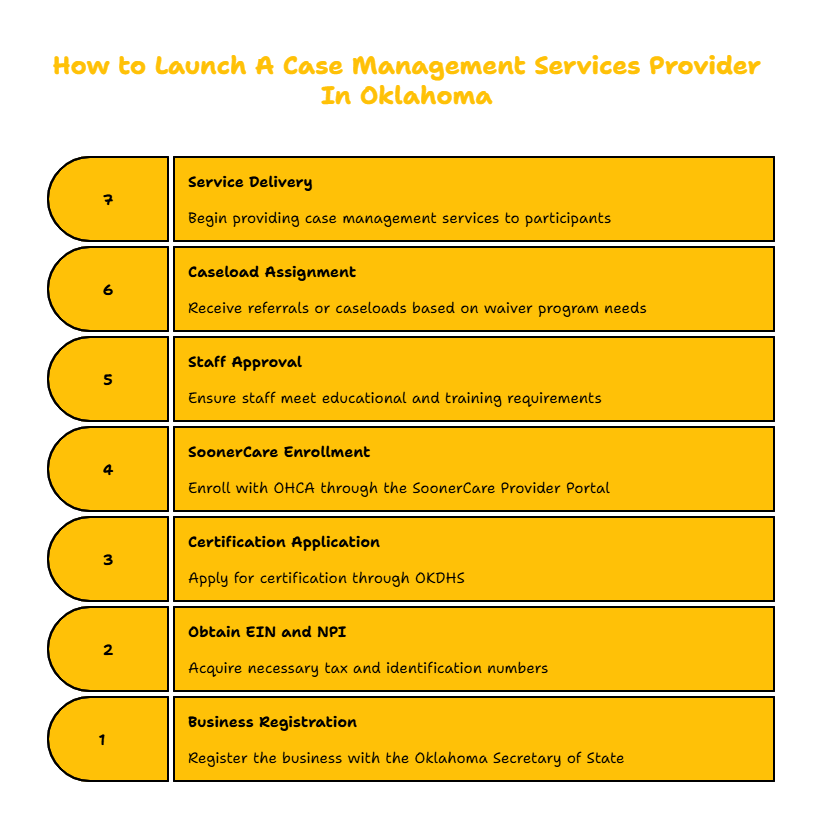
What Is the Step-by-Step Process for Provider Enrollment?
The enrollment process is a sequential journey that moves from legal formation to active service delivery. In the initial phase, focus on corporate formation and the development of your internal operational manual. Having a robust Policy & Procedure manual is critical, as it is often a primary point of inspection during the certification review. Once your protocols are established, you will submit your certification application to OKDHS for the specific waiver programs you intend to serve, such as the ADvantage Waiver or the DDS programs.
After receiving OKDHS certification, you will proceed to the SoonerCare enrollment phase with the OHCA. This involves linking your agency’s NPI and credentials to the specific waiver programs in the SoonerCare provider portal. The final phase involves staff credentialing, which includes verifying degrees, completing program-specific training, and ensuring that all mandatory background checks are cleared. Only after these steps are completed will the agency be eligible to receive referrals and manage active caseloads.
What Are the Staffing and Documentation Requirements?
Staffing requirements are designed to ensure that case managers possess the professional maturity to handle complex care coordination. A Case Management Program Administrator must typically hold a Bachelor’s or Master’s degree in social work, public health, or a related field, combined with experience in supervising care coordination services. Similarly, individual Case Managers are required to hold at least a Bachelor’s degree in a human services discipline and must complete mandatory state-specific training modules before interacting with participants.
Documentation is the backbone of Medicaid reimbursement. An agency must maintain accurate, audit-ready records that demonstrate the necessity and delivery of services. Essential documentation includes:
- Articles of Incorporation and Business Licenses.
- Proof of General and Professional Liability Insurance.
- Comprehensive Policy & Procedure Manual covering HIPAA and participant rights.
- Records of staff training, background checks, and continuing education.
- Audit-ready Medicaid billing logs and service tracking templates.
Frequently Asked Questions
What is the difference between ADvantage and DDS case management?
The ADvantage Waiver focuses on aging adults and individuals with physical disabilities, whereas the Developmental Disabilities Services (DDS) programs are designed specifically for individuals with intellectual or developmental disabilities. Agencies may specialize in one or both, depending on their staff expertise and state certification status.
How long does the start-up process typically take?
The timeline varies based on the agency's readiness. Generally, business formation and policy development take 1–2 months, followed by 2–3 months for certification. SoonerCare enrollment and onboarding usually require an additional 60–90 days before an agency is fully ready to accept referrals.
Can a case manager provide both case management and direct services?
In most Medicaid HCBS programs, there is a strict "conflict of interest" policy. Case management is designed to be an independent advocacy role, meaning the same agency or individual is generally prohibited from providing both the care management and the direct service provision for the same participant.
Key Takeaway
Establishing a Case Management Services agency in Oklahoma requires a commitment to administrative precision, regulatory compliance, and person-centered advocacy. By aligning agency policies with OHCA and OKDHS mandates, maintaining rigorous documentation standards, and investing in qualified staff, new providers can successfully contribute to the health and independence of the Oklahoma Medicaid population. Success in this field relies on the ability to interpret evolving Medicaid guidelines and translate them into consistent, high-quality care for participants.
Last verified: October 2023. This information is provided for general guidance and educational purposes only. Regulatory requirements, program policies, and contact information for Oklahoma Medicaid (SoonerCare) and waiver programs are subject to change by the Oklahoma Health Care Authority (OHCA) and the Oklahoma Department of Human Services (OKDHS). Always consult the official Oklahoma Medicaid Provider Manuals and state agency websites for the most current legal requirements and operational guidance.