CASE MANAGEMENT SERVICES PROVIDER IN MARYLAND
By Fatumata Kaba · 2025-09-02 · 6 min read
Case Management services in Maryland serve as the critical bridge between individuals with disabilities and the Medicaid Home and Community-Based Services (HCBS) ecosystem. These providers are responsible for facilitating eligibility, developing person-centered care plans, and ensuring that essential medical, behavioral, and social supports are effectively coordinated to promote community integration and prevent institutionalization.
Operating as a case management agency in Maryland requires navigating distinct regulatory pathways governed by the Maryland Department of Health (MDH), the Developmental Disabilities Administration (DDA), and the Medicaid program. Whether an organization chooses to provide Coordination of Community Services (CCS) for DDA waiver participants or Supports Planning for the Community First Choice (CFC) and Community Options programs, success relies on strict adherence to person-centered planning standards, rigorous documentation, and ongoing quality assurance monitoring.
Navigating the Regulatory Landscape and Governing Agencies
The regulatory framework for Maryland case management is bifurcated, depending on the specific waiver population being served. The Maryland Department of Health (MDH) maintains ultimate oversight of Medicaid policy and waiver program integrity. Within this structure, the Developmental Disabilities Administration (DDA) holds the primary responsibility for authorizing and regulating CCS agencies, while the Office of Long-Term Services and Supports (LTSS Maryland) manages the operational infrastructure, including the portal used for service planning, billing, and clinical documentation.
For organizations seeking to enter this space, understanding the jurisdictional authority of each agency is vital for compliance. While the DDA focuses on the needs of individuals with intellectual and developmental disabilities, broader Medicaid programs—such as the Community Options Waiver—fall under the administration of the Medicaid program and utilize different enrollment channels. Federal oversight is provided by the Centers for Medicare & Medicaid Services (CMS), which requires that all case management activities align with federal HCBS regulations regarding participant choice and quality of care.
- Maryland Department of Health (MDH): Oversees Medicaid and waiver program policy for case management across all populations.
- Developmental Disabilities Administration (DDA): Authorizes and regulates CCS agencies and monitors case management standards under DDA waivers.
- Office of Long-Term Services and Supports (LTSS Maryland): Hosts the provider portal for case documentation, service planning, and billing.
- Centers for Medicare & Medicaid Services (CMS): Provides federal oversight of case management and care coordination under Medicaid HCBS Waivers.
Core Functions of a Case Management Provider
Case management agencies function as the primary point of contact for program participants, requiring staff to act as advocates, navigators, and monitoring agents. A primary objective is the development and implementation of the Person-Centered Plan (PCP) or Individual Plan (IP), which serves as the legal blueprint for the services a participant will receive. By maintaining consistent communication with the individual and their support network, case managers ensure that services remain aligned with the participant's evolving goals and health requirements.
Beyond plan development, providers must be skilled in identifying and linking participants to community-based resources. This involves connecting individuals to specialized medical care, behavioral health services, employment support, and housing assistance. Furthermore, case managers are tasked with monitoring the delivery of these services, ensuring that providers are fulfilling their obligations, and responding promptly to changes in the participant’s clinical or social status to avoid gaps in care.
Establishing Your Agency: Licensing and Provider Approval
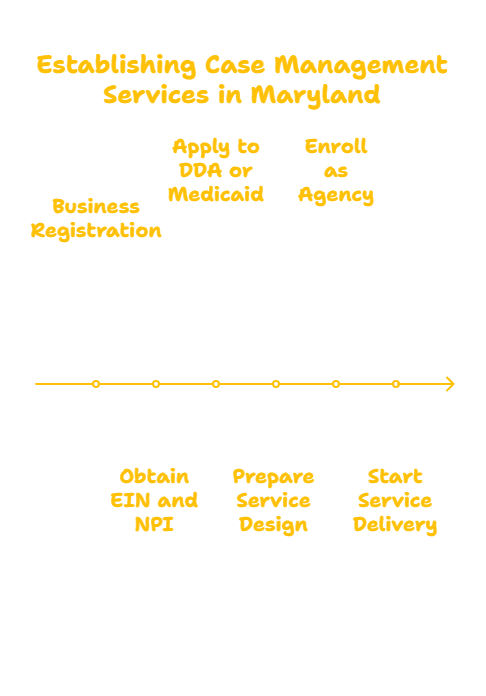
Launching a case management organization begins with establishing a formal legal entity registered with the Maryland Department of Assessments and Taxation (SDAT). Once the business structure is confirmed, an Employer Identification Number (EIN) and a Type 2 National Provider Identifier (NPI) must be obtained. These foundational steps are prerequisites for the provider enrollment process, which varies significantly between the DDA and the broader Medicaid program.
For those pursuing DDA authorization, the focus is on the DDA Coordination Services Provider Application. This process involves a detailed submission of the agency’s internal policy manuals, organizational charts, and evidence of a robust supervision model. Conversely, applicants for Supports Planning under the CFC or Community Options programs must navigate the Medicaid ePREP portal. Regardless of the pathway, organizations must demonstrate financial stability, carry appropriate professional liability insurance, and establish a HIPAA-compliant infrastructure to protect sensitive participant data.
- Register the organization with the Maryland Department of Assessments and Taxation (SDAT).
- Obtain a federal EIN and a Type 2 NPI.
- Apply as a CCS Agency through the DDA Coordination Services Provider Application or via the Medicaid ePREP system.
- Maintain HIPAA-compliant documentation systems and professional liability insurance.
- Employ qualified Case Managers (CCS or Supports Planners) who meet state-mandated credentialing standards.
Building a Compliant Infrastructure and Documentation System
Documentation is the backbone of any Medicaid-reimbursed case management service. An agency must develop a comprehensive policy and procedure manual that covers every aspect of the service delivery cycle, from the initial intake and referral to the annual review of the Person-Centered Plan. Clear protocols regarding critical incident reporting are non-negotiable; agencies must be prepared to respond to and document health and safety risks immediately to satisfy both DDA and Medicaid compliance standards.
Beyond standard operating procedures, agencies need systems to track service coordination logs, contact sheets, and staff training evaluations. Because these services are audited by state agencies, all records must be readily accessible and reflect clear evidence of advocacy, monitoring, and follow-up. This includes maintaining detailed records of staff credentials, as every individual performing case management duties must undergo mandatory background checks, HIPAA training, and state-specific professional development.
Staffing Requirements and Professional Development
The quality of a case management agency is directly linked to the qualifications of its staff. Typically, a Coordinator of Community Services (CCS) or Supports Planner must hold a Bachelor’s degree in a human services field—such as social work, psychology, or a related discipline—and possess at least one year of professional experience working with vulnerable populations or individuals with disabilities. Agencies are also required to employ a Clinical Supervisor or Program Director, who carries the responsibility for overseeing compliance and ensuring that the case management team adheres to ethical and performance standards.
Training is an ongoing requirement for all staff members. Upon hiring, employees must complete DDA-approved orientations and training in Person-Centered Thinking. As they progress, they must maintain expertise in HCBS rights, mandated reporting requirements, and crisis management. Agencies should implement an annual training schedule that includes ethics reviews and updates on state-specific policy changes to ensure that all staff remain equipped to advocate effectively for the individuals they serve.
Frequently Asked Questions
What is the primary difference between a CCS agency and a Supports Planning agency?
A CCS agency is specifically authorized by the DDA to serve individuals enrolled in DDA waivers. A Supports Planning agency typically serves individuals enrolled in broader Medicaid waiver programs, such as Community First Choice (CFC) or the Community Options Waiver.
How long does the provider enrollment process typically take?
While business registration can be completed in 1-2 weeks, the application process for DDA or Medicaid via ePREP generally takes between 4 and 8 weeks. This timeline can vary depending on the completeness of your application and current state capacity requirements.
What documentation is essential for a new case management agency?
An agency must have Articles of Incorporation, an EIN, an NPI, and a comprehensive policy manual that includes intake forms, PCP templates, critical incident reporting procedures, and HIPAA compliance policies.
Key Takeaway: Successfully launching a case management agency in Maryland requires a rigorous focus on regulatory compliance, the adoption of person-centered planning methodologies, and the establishment of robust internal quality assurance systems to ensure that all services meet DDA and Medicaid standards.
Last verified: 2024. The information contained in this document is for general informational purposes only and does not constitute legal or professional advice. Readers should consult directly with the Maryland Department of Health, the Developmental Disabilities Administration, or legal counsel regarding specific compliance requirements for their organization.