CASE MANAGEMENT SERVICES PROVIDER IN KENTUCKY
By Fatumata Kaba · 2025-07-25 · 5 min read
Coordinating Care, Empowering Participants, and Supporting Outcomes Through Person-Centered Service Planning.
Case Management Services in Kentucky function as the essential backbone of the Medicaid Home and Community-Based Services (HCBS) waiver system. By providing comprehensive coordination, advocacy, and monitoring, these providers ensure that individuals with disabilities or aging-related needs receive personalized support that allows them to thrive in their own homes rather than in institutional settings.
As a provider, operating within this space requires strict adherence to state and federal regulations, particularly those regarding conflict-free service delivery. This guide outlines the regulatory framework, provider requirements, and operational steps necessary to launch and maintain a successful Case Management practice in the Commonwealth of Kentucky.
What is the Regulatory Framework Governing Kentucky Case Management?
The delivery of Case Management Services in Kentucky is governed by a multi-tiered regulatory structure designed to protect participant rights and ensure high-quality care. At the state level, the Kentucky Cabinet for Health and Family Services (CHFS) serves as the primary authority. Specifically, the Department for Medicaid Services (DMS) establishes the essential provider qualifications, billing protocols, and care planning requirements that all agencies must follow to maintain participation in Medicaid waivers.
The Kentucky Department for Aging and Independent Living (DAIL) provides crucial oversight and quality assurance, particularly for waivers serving the aging population and individuals with disabilities. Simultaneously, federal oversight is provided by the Centers for Medicare & Medicaid Services (CMS). CMS mandates that all case management must remain conflict-free, meaning the agency delivering case management cannot also provide direct waiver services to the same individual. Managed Care Organizations (MCOs) act as the final tier of oversight, managing service authorizations, credentialing, and ongoing monitoring of the Person-Centered Service Plan (PCSP).
How Do Providers Deliver Case Management Services?
Case management is fundamentally a process of connection and oversight. Providers are responsible for assessing the holistic needs of the participant, identifying appropriate community resources, and facilitating the development of a PCSP. This document serves as the roadmap for the participant’s care, and the case manager’s role is to ensure that all services outlined within the plan are delivered timely and effectively.
Approved activities for a case management provider include:
- Performing comprehensive initial needs assessments and conducting regular reassessments.
- Developing, reviewing, and updating the Person-Centered Service Plan (PCSP).
- Coordinating a blend of waiver and non-waiver services, including medical, behavioral, and housing supports.
- Facilitating interdisciplinary team meetings to ensure all parties are aligned on the participant’s goals.
- Monitoring the participant’s health, safety, and welfare on an ongoing basis.
- Addressing emerging gaps in care or adjusting services when the participant’s condition changes.
- Providing dedicated advocacy and crisis intervention services.
- Maintaining meticulous documentation and reporting metrics to the DMS or the relevant MCO.
What are the Licensing and Provider Approval Requirements?
Establishing a Case Management agency in Kentucky requires a structured administrative approach. Before applying for enrollment, an entity must be fully organized as a legal business entity with the Kentucky Secretary of State. Once the business is formed, the provider must obtain an IRS Employer Identification Number (EIN) and a Type 2 National Provider Identifier (NPI) to function within the Medicaid system.
Administrative readiness is the most critical hurdle for new providers. Agencies must develop a robust Policy & Procedure Manual that addresses HIPAA compliance, quality assurance, emergency protocols, and internal auditing. Furthermore, providers must secure appropriate professional and general liability insurance. Because of the sensitivity of the services provided, agencies must also establish a rigorous internal system for vetting staff and maintaining secure documentation.
How Do You Navigate the Kentucky Provider Enrollment Process?
The enrollment process is a sequential journey that begins with the Medicaid Partner Portal Application (MPPA). Applicants must register as a Case Management provider specifically linked to the HCBS waiver programs they intend to serve. This portal is the primary gateway for submitting credentials and maintaining administrative records with the state.
Following MPPA registration, the provider must undergo MCO credentialing. Since most Medicaid services in Kentucky are managed through MCOs, successful credentialing is necessary for the authorization of services and the processing of claims. During this phase, the provider must submit documented evidence of business licensure, insurance coverage, and staff qualifications. Once enrolled, the agency moves into the implementation phase, which includes setting up intake workflows and establishing referral networks with hospital discharge planners, community organizations, and local waiver teams.
What Documentation and Staffing Standards Must Be Met?
Compliance depends on the quality of an agency’s internal records. A compliant Case Management provider must maintain clear, auditable files for every participant. This includes intake records, signed PCSPs, monthly service logs, incident reports, and evidence of periodic reassessments. These documents are the primary evidence used during state and MCO audits to determine whether the services billed were actually provided and whether they met the participant's needs.
Staffing requirements are equally stringent to ensure high-quality, professional interaction with vulnerable populations. Case managers generally must hold a Bachelor’s or Master’s degree in social work, nursing, or a closely related human services field, alongside at least one year of experience with the targeted waiver population. All staff must undergo comprehensive background checks and receive documented training in the following areas:
- Person-centered planning principles and application.
- HIPAA privacy standards and participant rights.
- Prevention, identification, and reporting of abuse, neglect, and exploitation.
- Emergency response, crisis management, and safety protocols.
- Ongoing continuing education to ensure professional development and program alignment.
Frequently Asked Questions
What is the difference between an MCO and the Department for Medicaid Services?
The Department for Medicaid Services (DMS) sets the overarching policy, provider standards, and regulations for the state. Managed Care Organizations (MCOs) are the entities contracted to manage the day-to-day administration of benefits, including service authorization, provider credentialing, and claims processing for individual participants.
Is there a specific timeline for starting a case management agency?
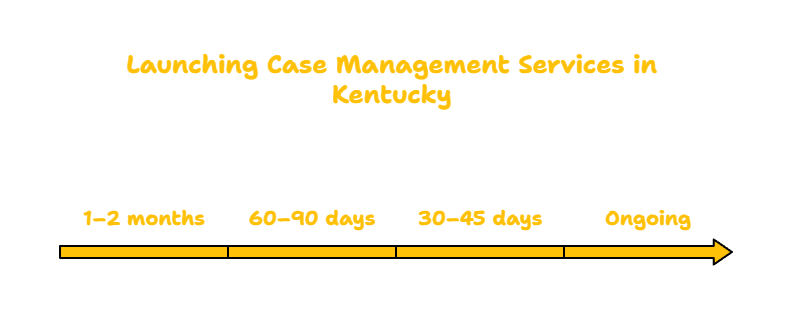
The process generally spans several months. Business formation and policy development typically require 1–2 months, while the formal Medicaid enrollment and MCO credentialing process can take 60–90 days. Staffing and network building often run parallel to the final stages of credentialing, adding another 30–45 days before the agency is fully operational.
Can a case management agency also provide personal care or home health services?
No. Under federal CMS guidelines, all case management must be conflict-free. This means an agency is prohibited from delivering both case management and other direct HCBS waiver services to the same individual, as it creates a financial conflict of interest that could compromise the impartiality of the care planning process.
Key Takeaways for Provider Success
Success in the Kentucky HCBS market depends on a firm grasp of the regulatory landscape and a commitment to meticulous documentation. By prioritizing conflict-free operations, maintaining a well-trained staff, and adhering strictly to the requirements set by the CHFS, DMS, and MCOs, providers can deliver essential services that directly improve the lives of Kentucky’s most vulnerable citizens. As the state continues to emphasize community-based care, the role of professional case management providers remains more critical than ever.
Last verified: 2024. The information provided is for educational purposes and does not constitute legal or professional advice. Always consult directly with the Kentucky Cabinet for Health and Family Services or your specific MCO regarding current policy and regulatory changes.