CASE MANAGEMENT SERVICES PROVIDER IN KANSAS
By Fatumata Kaba · 2025-07-24 · 6 min read
How to Become a Case Management Services Provider in Kansas
Becoming a Case Management Services provider in Kansas requires a strategic approach to aligning agency operations with the rigorous standards set by the Kansas Department for Aging and Disability Services (KDADS) and the Kansas Department of Health and Environment (KDHE). Agencies serve as the critical link for individuals with disabilities, chronic conditions, and behavioral health needs, facilitating access to essential Home and Community-Based Services (HCBS) and ensuring that care delivery remains person-centered and outcomes-focused within the KanCare managed care framework.
Launching a successful agency necessitates a thorough understanding of the regulatory landscape, robust policy development, and a commitment to maintaining compliance across multiple oversight entities. This guide outlines the essential steps, documentation requirements, and structural milestones required to transition from a startup phase to an active, authorized provider of case management services in the state of Kansas.
Navigating the Regulatory Landscape and Governing Agencies
The Kansas Medicaid landscape, known as KanCare, is governed by a multifaceted hierarchy of agencies that ensure service delivery meets federal and state requirements. Understanding the specific role of each entity is the first step in successful program implementation. The Kansas Department for Aging and Disability Services (KDADS) acts as the primary authority for HCBS waiver programs and is responsible for contracting with Targeted Case Management (TCM) agencies. Simultaneously, the Kansas Department of Health and Environment (KDHE) oversees the Division of Health Care Finance, which manages the critical aspects of Medicaid provider enrollment and service reimbursement.
Service delivery is further managed through the state's contracted Managed Care Organizations (MCOs). These entities are responsible for approving individualized care plans, monitoring the quality of service delivery, and processing reimbursement for claims submitted by TCM providers. At the federal level, the Centers for Medicare & Medicaid Services (CMS) provides overarching regulatory guidance, ensuring that all Kansas-based case management programs remain in strict compliance with federal HCBS and TCM mandates. Providers must establish professional relationships with each of these bodies to ensure operational continuity.
Establishing Your Agency: Licensing and Provider Enrollment
The path to becoming an approved provider begins with formal business entity formation. Agencies must first register with the Kansas Secretary of State and obtain a Federal Employer Identification Number (EIN) from the IRS. Furthermore, obtaining a Type 2 National Provider Identifier (NPI) is mandatory for organizations providing health-related services. Once the foundational business structure is in place, the agency must initiate the enrollment process through the Kansas Medical Assistance Program (KMAP). During this phase, it is vital to secure the appropriate certifications from KDADS, particularly if the agency intends to serve specialized populations, such as those with intellectual/developmental disabilities or behavioral health needs.
Contracting with KanCare MCOs is the final, decisive step in the enrollment journey. Each MCO has distinct credentialing requirements that must be met before a provider can accept referrals. Agencies should be prepared to demonstrate their readiness through the following organizational requirements:
- Maintenance of comprehensive general liability and professional insurance policies.
- Establishment of clear internal policies for service planning, documentation, and participant protection.
- Demonstration of staff credentialing, including background checks for all personnel.
- Development of a formal grievance and incident reporting system.
Core Service Delivery and Clinical Documentation Standards
Case management in Kansas is defined by the development and monitoring of the Individualized Service Plan (ISP). This document is the cornerstone of service delivery, detailing the participant's goals, the services they require, and the supports necessary to promote health, independence, and community integration. Providers are expected to perform regular assessments of participant needs, ensuring that the services authorized under the specific HCBS waiver—such as the Intellectual/Developmental Disability (IDD) Waiver or the Frail Elderly (FE) Waiver—are utilized effectively. This involves continuous coordination with medical, housing, educational, and employment service providers.
Documentation is a significant component of compliance. All services must be recorded accurately, typically billed in 15-minute increments. Failure to maintain rigorous documentation logs or timely ISP updates can result in audit failures and payment recoupments. Providers must maintain a robust Policy & Procedure Manual that covers:
- Intake, comprehensive assessment, and ISP development protocols.
- Crisis intervention and critical incident reporting procedures.
- Care transition processes for participants moving between settings, such as hospital to home.
- Informed choice documentation and participant rights advocacy.
Staffing Requirements and Professional Development
The quality of case management services is inherently tied to the competence of the staff. Each agency must employ a Case Management Program Supervisor who holds at least a Bachelor’s or Master’s degree in social work, nursing, psychology, or a related human services field. This supervisor must also possess relevant experience in the field and pass a thorough background check. Similarly, front-line Case Managers must hold a Bachelor’s degree in a human services field and demonstrate a working knowledge of Medicaid services and local community resources.
Beyond initial hiring requirements, all staff must undergo ongoing training and competency evaluations. This includes mandatory HIPAA and confidentiality training, abuse prevention, and emergency response. Furthermore, staff should be trained in person-centered planning techniques, which are essential for fulfilling the mission of HCBS waiver programs. Agencies are responsible for maintaining organized training logs to provide evidence of compliance during periodic state and MCO reviews.
The Implementation Roadmap: From Startup to Operations
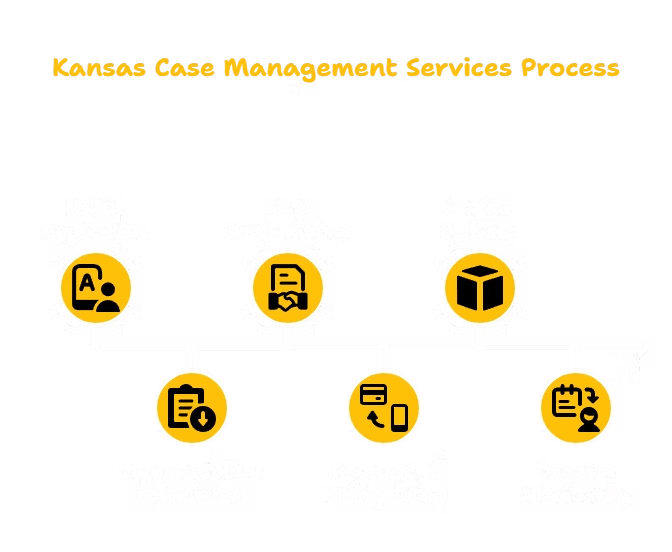
Launching a case management agency is a structured process that generally spans several months. The initial phase focuses on business formation and the creation of internal policy manuals, which takes approximately 1–2 months. Following this, the agency moves into staff credentialing and KMAP/KDADS enrollment, a phase that typically requires 2–3 months to complete. Once enrollment is in progress, the agency will enter the MCO contracting and readiness review phase, which lasts between 60 to 90 days. The final stage involves setting up billing systems and initiating service delivery, which usually takes an additional 30–45 days.
Frequently Asked Questions
What is the difference between Case Management and Targeted Case Management (TCM)?
Targeted Case Management (TCM) is a specific delivery model of case management services designed for populations with specific needs, such as those with intellectual/developmental disabilities. While general case management coordinates broad care, TCM services are specifically authorized under waiver programs to provide intensive assistance with accessing and monitoring HCBS services.
Do I need separate contracts for each Managed Care Organization (MCO)?
Yes, as a provider in Kansas, you must contract with each of the KanCare MCOs—Sunflower Health Plan, UnitedHealthcare Community Plan, and Aetna Better Health of Kansas. Each MCO conducts its own credentialing process and manages its own network of providers.
What are the primary waivers that include Case Management services?
Case management is a reimbursable service under several programs, including the Intellectual/Developmental Disability (IDD) Waiver, Physical Disability (PD) Waiver, Brain Injury (BI) Waiver, Autism Waiver, Frail Elderly (FE) Waiver, Technology Assisted (TA) Waiver, and the Children’s Mental Health Waiver.
Key Takeaways
Launching a Case Management Services provider agency in Kansas requires a methodical approach to state-specific regulations and a deep commitment to administrative excellence. By prioritizing robust policy development, ensuring staff are highly qualified, and maintaining strict adherence to KDADS and KMAP documentation standards, agencies can effectively support the independence and well-being of Kansas residents while remaining financially and operationally viable.
Last verified: October 2023. The information provided in this article is for educational purposes only and does not constitute legal or professional advice. Always refer to the latest manuals and guidance provided by the Kansas Department for Aging and Disability Services (KDADS) and the Kansas Medical Assistance Program (KMAP) for current program requirements and policies.