CASE MANAGEMENT SERVICES PROVIDER IN ILLINOIS
By Fatumata Kaba · 2025-07-19 · 5 min read
Defining the Role of Case Management Services in Illinois Medicaid
Case Management Services in Illinois serve as the cornerstone of the state’s Home and Community-Based Services (HCBS) ecosystem, acting as the primary point of contact for individuals navigating complex long-term care needs. By providing comprehensive assessment, individualized care planning, service coordination, and ongoing advocacy, these providers ensure that Medicaid participants maintain their independence and health while living in their chosen communities. These services are officially authorized under both Illinois Medicaid HCBS Waiver programs and the Medicaid State Plan, functioning to bridge the gap between clinical requirements and community-based resources.
For provider agencies, the primary objective is to facilitate a person-centered approach that empowers participants while ensuring compliance with stringent state and federal mandates. Because these services are often the gatekeepers for accessing Medicaid-funded supports, they are subject to rigorous oversight by the Illinois Department of Healthcare and Family Services (HFS), the Department of Human Services (DHS), and the Department on Aging (IDoA). Maintaining high standards of service delivery is not merely a professional goal; it is a regulatory requirement to ensure participants receive safe, effective, and non-discriminatory care.
Understanding Governing Agencies and Regulatory Oversight
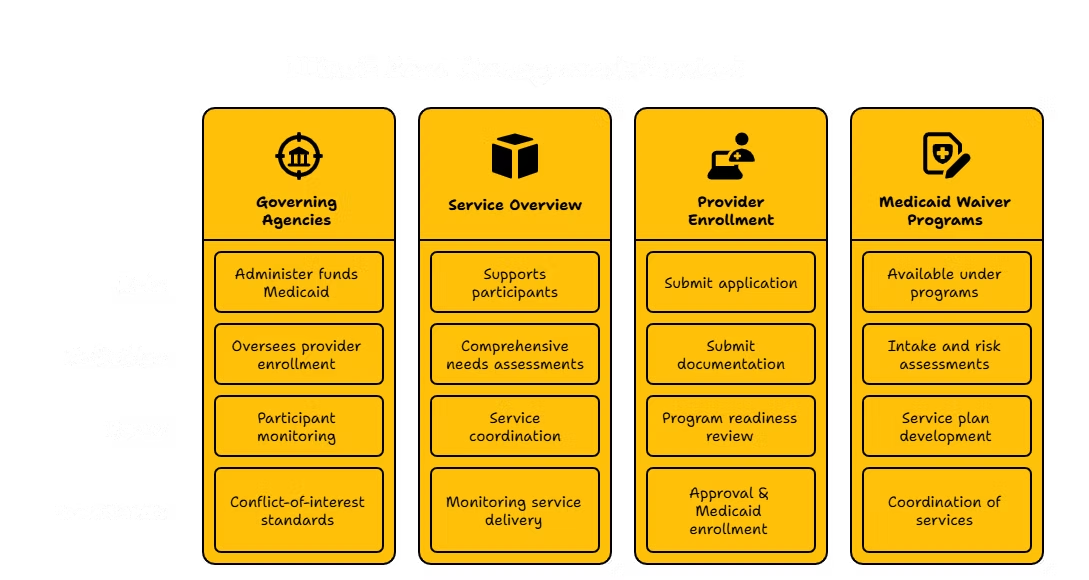
The regulatory landscape for Case Management in Illinois is multi-faceted, requiring providers to coordinate with several distinct entities depending on the waiver program. The Illinois Department of Healthcare and Family Services (HFS) holds the primary responsibility for the administration of Medicaid funding. HFS oversees the critical functions of provider enrollment, reimbursement structures, and the enforcement of quality assurance benchmarks across the state.
In addition to HFS, specific populations are managed through targeted state departments:
- Illinois Department of Human Services (DHS): The Division of Developmental Disabilities (DDD) and the Division of Rehabilitation Services (DRS) manage waiver-specific requirements, conduct participant monitoring, and perform direct provider oversight for their respective populations.
- Illinois Department on Aging (IDoA): This department is responsible for managing case management activities specifically for older adults participating in the Community Care Program (CCP).
- Centers for Medicare & Medicaid Services (CMS): As the federal authority, CMS provides the overarching framework for all HCBS programs. They mandate strict adherence to person-centered planning standards, conflict-of-interest mitigation, and robust participant protections that all Illinois providers must follow.
Core Components of Case Management Service Delivery
Approved case management providers are responsible for delivering a standardized set of activities designed to improve the functional status and quality of life for Medicaid beneficiaries. At the heart of this service is the development of the Individualized Service Plan (ISP) or Person-Centered Plan (PCP). These plans are living documents that reflect the participant's goals, preferences, and clinical needs, serving as a roadmap for the services authorized under the Medicaid waiver.
Beyond planning, providers are tasked with the active monitoring of service delivery and the evaluation of participant outcomes. This includes:
- Conducting comprehensive needs assessments and periodic risk evaluations to adjust care as the participant's situation evolves.
- Linking participants to essential medical, social, and educational supports within the community.
- Performing crisis intervention and fulfilling mandated reporting requirements for critical incidents.
- Engaging in formal transition planning for individuals moving between care settings, such as discharging from a hospital or facility back into a community home.
Navigating the Illinois Provider Enrollment Process
Becoming an approved Medicaid provider in Illinois is a structured, multi-step journey that begins with the IMPACT (Illinois Medicaid Provider Enrollment) system. Before initiating an application, an organization must be legally formed with the Illinois Secretary of State and possess a valid Federal Employer Identification Number (EIN) and a Type 2 National Provider Identifier (NPI). The IMPACT system acts as the central hub for all enrollment activities for Case Management Services.
The enrollment trajectory generally follows this sequence:
- Application Submission: Agencies must submit their registration through IMPACT, selecting the appropriate service category for their specific waiver or State Plan program.
- Documentation Submission: Agencies must upload verifiable credentials, including Articles of Incorporation, proof of insurance (general and professional liability), and detailed operational policies.
- Program Readiness Review: DHS, HFS, or IDoA will evaluate the agency’s readiness. This review focuses on the provider's conflict-of-interest safeguards, staff credentialing, and internal documentation standards.
- Approval and Billing Activation: Once the review is successfully cleared, the provider is officially enrolled and assigned the necessary billing codes to begin claiming for services such as intake, assessment, and care coordination.
Staffing, Credentialing, and Professional Requirements
The quality of case management is inherently tied to the qualifications of the staff delivering the services. Illinois requires that organizations maintain a clear distinction between administrative oversight and direct care coordination. The Program Director or Supervisor is generally required to hold a bachelor’s degree in social work, nursing, psychology, or a related human services field, supported by a clean background check and relevant supervisory experience.
For Case Managers and Care Coordinators, the minimum requirement is typically a bachelor’s degree in a human services field. However, technical proficiency is just as critical as academic background. All staff must undergo comprehensive, ongoing training in several core areas to maintain compliance:
- Person-centered planning methodologies and the protection of participant rights.
- HIPAA compliance and strict standards regarding medical record confidentiality.
- Recognizing and reporting indicators of abuse, neglect, and exploitation.
- Conflict-free case management principles to ensure objective service planning.
- Emergency response protocols and mandatory critical incident reporting procedures.
Frequently Asked Questions
What is the difference between a Case Manager and a direct service provider?
In the Illinois Medicaid waiver system, Case Managers focus on the coordination, planning, and monitoring of services, whereas direct service providers (such as home health aides or personal assistants) perform the physical tasks of care. Under CMS guidelines, Case Managers must operate independently of direct service provision to maintain conflict-free service delivery.
What is the purpose of the IMPACT system?
The IMPACT system is the Illinois Medicaid Provider Enrollment portal. It is the mandatory, centralized platform where prospective and current providers submit enrollment applications, update organizational information, and maintain their status as an authorized Medicaid provider in the state.
How long does the provider enrollment process typically take?
While timelines vary based on program complexity and agency readiness, the typical window to launch a Case Management agency involves 1–2 months for business formation, 2–3 months for staffing and program development, 60–90 days for the IMPACT enrollment and readiness review, and 30–45 days for final billing system setup.
Key Takeaway
Launching a Case Management Services agency in Illinois is a complex administrative undertaking that requires strict adherence to state-specific certification and federal Medicaid compliance standards. By prioritizing robust policy development, rigorous staff training, and transparent operational systems, agencies can effectively position themselves to support Illinois's most vulnerable populations while maintaining audit-ready documentation and financial sustainability.
Last verified: 2024. This information is provided for educational purposes and does not constitute legal or professional advice. Requirements for Illinois Medicaid programs may change; please consult the Illinois Department of Healthcare and Family Services (HFS) and the specific division of the Department of Human Services (DHS) or Department on Aging (IDoA) for the most current regulations and program bulletins.