CASE MANAGEMENT SERVICES PROVIDER IN IDAHO
By Fatumata Kaba · 2025-07-18 · 5 min read
Becoming a Case Management Services provider in Idaho requires a strategic approach to navigating the regulatory landscape managed by the Idaho Department of Health and Welfare (IDHW). This process involves establishing a formal business entity, meeting stringent credentialing standards for staff, and securing approval as a Medicaid provider to deliver essential person-centered coordination for individuals participating in Home and Community-Based Services (HCBS) waiver programs.
Understanding the Role of a Case Management Provider
Case Management Services serve as the bridge between individuals with disabilities or aging-related needs and the services required to maintain their health, safety, and independence within the community. These providers are responsible for a range of functions, including identifying participant needs, crafting individualized service plans, and ensuring that community-based support systems are effectively utilized. By facilitating access to medical, behavioral, and personal supports, case managers play a vital role in preventing institutionalization.
The core objective of these services is to provide comprehensive, person-centered support that empowers participants in their own decision-making. This involves not only the initial assessment of a participant's environment and health status but also the continuous monitoring of the service delivery process to ensure that the Individualized Service Plan (ISP) remains responsive to the participant's changing life goals and health requirements.
Navigating Agency Governance and Regulatory Oversight
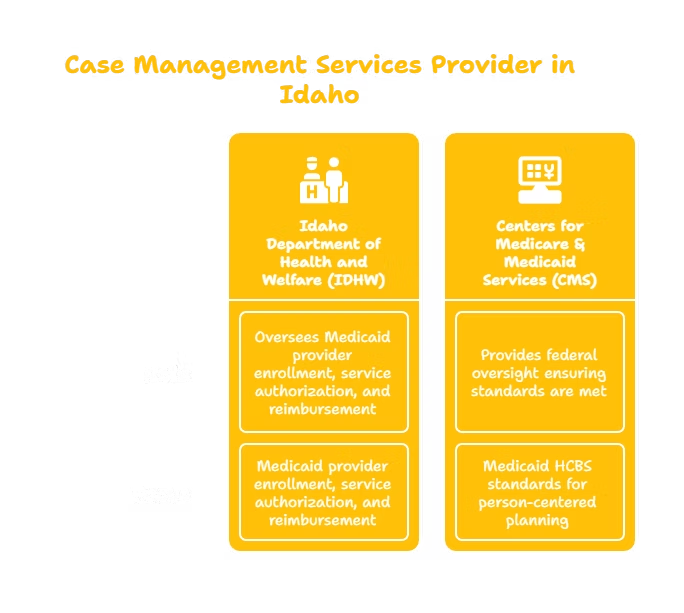
The regulatory framework for case management in Idaho is established by the Idaho Department of Health and Welfare (IDHW), specifically through the Division of Medicaid. The IDHW maintains direct oversight of provider enrollment, service authorization criteria, and the processes for reimbursement. Organizations looking to enter this space must align their operations with IDHW directives to ensure compliance with state-specific Medicaid mandates.
At the federal level, the Centers for Medicare & Medicaid Services (CMS) provides the overarching standards for all Medicaid HCBS waiver programs. These standards mandate that all service coordination remains strictly person-centered. Compliance with these federal regulations is essential, as it dictates how states structure their waiver programs and how individual case management agencies must document their interactions with participants to ensure the long-term sustainability of the Medicaid program.
Step-by-Step Provider Enrollment and Readiness
The provider enrollment process begins with the registration of a business entity with the Idaho Secretary of State and the procurement of an Employer Identification Number (EIN) and a Type 2 National Provider Identifier (NPI). Once the organizational structure is in place, providers must register through the Idaho Medicaid Management Information System (MMIS). This step is critical, as it establishes the agency’s identity within the state’s official billing and tracking ecosystem.
Following registration, applicants must undergo a program readiness review. During this phase, the IDHW evaluates the agency's internal policies, documentation templates, and staff qualifications. Providers must demonstrate that they have robust systems for participant intake, service plan development, and critical incident reporting. Success in this phase is dependent on presenting a clear, audit-ready operational framework that satisfies all state and federal requirements.
- Submit comprehensive business documentation, including Articles of Incorporation and insurance certifications.
- Provide detailed templates for participant intake, monitoring checklists, and grievance handling.
- Demonstrate proof of HIPAA-compliant record-keeping and secure communication protocols.
- Coordinate with IDHW to configure billing codes specific to Targeted Case Management (TCM) and HCBS waiver programs.
Establishing Mandatory Staffing and Training Protocols
Staffing requirements are rigorous to ensure the highest standard of care for vulnerable populations. The Case Management Program Supervisor must hold at least a Bachelor’s or Master’s degree in social work, nursing, psychology, human services, or a related field, alongside relevant supervisory experience. Case managers must possess a minimum of a Bachelor’s degree and demonstrate prior experience in the field of disability services or Medicaid populations.
Beyond academic credentials, the agency must implement a comprehensive training curriculum for all staff. This training must cover essential areas such as person-centered planning, participant rights, and the nuances of community integration. Ongoing education is a requirement for maintaining licensure, with staff needing annual competency evaluations to ensure their practice remains aligned with the evolving standards of Medicaid service delivery.
Operationalizing Documentation and Compliance Systems
Maintaining a high level of administrative accuracy is the hallmark of a successful Case Management Services provider. The Policy and Procedure Manual serves as the backbone of the organization, providing clear guidance on service coordination, referral protocols, and HIPAA-mandated confidentiality. Agencies must be prepared to document every interaction with a participant, from the initial comprehensive assessment to ongoing reassessments that justify the continued need for waiver services.
Risk management and emergency preparedness are also non-negotiable components of the required policy infrastructure. Agencies are required to have established protocols for reporting critical incidents and ensuring that participants have access to emergency resources. By integrating these systems into a centralized digital or physical management platform, providers can ensure they remain prepared for regular state audits and compliance reviews.
Frequently Asked Questions
What types of Medicaid waiver programs in Idaho require Case Management Services?
Case Management Services are authorized across several major Idaho programs, including the Developmental Disabilities (DD) Waiver, the Aged and Disabled (A&D) Waiver, and the Children’s Developmental Disabilities Waiver. Additionally, these services are provided under the Medicaid State Plan Targeted Case Management (TCM) programs.
How long should a new agency expect the enrollment and startup process to take?
The timeline varies based on the agency's readiness, but generally, business formation and credentialing take 1–2 weeks, staff hiring and development takes 2–3 months, the Medicaid enrollment and readiness review process spans 60–90 days, and final billing system configuration takes an additional 30–45 days.
What are the essential documents required for the IDHW provider application?
Applicants must provide Articles of Incorporation, proof of EIN and NPI, staff credentialing documentation, proof of liability insurance, and a comprehensive Policy and Procedure Manual that covers intake, assessment, HIPAA compliance, grievance handling, and emergency reporting.
Strategic Implementation and Growth
Launching a case management agency in Idaho is a complex undertaking that requires careful coordination between legal, clinical, and administrative functions. WCG supports organizations in this effort by providing structured guidance on business setup, staff credentialing, and the development of Medicaid-compliant documentation systems. Our services include assisting with the creation of participant intake forms, quality assurance programs for measuring participant satisfaction, and strategies for effective resource networking within the community.
For founders, the key takeaway is that regulatory compliance is not a static goal but an ongoing operational commitment. Success is achieved by building a culture of accountability where every staff member understands the importance of person-centered documentation and the critical role that accurate billing and service monitoring play in the stability of Idaho’s HCBS system. By focusing on these foundational elements, agencies can effectively support the independence of those they serve while ensuring the long-term viability of their business.
Last verified: September 2024. The information provided is for educational purposes only and does not constitute legal or professional advice. Always consult directly with the Idaho Department of Health and Welfare (IDHW) regarding current Medicaid provider requirements and program updates.