CASE MANAGEMENT SERVICES PROVIDER IN DELAWARE
By Fatumata Kaba · 2025-07-07 · 5 min read
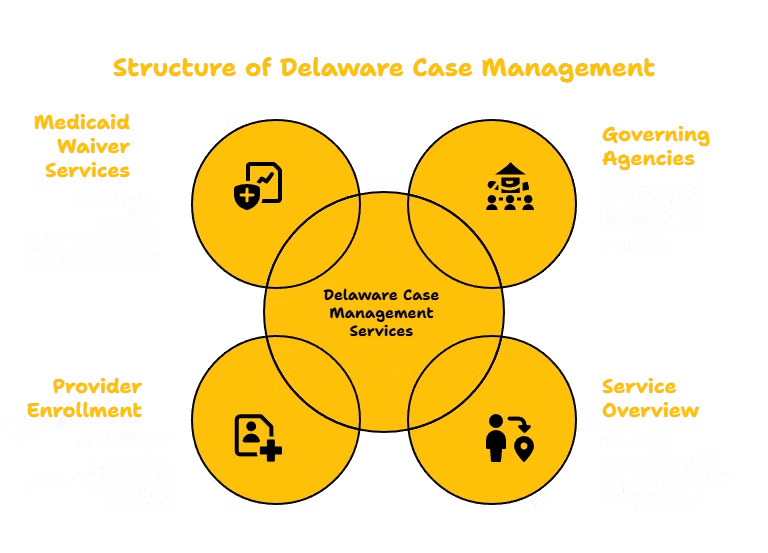
Becoming a Case Management Services provider in Delaware is a rigorous process that requires a deep understanding of the regulatory landscape governing Home and Community-Based Services (HCBS). Agencies aiming to serve individuals with disabilities must demonstrate full compliance with the standards set by the Division of Developmental Disabilities Services (DDDS) and the Division of Medicaid and Medical Assistance (DMMA) to ensure that participants receive person-centered, high-quality care coordination that enables them to live safely and independently in their communities.
This guide serves as a foundational resource for organizations navigating the path toward becoming a state-approved Medicaid HCBS case management provider. By aligning operational structures with the specific mandates of the Delaware Lifespan Waiver and state Medicaid requirements, new providers can establish sustainable programs that bridge the gap between essential medical, social, and behavioral health services.
What is the Role of Case Management in Delaware’s HCBS System?
Case Management Services in Delaware are designed to act as the central hub for an individual’s support system. By coordinating care, services, and supports, case managers ensure that individuals with complex support needs or disabilities are not navigating the healthcare landscape in isolation. The core objective is the effective planning, coordination, and monitoring of services, ensuring that every participant’s unique life goals and medical requirements are met through the structure of the Lifespan Waiver.
The primary responsibilities involve acting as a navigator for the participant. Case managers must possess the clinical and administrative capacity to manage ongoing relationships with support teams, family members, and community service providers. By maintaining an up-to-date Individual Service Plan (ISP), these providers translate a participant's preferences into actionable service delivery, all while ensuring that health, safety, and community integration remain the top priorities.
How Do Governing Agencies Oversee Provider Compliance?
The Delaware HCBS ecosystem operates under a hierarchical structure of oversight. The Delaware Division of Developmental Disabilities Services (DDDS) serves as the primary agency overseeing case management under the Lifespan Waiver, focusing on the quality of person-centered planning and the consistent monitoring of services delivered to individuals. Providers are expected to maintain constant communication with DDDS to remain aligned with evolving waiver requirements.
At the funding level, the Division of Medicaid and Medical Assistance (DMMA) administers all Medicaid-related financial policies and compliance standards. Because these services are Medicaid-funded, they must also adhere to federal regulations established by the Centers for Medicare & Medicaid Services (CMS). This tripartite structure ensures that providers are not only meeting state-level quality benchmarks but are also maintaining the financial and administrative integrity required for federal Medicaid reimbursement.
What are the Operational Requirements for New Providers?
The path to becoming an approved provider begins with formal business formation. Organizations must register with the Delaware Division of Corporations, obtain an Employer Identification Number (EIN) from the IRS, and secure a National Provider Identifier (NPI) Type 2. These administrative prerequisites provide the legal foundation upon which all subsequent Medicaid enrollment and service provision contracts are built.
Beyond legal registration, prospective providers must implement a robust internal infrastructure. This includes maintaining comprehensive general liability and professional insurance, establishing full HIPAA compliance for electronic health records, and ensuring that all organizational policies reflect the principle of conflict-free case management. Providing services requires a commitment to a person-centered model, where the participant’s voice is the primary driver in every assessment, referral, and service update.
What Steps are Required to Enroll as a Medicaid Provider?
The enrollment process is a sequenced journey that begins with establishing the business identity and ends with the activation of referral networks. After obtaining the necessary business credentials, the provider must submit a formal application to the DDDS to be considered a Lifespan Waiver Case Management Provider. This application must include organizational charts, a clear service delivery approach, and professional resumes demonstrating the qualifications of the proposed staff.
Once the DDDS approval is obtained, the organization must complete the enrollment process through the Delaware Medicaid Assistance Program (DMAP). This is the final gatekeeping step that enables the provider to bill for services rendered. Throughout this process, it is essential to cultivate relationships with existing Support Coordinators and community organizations. Building this professional network early on is critical to receiving referrals once the provider is formally activated within the Medicaid system.
What Documentation and Staffing Standards Must Be Maintained?
Maintaining compliance is an ongoing, documented process. Providers must have a comprehensive policy and procedure manual that covers every aspect of service delivery, from initial intake and assessment protocols to the nuanced procedures required for crisis planning and incident reporting. Audit readiness is achieved only when these policies are clearly documented, consistently practiced, and accessible for review by DDDS or DMMA officials.
- Case managers must hold a Bachelor’s degree in a relevant field like social work, psychology, or nursing.
- Staff must be proficient in person-centered planning, cultural competence, and mandated reporting protocols.
- Documentation must include regular contact notes, ISP updates, and service monitoring logs that track progress against established goals.
- Ongoing training, including annual CEU compliance and HIPAA refreshers, must be tracked for every staff member.
Frequently Asked Questions
What is the typical timeline to launch a Case Management practice in Delaware?
The process generally spans several months. Initial business formation takes approximately 1-2 weeks, followed by the DDDS provider application process, which typically lasts 30-60 days. Staff onboarding, policy development, and system testing usually require another 2-4 weeks before the provider is ready for referral activation.
Is a Program Supervisor required for a new Case Management agency?
While requirements can vary, having a Program Supervisor or Compliance Officer is strongly recommended. This role is essential for maintaining oversight of documentation quality, regulatory compliance, and staff performance, ensuring that the agency remains audit-ready and consistently meets the high standards required by the DDDS.
What are the primary funding sources for these services?
Case Management services are primarily reimbursed through the Delaware Lifespan Waiver (DDDS). Some populations may also be eligible for services under the State Plan Targeted Case Management, depending on specific eligibility criteria and the nature of the support required.
Key Takeaway
Establishing a Case Management agency in Delaware requires careful adherence to the standards set forth by the DDDS and DMMA. Success is built upon a foundation of compliant business practices, qualified staffing, and an unwavering commitment to the person-centered principles that define the Lifespan Waiver. By focusing on rigorous documentation and effective service coordination, new providers can successfully contribute to the independence and well-being of Delaware's disability community.
Last verified: October 2023. This information is for educational purposes only and does not constitute legal or professional advice. Always consult directly with the Delaware Division of Developmental Disabilities Services (DDDS) and the Division of Medicaid and Medical Assistance (DMMA) for the most current regulatory requirements and enrollment guidelines.