CASE MANAGEMENT SERVICES PROVIDER IN COLORADO
By Fatumata Kaba · 2025-07-06 · 6 min read
NAVIGATING LONG-TERM SERVICES AND SUPPORTS (LTSS) TO ENSURE INDIVIDUALIZED CARE AND COMMUNITY INTEGRATION
Case Management Services in Colorado provide the essential bridge between individuals with disabilities, chronic health conditions, or age-related needs and the vital Home and Community-Based Services (HCBS) they require. As part of Colorado’s comprehensive Medicaid redesign, the state has transitioned to a conflict-free case management model, requiring a strict separation between entities that manage care and those that deliver direct services. Organizations seeking to operate in this space must be designated as Case Management Agencies (CMAs) by the Colorado Department of Health Care Policy and Financing (HCPF) to facilitate person-centered planning, service coordination, and long-term support monitoring.
What is the Strategic Importance of the Colorado Case Management Redesign?
The Colorado Case Management Redesign represents a fundamental shift in how Long-Term Services and Supports are administered across the state. By moving toward a conflict-free model, the HCPF aims to ensure that the individuals planning and authorizing a participant's services have no financial or vested interest in the service delivery itself. This objective oversight is designed to protect participant choice and ensure that every service plan is developed solely in the interest of the individual’s health, safety, and community integration goals.
For providers, this means that operating as a CMA requires a high level of administrative integrity and rigorous adherence to state-mandated compliance standards. CMAs act as the primary point of contact for participants, managing everything from initial intake and eligibility determinations to the ongoing monitoring of care outcomes. As the state continues to refine these systems, agencies must remain agile and deeply integrated into the HCPF’s data and documentation expectations to maintain their designated status.
How Does the CMA Designation and Enrollment Process Work?
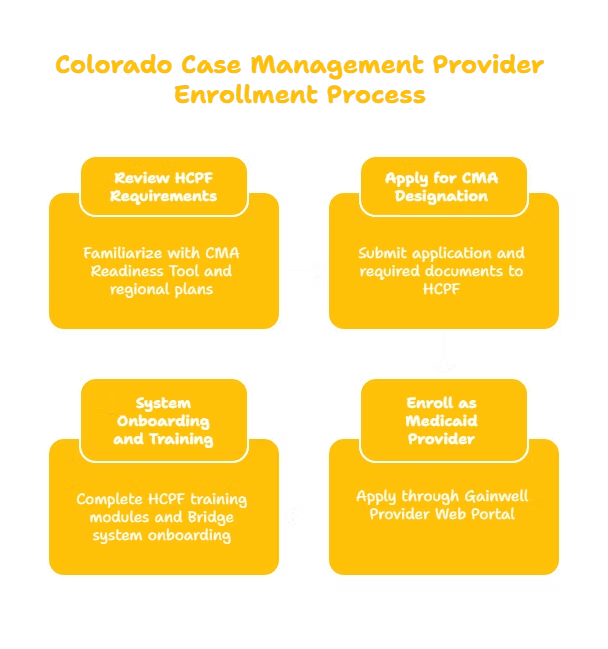
Securing status as an approved Case Management Agency is a multi-phased endeavor that begins long before a provider can begin billing for services. Organizations must first solidify their business foundation by registering with the Colorado Secretary of State and obtaining the necessary federal tax identification and NPI (Type 2) numbers. These foundational steps must be followed by a formal application to the HCPF, which includes proving that the agency meets conflict-free criteria and possess the organizational infrastructure to manage complex Medicaid workloads.
Once an agency has been designated by HCPF, the focus shifts to Medicaid provider enrollment. This requires active engagement with the Gainwell Provider Web Portal, where agencies must submit detailed organizational disclosures, policies, and administrative procedures. The process concludes with system onboarding, which is critical for accessing the state’s case management database, known as Bridge. Successful enrollment is contingent upon the agency’s ability to demonstrate that its internal workflows align with state-mandated requirements for documentation and care planning.
- Register business with the Colorado Secretary of State.
- Obtain EIN from the IRS and NPI (Type 2).
- Apply and be designated as a Case Management Agency (CMA) by HCPF.
- Demonstrate separation from direct service provision (conflict-free criteria).
- Enroll as a Colorado Medicaid provider via the Gainwell Provider Web Portal.
- Complete HCPF training modules and Bridge system onboarding.
What Documentation and Operational Policies are Mandatory?
Auditable documentation is the bedrock of a successful Case Management Agency. Because CMAs are responsible for authorizing public funds, the HCPF requires comprehensive evidence that every service plan, assessment, and monitor is handled in strict accordance with state rules. Agencies must maintain a robust policy and procedure manual that covers everything from initial intake protocols to complex crisis planning. These policies must be accessible, current, and regularly audited to ensure they meet the latest regulatory updates.
Beyond general administrative documents like articles of incorporation, an agency must possess specific templates for person-centered service planning and clinical monitoring. Every interaction with a participant—or the coordination of their care—must be documented within the Bridge system. Failure to maintain these records in a HIPAA-compliant, secure, and organized manner poses a significant risk to the agency’s standing with the state, making rigorous internal quality assurance a standard, rather than an optional, activity.
How Must Agencies Structure Their Staffing and Training?
Staffing a CMA requires individuals with specific clinical and social work competencies. Case managers must possess at least a bachelor’s degree in social work, nursing, psychology, or a closely related human services field. Because they are the face of the agency to the participant, they must also be deeply familiar with the nuances of HCBS waivers and Medicaid eligibility criteria. Supervisors and clinical reviewers, meanwhile, are tasked with the high-stakes responsibility of auditing plans, approving clinical decisions, and ensuring that the agency’s documentation remains audit-ready.
Continuous education is a non-negotiable component of staff development. All personnel must complete HCPF-required training modules covering topics such as person-centered planning, critical incident reporting, and the functional use of the Bridge system. Because the regulatory landscape for Medicaid LTSS is subject to change, agencies should implement quarterly refreshers and ongoing training cycles to ensure that all team members are updated on best practices and compliance expectations.
Which HCBS Waiver Programs Require Case Management?
Case Management Services serve as the essential administrative arm for a wide variety of Colorado’s Medicaid waiver programs. Each waiver targets a specific population, ranging from the Elderly, Blind, and Disabled (EBD) population to children with extensive support needs or developmental disabilities. The role of the CMA is to ensure that the unique needs of these populations are met through the tailored application of waiver resources and community-based supports.
Approved CMAs provide a consistent scope of work across these programs, focusing on intake, eligibility screening, and ongoing care team coordination. Whether managing the HCBS-DD waiver or supporting those in the HCBS-CMHS program, the case manager must remain the primary advocate for the participant. They are responsible for ensuring that the person-centered service plan is not merely a static document, but a dynamic, active tool that evolves with the participant's changing health status and personal goals.
Frequently Asked Questions
What is the primary role of a Case Management Agency in the conflict-free model?
In the conflict-free model, the primary role of the CMA is to provide independent, unbiased support to the participant. CMAs assess needs, develop person-centered service plans, and coordinate services without the influence of direct service provision, ensuring the participant’s care choices are prioritized and objective.
What is the purpose of the Bridge system for CMAs?
Bridge is the official Colorado state case management system used for documentation, data entry, and tracking. It is a critical tool for ensuring that all eligibility information, service authorizations, and monitoring outcomes are recorded in compliance with HCPF standards.
What is the expected timeline for establishing a new Case Management Agency?
The timeline varies based on the agency's readiness, but generally, business formation takes 1–2 weeks, followed by a 60–90 day window for the HCPF CMA designation application. Subsequent Medicaid enrollment and system access via Gainwell typically require an additional 30–45 days, with staff training and onboarding spanning 2–4 weeks.
The successful launch and management of a Case Management Agency in Colorado depend on strict adherence to the HCPF redesign framework, a commitment to high-quality clinical documentation, and a robust understanding of the state’s Medicaid waiver systems. By focusing on administrative compliance and maintaining well-trained staff, providers can ensure the delivery of essential, individualized support to Colorado's most vulnerable populations.
Last verified: August 2024. This content is provided for informational purposes only and does not constitute legal or professional advice. Always consult directly with the Colorado Department of Health Care Policy and Financing (HCPF) and relevant state regulations for the most current requirements and compliance standards applicable to your agency.