CASE MANAGEMENT SERVICES PROVIDER IN CALIFORNIA
By Fatumata Kaba · 2025-07-06 · 5 min read
What Are Case Management Services in California?
Case management services in California serve as a critical bridge, enabling individuals with developmental disabilities to navigate complex support systems, access necessary resources, and achieve personal autonomy. These services focus on empowering individuals to thrive within their communities by meticulously coordinating care based on unique needs, health goals, and personal preferences.
The delivery of these services is primarily structured through California’s 21 nonprofit Regional Centers, operating under the mandate of the Lanterman Developmental Disabilities Services Act. Beyond the traditional Regional Center model, individuals may also access case management through the Self-Determination Program (SDP) or via specific Home and Community-Based Services (HCBS) waivers. By providing ongoing monitoring and advocacy, case managers ensure that the services delivered remain aligned with the individual's evolving life trajectory.
How Do Regulatory Agencies Oversee Service Delivery?
The landscape of California’s developmental disability system involves a tiered hierarchy of oversight agencies, each playing a distinct role in ensuring quality and compliance. The California Department of Developmental Services (DDS) serves as the primary state authority, providing statewide guidance and policy direction for both Regional Centers and SDP providers. By setting the standards for service delivery, the DDS ensures a baseline of quality across the state's diverse geographic regions.
At the local level, the 21 nonprofit Regional Centers act as the primary operational hubs, employing or contracting with service coordinators to facilitate the development and implementation of the Individual Program Plan (IPP) or Person-Centered Plan (PCP). On a broader scale, the California Department of Health Care Services (DHCS) administers the state’s Medicaid funding, coordinating closely with the federal Centers for Medicare & Medicaid Services (CMS) to ensure that all waiver-based services adhere to strict federal HCBS standards.
What Is the Scope of Services for Case Management Providers?
Approved case management providers fulfill a multifaceted role that goes beyond simple referrals. Their primary responsibility is to ensure that individuals receive the services for which they are eligible while maintaining alignment with their health, educational, and vocational goals. Whether operating as a Regional Center staff member or an Independent Facilitator under the Self-Determination Program, the provider is responsible for the integrity of the person-centered planning process.
Core operational responsibilities include:
- Conducting comprehensive needs assessments and facilitating person-centered planning meetings.
- Developing, monitoring, and updating the Individual Program Plan (IPP) or Person-Centered Plan (PCP).
- Coordinating a wide array of medical, educational, vocational, and community-based supports.
- Providing ongoing referrals to specialized service providers, accessible housing, and essential benefit resources.
- Maintaining meticulous documentation of all contacts, activities, and clinical outcomes to ensure high-quality service delivery.
What Are the Pathways to Provider Enrollment and Vendorization?
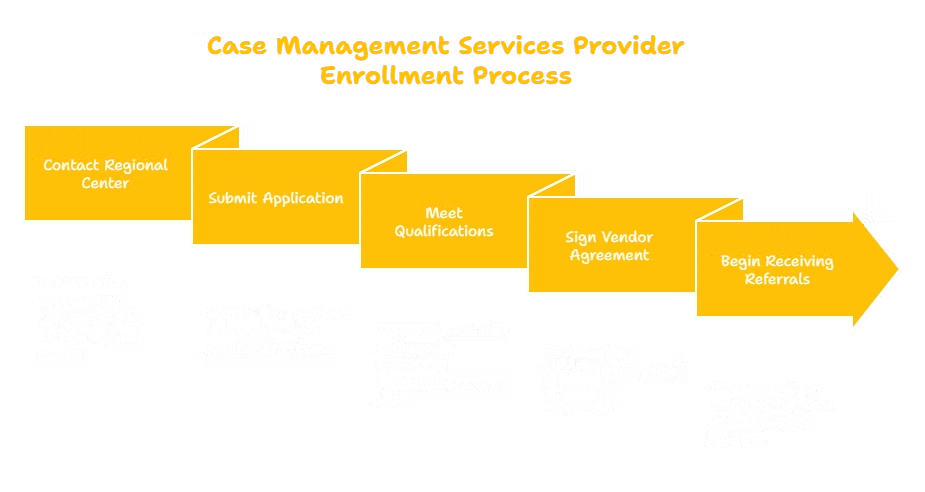
To operate as a case management provider, an entity must secure appropriate authorization through one of two primary pathways. The first path is Regional Center Vendorization (Service Code 880), which requires a formal application process with a local Regional Center. This involves submitting organizational documentation, passing quality assurance reviews, and demonstrating that the agency meets established staffing qualifications before signing a vendor agreement.
The second path is participation as an Independent Facilitator within the Self-Determination Program (SDP). This route requires the completion of a mandatory DDS-approved Independent Facilitator training course. Unlike traditional vendorization, there is no formal "vendor number" assigned by a Regional Center; however, providers must coordinate with a Financial Management Services (FMS) entity to handle the fiscal aspects of the client’s budget. This role is highly specialized, focusing on supporting the participant’s planning team and tracking service utilization within the individual’s allocated budget.
What Essential Documentation and Staffing Standards Must Be Met?
Success as a case management provider requires a robust internal infrastructure. Before beginning operations, an agency must possess a clear set of administrative documents, including Articles of Incorporation or a Fictitious Business Name (FBN), an IRS-issued EIN, a Type 2 NPI, and current liability insurance. Furthermore, the agency must maintain a comprehensive Policy & Procedure manual that covers intake protocols, person-centered planning tools, service monitoring, and strict confidentiality guidelines.
Staffing requirements are equally rigorous to ensure professional competency. Case managers must hold a bachelor's degree in social work, psychology, education, or a related field, supplemented by professional experience in developmental disabilities or community service coordination. All personnel must pass background clearances, such as Live Scan, and fulfill mandatory training requirements, including:
- Comprehensive study of the Lanterman Act and person-centered planning principles.
- Training in HCBS compliance, ethical practices, and HIPAA-compliant documentation.
- Emergency response protocols and mandated reporting requirements.
- Annual education regarding cultural competence and effective client advocacy strategies.
Frequently Asked Questions
What is the difference between an IPP and a PCP?
An Individual Program Plan (IPP) is the formal plan developed by the Regional Center for individuals receiving services under the Lanterman Act. A Person-Centered Plan (PCP) is a more specialized, strengths-based approach often used in the Self-Determination Program that focuses on the individual's unique life goals and desired outcomes, though both serve to drive service authorization.
Is an NPI required for a case management agency?
Yes, all providers billing for medical or community-based services in the Medicaid waiver system typically require a Type 2 NPI (Organizational) to uniquely identify the business in electronic transactions and government reporting.
How long does the vendorization process take?
While timelines vary based on the specific Regional Center’s workload, the typical window for vendorization is 45 to 90 days, following the initial contact and submission of the required application packet.
Key Takeaways for Prospective Providers
Launching a case management service requires careful attention to regulatory compliance, thorough administrative preparation, and a commitment to person-centered outcomes. Success is contingent upon following the established pathways for Regional Center vendorization or Independent Facilitator certification, maintaining rigorous documentation standards, and ensuring all staff meet the educational and ethical requirements set forth by the California Department of Developmental Services. By systematically addressing business formation, credentialing, and operational policy development, providers can successfully integrate into the California waiver ecosystem and provide essential support to the developmental disability community.
Last verified: August 2024. This content is for informational purposes only and does not constitute legal or professional advice. Always verify current requirements with your specific Regional Center or state agency.