CASE MANAGEMENT SERVICES PROVIDER IN ALABAMA
By Fatumata Kaba · 2025-06-28 · 5 min read
Case Management Services in Alabama act as the foundational support system for individuals with intellectual and developmental disabilities (IDD), ensuring they receive necessary community-based resources through Medicaid HCBS waivers. By acting as the central coordinator for person-centered care, case management agencies bridge the gap between complex regulatory requirements and the actual delivery of life-enhancing services for program participants.
Operating a Case Management agency requires a deep understanding of the protocols established by the Alabama Department of Mental Health (ADMH) and the Alabama Medicaid Agency. Providers must facilitate ongoing assessments, develop comprehensive service plans, and perform consistent monitoring to ensure that every individual is supported in achieving their goals for independence and community integration.
What Are the Governing Agencies and Regulatory Frameworks?
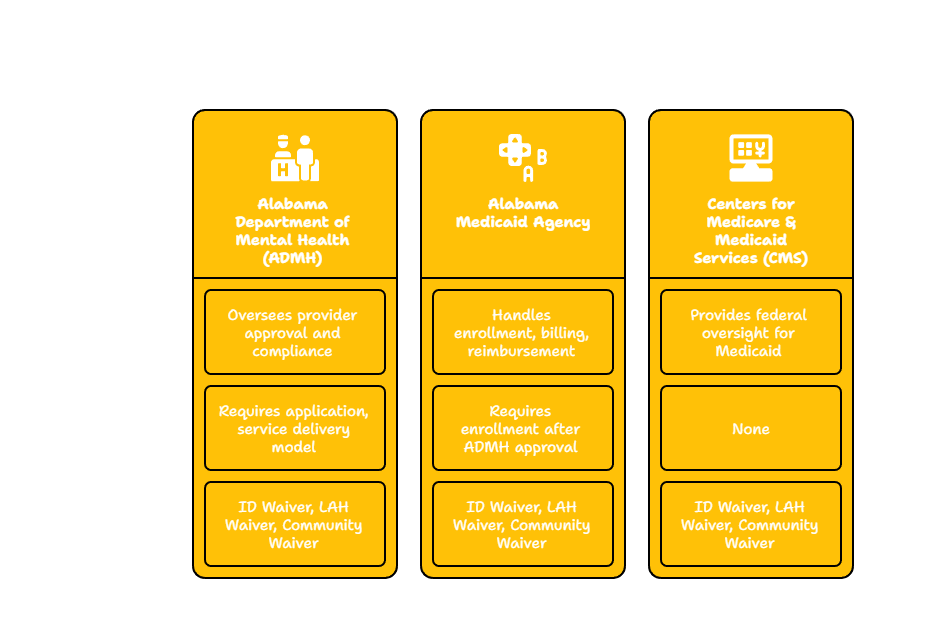
The provision of Case Management Services in Alabama is highly regulated to ensure participant safety and the responsible use of public funds. The Alabama Department of Mental Health (ADMH) serves as the primary regulatory body, overseeing provider approval, mandatory staff training, and ongoing compliance with state quality standards. Their oversight ensures that agencies remain aligned with the specific requirements of Alabama’s Home and Community-Based Services (HCBS) waivers.
The Alabama Medicaid Agency works in tandem with the ADMH, focusing on the fiscal and administrative aspects of service delivery. This agency manages Medicaid enrollment, handles billing submissions, and processes reimbursements for authorized case management activities. At the federal level, the Centers for Medicare & Medicaid Services (CMS) provides the overarching regulatory structure, mandating that all services meet federal person-centered coordination requirements to maintain waiver eligibility.
How Are Case Management Services Delivered?
Case Management Services are fundamentally person-centered, meaning they are tailored to the unique goals and support needs of each individual enrolled in the ID, LAH, or Community Waiver programs. Case managers facilitate a comprehensive assessment of needs across various life domains, including health, employment, housing, and social inclusion. This information is synthesized into a formal person-centered service plan that serves as the blueprint for all subsequent support.
Beyond planning, providers are responsible for the ongoing coordination and linkage to essential supports. This involves continuous monitoring to ensure that services are delivered as promised and that the consumer remains satisfied with their quality of life. Case managers also provide critical advocacy, assisting individuals in navigating crises, managing transitions between service types, and resolving potential barriers to success.
- Comprehensive assessment of needs across all life domains.
- Development and ongoing maintenance of the person-centered service plan.
- Direct coordination and linkage to medical, behavioral, and social resources.
- Continuous monitoring of service delivery and consumer satisfaction.
- Crisis planning and support during service transitions.
What Are the Prerequisites for Provider Approval?
Before an agency can begin serving individuals, it must satisfy several foundational administrative requirements. The business must be formally registered with the Alabama Secretary of State and obtain an Employer Identification Number (EIN) from the IRS. Furthermore, a Type 2 National Provider Identifier (NPI) is necessary to function as a professional healthcare organization within the Medicaid system.
Logistically, providers must maintain a physical or virtual office presence capable of serving their assigned geographic regions. The organization must demonstrate its operational capacity by employing qualified staff and implementing robust internal systems. These systems should be capable of tracking professional contacts, managing detailed service plans, and documenting progress toward participant goals across multiple service domains.
How Do You Navigate the ADMH Enrollment Process?
The enrollment process is a multi-phased journey that begins with a formal request to the ADMH for the Case Management Services Provider Application Packet. The applicant must submit a detailed service delivery model that clearly defines their assessment tools, contact standards, and methodologies for developing person-centered plans. Additionally, the application must include comprehensive policies covering client confidentiality, emergency response protocols, and inter-agency coordination strategies.
Following the document submission, the process moves into a rigorous credentialing and readiness phase. This includes verifying the background and qualifications of all staff members, ensuring every case manager holds the required education—typically a Bachelor’s degree or higher in a human services field—and has completed all necessary training in disability services and Medicaid compliance. The final phase involves a programmatic review where the ADMH evaluates the agency's internal tracking systems, file management quality, and supervisory structures before granting approval to enroll with the Alabama Medicaid Agency for billing.
What Documentation and Staffing Standards Must Be Met?
Maintaining high-quality documentation is the cornerstone of regulatory compliance. An agency must maintain a comprehensive Policy and Procedure Manual that encompasses everything from referral management and informed consent to abuse prevention and grievance procedures. Staff must be diligent in creating and storing signed service plans, progress notes, and records of regular contact with the individuals they serve.
Staffing requirements are strictly enforced to protect the welfare of the IDD population. A Case Manager must hold a Bachelor’s degree or higher in a field such as psychology, social work, or special education. The Program Supervisor, who oversees quality assurance and clinical compliance, is generally required to possess a Master’s degree. All personnel, regardless of their specific role, must complete mandatory orientation, annual training in ethics and person-centered planning, and ongoing modules regarding the protection of participant rights.
Frequently Asked Questions
What are the primary Alabama Medicaid Waivers that utilize Case Management?
Case Management Services are authorized under the ID Waiver (Intellectual Disabilities Waiver), the LAH Waiver (Living at Home Waiver), and the State of Alabama Community Waiver Program. These programs provide the mechanism for Medicaid reimbursement for coordination services.
How long should a new agency expect the launch timeline to be?
The timeline typically spans several months. Business formation takes roughly 1 week, followed by 60–90 days for the ADMH application review, 30–60 days for hiring and infrastructure setup, and an additional 60–90 days for final Medicaid enrollment and billing setup.
What specific qualifications must case management staff possess?
Staff must hold at least a Bachelor’s degree in a human services or related field. Furthermore, all staff members are required to complete ADMH-specific orientation and ongoing annual training in person-centered planning, Medicaid documentation standards, and the protection of consumer rights.
Key Takeaway
Success as a Case Management Services provider in Alabama depends on meticulous adherence to ADMH and Alabama Medicaid standards. By prioritizing the rigorous development of internal policies, maintaining qualified and well-trained personnel, and fostering a deep commitment to the person-centered planning process, agencies can effectively support individuals with IDD while meeting the complex regulatory requirements of the state’s HCBS waiver programs.
Last verified: 2024. The information provided herein is for educational purposes only and does not constitute legal or professional advice. Always consult directly with the Alabama Department of Mental Health and the Alabama Medicaid Agency for the most current regulatory guidance, as requirements are subject to change.