California NEMT Vehicle Requirements: What Your Medi-Cal Vans Must Have
By Fatumata Kaba · 2026-07-02 · 6 min read
To operate a Non-Emergency Medical Transportation (NEMT) service for Medi-Cal beneficiaries in California, your vehicles must comply with strict safety, accessibility, and operational standards mandated by the Department of Health Care Services (DHCS) and state transportation authorities. Ensuring every van in your fleet meets these regulatory benchmarks is the foundational requirement for successful enrollment, billing, and long-term compliance in the California Medicaid landscape.
Understanding the Medi-Cal NEMT Operational Framework
Non-Emergency Medical Transportation in California is a highly regulated service designed to transport beneficiaries who require medical care but do not need the life-support systems found in an ambulance. Because the population served often includes individuals with physical disabilities, cognitive impairments, or complex medical needs, the state enforces rigid standards on the vehicles used to transport them. These regulations are designed to ensure that the transition from a beneficiary's residence to a medical facility is both safe and dignified.
Failure to meet vehicle requirements is a primary cause for application delays and potential audit findings during the Medi-Cal enrollment process. As a provider, you must distinguish between the specific vehicle types required for different levels of service. Whether you are operating a fleet of wheelchair-accessible vans or specialized litter-equipped vehicles, your operational infrastructure must be vetted and fully compliant before you attempt to bill the DHCS for any rendered services.
Equipping Wheelchair Vans for Mobility Needs
Wheelchair-accessible vehicles are the backbone of most NEMT fleets. To meet California’s standard, a vehicle must be specifically engineered or modified to accommodate mobility devices safely. This goes beyond simply having a ramp or lift; the internal cabin must allow for the safe loading, movement, and stabilization of the passenger. Providers must ensure that the vehicle interior is kept clean and that all accessibility equipment is in optimal working order to pass periodic regulatory reviews.
Each wheelchair station within the vehicle must be equipped with specialized hardware to prevent movement during transit. These requirements are essential for maintaining the safety of the beneficiary and the liability protection of the provider agency. Every vehicle must demonstrate that it can accommodate a passenger without risk of shifting or tipping during acceleration, braking, or cornering.
- Mechanical Lifts or Ramps: Must be ADA-compliant and regularly maintained to ensure smooth operation during client boarding and deboarding.
- Securement Systems: Four-point tie-down systems must be installed to lock each mobility device firmly to the vehicle floor, ensuring it remains stationary during transit.
- Occupant Restraints: A separate, high-quality seatbelt and shoulder harness system is mandatory for the passenger, independent of the wheelchair securement mechanism.
Standards for Litter Van Operations
Transporting a client on a stretcher is classified as a distinct service level under Medi-Cal guidelines. You cannot fulfill this requirement with a standard minivan or a modified wheelchair van. Litter vans must be purpose-built or professionally outfitted to house a medical stretcher in a stable, secure, and sanitary environment. These vehicles serve patients who cannot sit upright and require a recumbent position for safe transport.
These vehicles are subject to heightened scrutiny regarding internal configuration. The interior must provide enough clearance for the stretcher to be loaded without tilting or jarring the patient. Additionally, the mounting system for the stretcher must be designed to absorb shocks during transit, ensuring that the client remains comfortable and stable throughout the trip. Sanitation is also a priority, as the interior surfaces must be easily cleanable and resistant to the medical environments common in NEMT operations.
Navigating Licensing and Permitting Requirements
Before a vehicle ever transports its first Medi-Cal beneficiary, it must be cleared for commercial operation. The state requires a tiered approach to licensing that involves multiple agencies, each ensuring that your fleet meets the legal standards for public transportation. These documents establish your agency as a legitimate entity authorized to perform NEMT services.
You generally need a California Public Utilities Commission (CPUC) transportation permit to provide these services for hire. Furthermore, each vehicle must carry current DMV commercial registration. These documents serve as the legal foundation for your fleet; without them, your Medi-Cal provider application will likely be rejected during the initial screening process. Maintaining these documents is a continuous responsibility, as expired permits can result in immediate suspension of billing privileges.
- CPUC Transportation Permit: Authorizes your agency to operate as a commercial passenger carrier within the state of California.
- DMV Commercial Registration: Confirms the vehicle is registered specifically for commercial usage rather than personal use, reflecting the regulatory requirements of the transportation sector.
- Commercial Insurance Proof: Must meet the minimum liability thresholds established for NEMT providers in California, providing coverage for both the agency and the beneficiaries.
Mandatory Inspections and Safety Protocols
The state of California mandates rigorous safety inspections to verify that your vehicles remain in top working condition. A passing vehicle safety inspection is a non-negotiable requirement. These inspections are designed to confirm that all mechanical components, including the lift, braking system, steering, and emergency lights, are functioning perfectly. Documentation of these inspections must be archived in your administrative office for audit purposes.
Beyond the hardware, your agency is responsible for the human component of fleet safety. Drivers must maintain clean DMV records, which are reviewed periodically to ensure ongoing eligibility. Furthermore, all personnel tasked with operating these vehicles must be certified in first aid and CPR. This ensures that in the event of an emergency during transport, your staff is equipped to handle the situation until professional medical assistance arrives, fulfilling a critical piece of the patient safety continuum.
Frequently Asked Questions
What is the difference between a wheelchair van and a litter van?
A wheelchair van is equipped with lifts and four-point tie-down systems to secure mobility devices. A litter van is a specialized vehicle designed specifically to transport patients on stretchers, requiring a mounting system that keeps the stretcher secure and stable during movement.
Are personal vehicles allowed for Medi-Cal NEMT services?
No. Medi-Cal NEMT services require commercial-grade, inspected, and permitted vehicles. Personal vehicles do not meet the safety, insurance, or equipment standards required for the transport of beneficiaries for hire under state regulations.
What documentation must be kept on file for each vehicle?
You must maintain a file for every vehicle that includes its current CPUC permit documentation, valid DMV commercial registration, current proof of commercial insurance, and the records of the most recent passing safety inspections.
Maintaining Fleet Compliance Over Time
Regulatory compliance is not a one-time event but a continuous administrative cycle. Provider agencies must implement a robust vehicle maintenance schedule that goes beyond the basic state requirements. This includes tracking the expiration dates of all permits and scheduling preventative maintenance for lifts and securement systems before they show signs of wear. Proactive management reduces the likelihood of service interruptions caused by vehicle downtime.
Documentation serves as the only evidence of your compliance during a DHCS audit. Administrators should maintain organized, easily accessible files for each vehicle in the fleet, indexed by license plate or vehicle identification number. By keeping meticulous records of safety checks, driver certifications, and insurance renewals, an agency demonstrates that it is a responsible partner in the Medi-Cal managed care ecosystem.
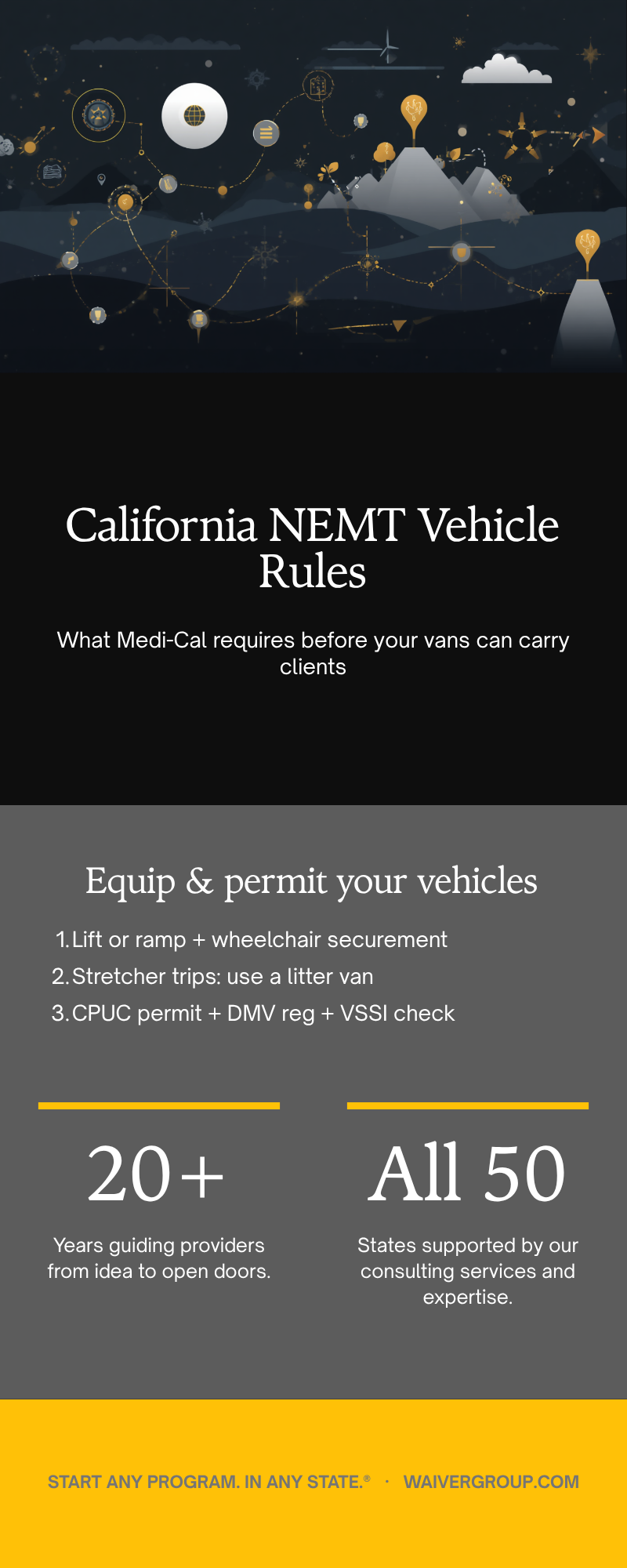
Key takeaway: Match each vehicle to its service level, equip wheelchair vans with lifts and securement, use a litter van for stretchers, and secure your CPUC permit, DMV registration, and inspection before you enroll to bill Medi-Cal.
Start Any Program. In Any State.®
20+ years clearing the path in all 50 states — we've done this before, and we'll do it for you. Book a video consultation at waivergroup.com/videoappointment · 302.888.9172 · [email protected]
Last verified: 2024. This content is for informational purposes only and does not constitute legal or professional advice. Always verify current state regulations and DHCS guidelines directly with the appropriate oversight agencies before initiating your program.