Build a Home Care Agency: What to Set Up Before Your First Client
By Fatumata Kaba · 2026-06-27 · 6 min read
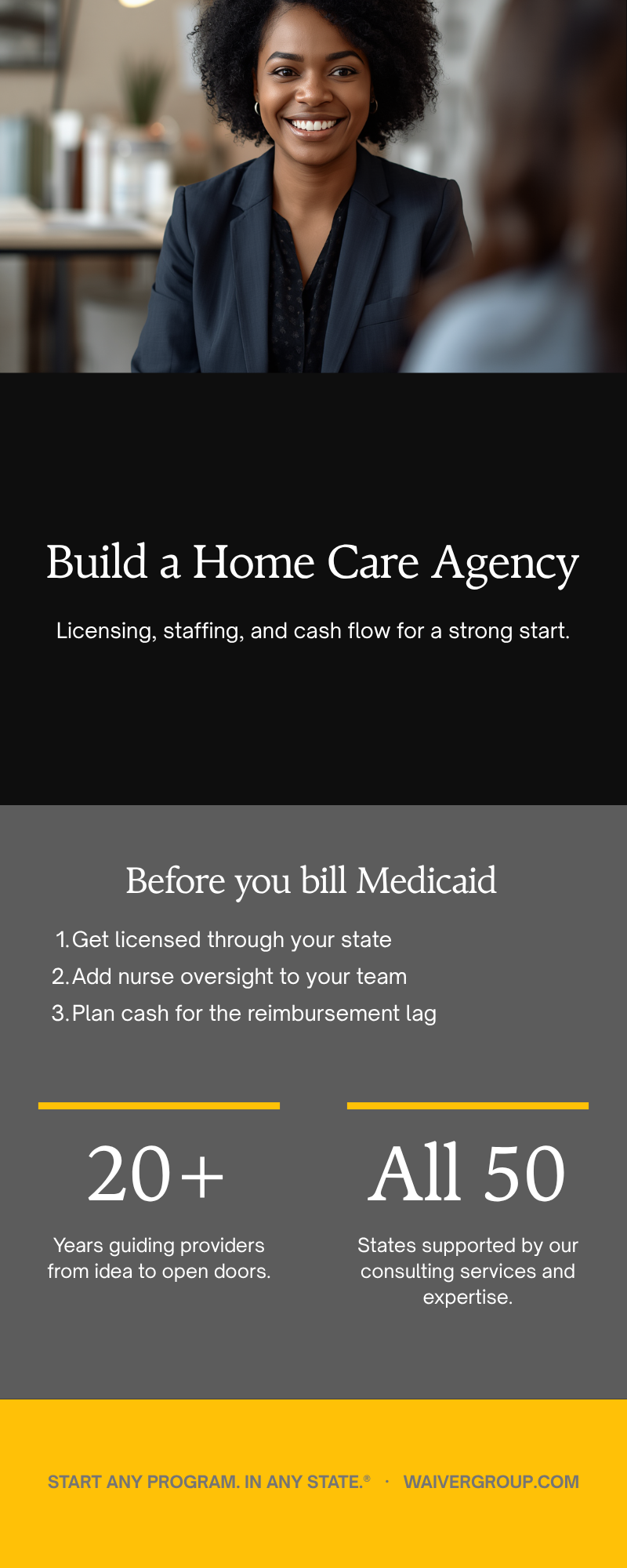
Building a successful non-medical home care agency requires a rigorous, systematic approach to regulatory compliance, operational infrastructure, and financial planning long before the first service is delivered. Success in the Medicaid Home and Community-Based Services (HCBS) space is defined by whether a provider has successfully established four critical pillars: a state license, clinical oversight, a sustainable cash flow strategy, and a robust, Electronic Visit Verification (EVV)-compliant workforce.
Navigating State-Specific Regulatory Requirements for Licensure
Most states mandate that a non-medical or personal care agency must obtain a specific license through the state’s health regulatory division or department of human services. This licensing process is not merely a formality; it is an extensive review of the agency’s capacity to provide safe, high-quality care to vulnerable populations. Regulators will scrutinize your agency’s organizational structure, clinical oversight documentation, and your ability to meet local administrative codes.
The application phase requires prospective owners to assemble a comprehensive policy and procedure manual. This documentation must mirror the specific state administrative codes regarding client rights, emergency preparedness, and grievance procedures. Failing to align your internal policies with state-mandated requirements during the initial application can lead to significant delays in licensure, extending your pre-operational phase by months.
Founders must treat the required operating budget not just as a static document for the application, but as a dynamic financial blueprint. State authorities often require proof of financial solvency or a detailed pro-forma budget to ensure the agency will not fold under the initial capital-intensive period. A well-constructed budget should account for overhead, professional liability insurance, surety bonds, and the administrative staff necessary to process claims and manage compliance.
Establishing Clinical Oversight in a Non-Medical Environment
Even though non-medical home care agencies focus on activities of daily living (ADLs) such as bathing, dressing, and mobility assistance, regulatory bodies almost universally mandate some level of clinical oversight. Most states require that a Registered Nurse (RN) be either on staff or contracted by the agency to verify the scope of service and ensure that the care plan meets the health and safety standards required by Medicaid waivers.
The integration of an RN is not only a regulatory necessity but a vital component of risk management. The nurse serves as the bridge between general personal care and the specific health-related outcomes defined in a participant's individualized service plan. This clinical presence ensures that the agency is identifying changes in a client’s condition early, thereby mitigating the risk of incidents that could jeopardize the agency’s licensure or trigger state audits.
The nurse’s role typically includes:
- Conducting initial and ongoing assessments of client care needs.
- Supervising the performance of personal care aides and home health aides.
- Developing and reviewing individualized service plans to ensure alignment with state Medicaid waiver regulations.
- Ensuring documentation meets the standards required for reimbursement.
Securing a Sufficient Cash Runway for Medicaid Reimbursement
A significant challenge for new agency owners is the inherent delay between the delivery of care and the actual receipt of payment. Medicaid reimbursement is rarely instantaneous; agencies often face a significant "lag" period that can last months from the date of enrollment until the first payment cycle is finalized and processed. Understanding the claims submission cycle is critical for maintaining agency solvency.
To survive this initial phase, an agency must secure sufficient operating funds to bridge the gap. This capital is necessary to cover immediate expenses, including payroll for caregivers who must be paid regardless of claim status. Without a robust financial buffer, an agency may find itself unable to retain high-quality staff, leading to high turnover and gaps in service that can result in regulatory penalties or loss of contracts.
Essential budgetary line items include:
- Payroll for caregivers and administrative staff.
- Software subscription costs for EVV and billing platforms.
- Ongoing licensing, surety bond renewals, and professional liability insurance premiums.
- Recruitment and background check fees for new staff members.
Developing a Compliance-Ready Workforce
A workforce is only as viable as its ability to satisfy the stringent documentation requirements of the state. Before an agency can bill for a single hour of care, caregivers—including those who may be family members hired under self-direction programs—must satisfy a rigorous list of prerequisites. Neglecting these steps will lead to denied claims and potential recoupment actions.
Operationalizing the hiring process requires a centralized system for tracking credentials. Each caregiver file must be audited periodically to ensure that certifications remain current and that mandatory training hours have been completed according to state timelines. Automation of these reminders can prevent the unintentional use of an ineligible staff member, which is a frequent trigger for regulatory citations.
Every caregiver file must typically contain the following before the first shift is logged:
- Completed and cleared criminal background checks and abuse registry screenings.
- Documentation of required certifications, such as basic first aid or cardiopulmonary resuscitation (CPR).
- Evidence of mandatory pre-service training modules as defined by the state’s HCBS program rules.
- Verification of employment eligibility and tax documentation.
Mastering Electronic Visit Verification (EVV) for Billing Integrity
Electronic Visit Verification (EVV) is no longer an optional tool; it is a federal requirement for all Medicaid-funded personal care services. EVV systems track the date, time, location, and type of service provided, creating a digital trail that is cross-referenced against Medicaid claims. If the EVV data does not align perfectly with the claim submitted, the agency will face rejection.
Agencies must ensure their staff is fully trained on how to properly clock in and out using the agency-selected EVV software. If a caregiver fails to record a visit correctly, the hours are effectively unbillable. For the agency founder, this means implementing a monitoring process to identify and correct EVV errors in real-time, preventing large-scale billing issues from compounding.
Proactive management of EVV data includes conducting weekly audits of visit logs. By addressing missing clock-outs or incorrect location data within the same pay period, administrators minimize the administrative burden of manual visit adjustments. Furthermore, consistent training for staff on the mobile applications or telephonic systems used for EVV can reduce common user errors, such as forgetting to tag specific tasks performed during the visit.
Frequently Asked Questions
What is the difference between non-medical home care and home health care?
Non-medical home care, often referred to as personal care services, focuses on assistance with activities of daily living (ADLs). Home health care involves skilled medical services provided by licensed nurses or therapists, which generally falls under more stringent clinical regulation and Medicare coverage rather than HCBS Medicaid waivers.
Can family members be hired as caregivers?
Many Medicaid waiver programs allow for family members to be hired as caregivers, particularly in consumer-directed or self-directed models. However, these caregivers are still subject to the same background checks, training, and EVV requirements as any other employee to ensure Medicaid compliance.
What happens if a Medicaid claim is denied?
Medicaid claims are typically denied due to missing documentation, inaccurate EVV data, or lapses in caregiver credentialing. Providers must perform a thorough audit of their clinical and payroll records to identify the discrepancy and, if the documentation exists, resubmit the claim according to the state’s specific appeal or correction process.
Key takeaway: Build the four foundations — license, nurse oversight, cash runway, and an EVV-ready workforce — before your first client, and enrollment becomes a step instead of a wall.
Start Any Program. In Any State.® Ready to move? Book a video consultation at waivergroup.com/videoappointment, call 302.888.9172, or email [email protected]. Last verified May 2024. This information is for educational purposes only and does not constitute legal or financial advice; consult with a qualified professional regarding your specific state regulations and requirements.