BEHAVIORAL SUPPORT SERVICES PROVIDER IN UTAH
By Fatumata Kaba · 2026-03-31 · 5 min read
Enhancing Behavioral Stability and Quality of Life for Individuals with Disabilities Through Positive Intervention and Care Planning
Behavioral Support Services in Utah are essential components of the Home and Community-Based Services (HCBS) framework, designed to assist individuals with intellectual disabilities, developmental disabilities (ID/DD), autism spectrum disorder (ASD), or co-occurring mental health conditions. These services provide specialized clinical interventions that help individuals reduce challenging behaviors while developing functional, socially appropriate alternatives to increase their independence and quality of life.
Administered by the Utah Department of Health and Human Services (DHHS) through the Division of Services for People with Disabilities (DSPD), these services operate under federal guidance from the Centers for Medicare & Medicaid Services (CMS). Providers must navigate a rigorous regulatory landscape to ensure compliance, maintain high standards of person-centered care, and secure reimbursement within the Medicaid waiver system.
What Are the Governing Agencies and Regulatory Frameworks?
The provision of Behavioral Support Services in Utah is strictly regulated to protect participant safety and ensure the efficacy of care. The Utah Department of Health and Human Services (DHHS), specifically the Division of Services for People with Disabilities (DSPD), serves as the primary governing authority. DSPD is responsible for authorizing behavioral supports within HCBS waivers, overseeing the delivery of services, and managing the reimbursement processes for enrolled providers.
On a federal level, the Centers for Medicare & Medicaid Services (CMS) oversees the integrity of Utah’s waiver programs. All providers must adhere to federal HCBS regulations, which mandate that services remain person-centered, promote community integration, and prioritize the rights and dignity of individuals with disabilities. Failure to comply with these state and federal mandates can result in suspension of billing privileges or termination of the provider agreement.
How Do Behavioral Support Services Function in Practice?
Behavioral Support Services are rooted in the application of positive behavior support (PBS) and clinical data analysis. The process begins with a comprehensive Functional Behavior Assessment (FBA), which is essential for identifying the environmental triggers and underlying causes of maladaptive behaviors. Once the assessment is complete, a Positive Behavior Support Plan (PBSP) is developed to provide a roadmap for the individual, their caregivers, and their support staff.
The core components of these services include:
- Conducting detailed FBAs to identify the function of challenging behaviors.
- Developing and implementing individualized Positive Behavior Support Plans (PBSPs).
- Providing systematic training to families, caregivers, and direct support staff on de-escalation strategies.
- Monitoring ongoing behavioral data to measure progress and revise plans as needed.
- Ensuring all interventions are trauma-informed, ethical, and aligned with the Person-Centered Support Plan (PCSP).
What Are the Licensing and Provider Approval Requirements?
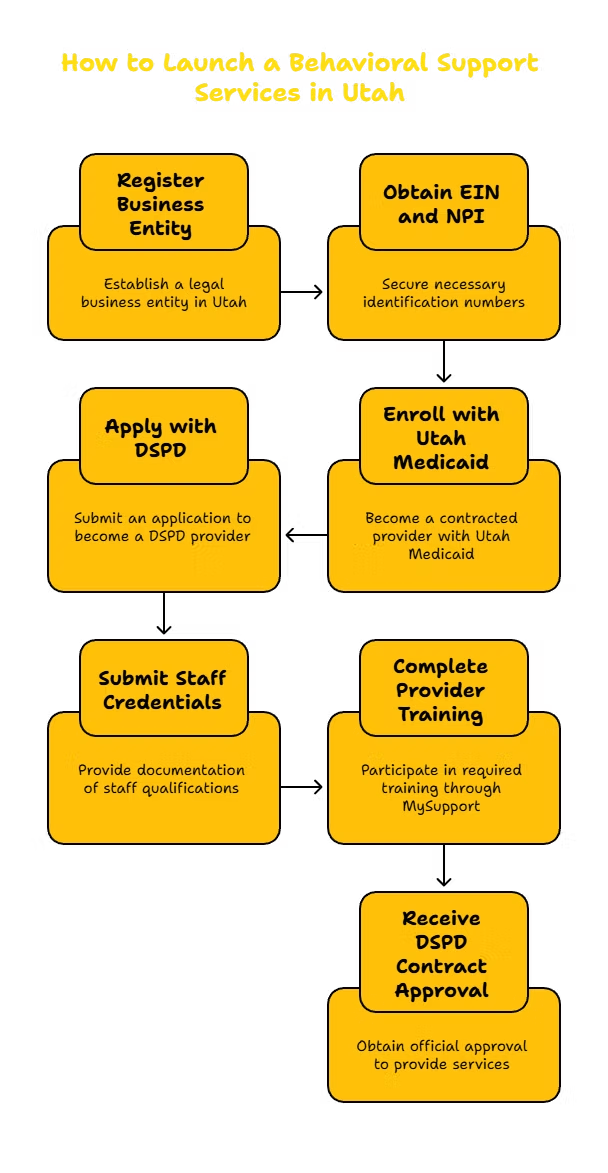
Becoming an approved Behavioral Support Services provider requires a series of administrative and clinical prerequisites. Before an organization can bill for services, it must establish a formal business entity registered with the Utah Division of Corporations and secure both an Employer Identification Number (EIN) and a National Provider Identifier (NPI, Type 2). These identifiers are non-negotiable for Medicaid enrollment and DSPD contracting.
Beyond administrative setup, providers must establish a robust internal infrastructure. This includes developing a comprehensive Behavioral Support Services Policy & Procedure Manual that covers clinical documentation, incident reporting, HIPAA compliance, and client rights. Additionally, providers must ensure their staff meets the Division of Professional Licensing (DOPL) requirements for their respective clinical disciplines, such as Board Certified Behavior Analysts (BCBAs), psychologists, or licensed social workers.
How Do You Navigate the Provider Enrollment Process?
The enrollment timeline for a new Behavioral Support provider typically spans several months, requiring careful coordination with state agencies. Organizations must first finalize their business registration and NPI/EIN acquisition. Once the business is established, the agency must complete the Utah Medicaid provider enrollment process followed by the specific application process with DSPD to become a recognized service provider.
The sequence for successful enrollment involves:
- Completing Utah Medicaid provider enrollment.
- Submitting an application to the DSPD for designation as a behavioral service provider.
- Providing proof of professional credentials for all clinical staff members.
- Ensuring all staff complete the mandatory MySupport eLearning modules administered by the state.
- Finalizing the DSPD contract, which authorizes the provider to begin accepting referrals and delivering services.
What Are the Staffing and Documentation Obligations?
Staffing mandates are rigorous to ensure the high clinical quality of behavioral supports. The lead practitioner must be a licensed professional, such as a BCBA, psychologist, Licensed Clinical Social Worker (LCSW), or Licensed Marriage and Family Therapist (LMFT). These individuals are responsible for the clinical integrity of the PBSPs, while Behavior Support Technicians may assist under supervision, provided they are adequately trained in plan implementation and data collection.
Comprehensive documentation is the backbone of service compliance. Providers are required to maintain detailed records, including:
- Evidence of staff training in abuse, neglect, and exploitation prevention (ANEP).
- Current licenses, board certifications, and verified background checks.
- Templates for progress notes, data sheets, and incident reports.
- Documented evidence of staff training on HIPAA and client rights.
- Quality assurance logs that track the effectiveness of interventions over time.
Frequently Asked Questions
Which Medicaid waivers currently cover Behavioral Support Services in Utah?
These services are primarily authorized under the Community Supports Waiver, the Acquired Brain Injury (ABI) Waiver, and the Autism Waiver. They may also be accessed through the Physical Disabilities Waiver and the Medically Complex Children’s Waiver (MCCW) on a case-by-case basis depending on the participant's specific clinical needs.
How long does the launch process generally take?
Business formation and initial credentialing typically take 1–2 months, while the Medicaid and DSPD contracting phase requires an additional 2–4 months. Following this, providers should allow 30–60 days for staff onboarding and training before service delivery commences.
What happens if a provider fails a quality assurance audit?
Providers must maintain strict adherence to state policy manuals. If an audit reveals gaps in documentation, training, or clinical practice, the provider may be subject to a corrective action plan (CAP). Persistent non-compliance can lead to the revocation of the DSPD contract or suspension from the Medicaid program.
Key Takeaway: Establishing a Behavioral Support Services agency in Utah requires a strategic balance between clinical expertise and administrative rigor. By focusing on compliant documentation, credentialing qualified behaviorists, and maintaining strong alignment with DSPD policies, providers can build a sustainable practice that significantly improves outcomes for individuals within the HCBS waiver system.
Waiver Consulting Group (WCG) partners with clinicians, ABA providers, and IDD specialists to help launch and scale compliant behavioral support services in Utah. Our scope of work includes Medicaid and DSPD provider enrollment, the development of Policy & Procedure Manuals, creation of FBA/PBSP templates, and training on documentation and HIPAA compliance.
Last verified: October 2023. This content is provided for informational purposes only and does not constitute legal or professional advice. Always verify current state regulations and waiver requirements through official government portals before initiating business operations.