BEHAVIORAL SUPPORT SERVICES PROVIDER IN OREGON
By Fatumata Kaba · 2025-10-06 · 6 min read
Behavioral Support Services in Oregon are specialized Medicaid-authorized interventions designed to empower individuals with intellectual or developmental disabilities (IDD), mental health conditions, or complex behavioral needs to achieve independence and stability within their homes and communities. These services, which are critical components of Oregon’s Home and Community-Based Services (HCBS) waivers and the Community First Choice (K Plan) option, focus on evidence-based strategies, functional assessments, and intensive staff training to improve quality of life and decrease reliance on restrictive interventions.
Operating as a provider in this sector requires rigorous adherence to both federal CMS guidelines and the state-specific mandates overseen by the Oregon Department of Human Services (ODHS) and the Oregon Health Authority (OHA). By delivering structured behavioral support, organizations play a vital role in the Oregon Health Plan (OHP) network, ensuring that individuals receive person-centered care that aligns with their unique behavioral health profiles.
Navigating the Regulatory Landscape for Oregon Behavioral Support
The regulatory framework for Behavioral Support Services in Oregon is a multi-tiered structure involving several key agencies, each responsible for different facets of provider oversight. Understanding these roles is the first step for any agency founder. The Oregon Department of Human Services (ODHS) – Developmental Disabilities Services (DDS) serves as the primary entity for authorizing services for the IDD population, acting through local Community Developmental Disabilities Programs (CDDPs). These local offices are the primary point of contact for service authorizations and referrals.
Simultaneously, the Oregon Health Authority (OHA) – Health Systems Division oversees Medicaid compliance and ensures that the professional credentials of mental and behavioral health clinicians meet state standards. On a national level, the Centers for Medicare & Medicaid Services (CMS) maintains federal oversight to ensure all Medicaid-funded services adhere to the HCBS and 1915(k) federal authorities. Additionally, all providers must maintain good standing with the Oregon Secretary of State (SOS) – Corporation Division, which handles the necessary business registration requirements for all legal entities operating within the state.
Defining the Scope of Behavioral Support Services
At its core, behavioral support is designed to reduce challenging behaviors and increase adaptive, positive skills. Approved providers perform a variety of essential functions, starting with the Functional Behavioral Assessment (FBA). This assessment identifies the specific triggers, patterns, and environmental influences that contribute to a client’s behavioral challenges, forming the scientific basis for all subsequent interventions.
Once the FBA is complete, providers develop a Behavior Support Plan (BSP). This document outlines proactive strategies, reinforcement systems, and crisis intervention protocols tailored to the individual. Ongoing delivery of these services requires clinical rigor, including:
- Direct Behavior Consultation: Providing one-on-one coaching, modeling, and skill-building sessions for both the individual and their direct support caregivers.
- Staff and Caregiver Training: Equipping support teams with the knowledge to implement the BSP consistently and safely, ensuring environmental stability.
- Plan Monitoring and Modification: Using data-driven tracking to adjust strategies based on real-time client progress and emerging needs.
- Crisis Planning: Creating individualized emergency protocols to respond effectively to behavioral crises while maintaining client safety and dignity.
Establishing Your Agency: Licensing and Provider Enrollment
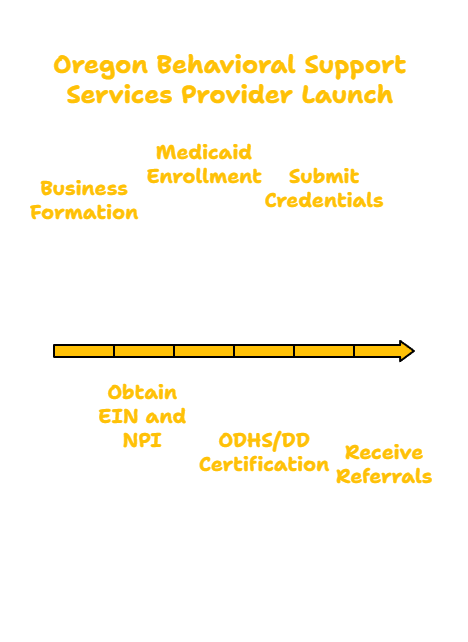
The process of becoming an authorized provider involves a logical, sequential path starting with business entity formation. An agency must register with the Oregon Secretary of State, obtain a federal Employer Identification Number (EIN) from the IRS, and secure a Type 2 National Provider Identifier (NPI). These are the foundational credentials required for all subsequent applications.
Once the business is legally established, the agency must enroll as a Medicaid provider through the OHA Provider Portal. If the agency intends to serve the DD population, a specific application for approval through ODHS/DD is necessary. This often involves building relationships with local CDDPs to understand the specific needs and referral processes within the catchment area. Furthermore, the agency must carry professional liability and workers’ compensation insurance to protect both the organization and the individuals served.
Developing the Required Operational Infrastructure
A successful provider organization requires a comprehensive Policy & Procedure Manual that serves as the blueprint for daily operations and regulatory compliance. This manual must explicitly outline how the agency handles FBA protocols, plan development standards, and crisis de-escalation. It acts as the primary document for internal quality assurance and external audits, detailing how the agency upholds client rights, confidentiality, and informed consent.
Equally important is the development of robust documentation systems. All staff must be trained to maintain accurate daily service logs, progress updates, and Medicaid-compliant billing records. A well-organized infrastructure should include:
- Data Collection Systems: Standardized tools for tracking behavioral incidents and progress toward goals.
- Training and Credentialing Trackers: Systems to ensure that all staff members remain compliant with mandatory education and recertification cycles.
- HIPAA Compliance Frameworks: Strict protocols governing the protection of protected health information in all digital and physical environments.
- Incident Reporting Policies: Clear procedures for the reporting and review of any behavioral or safety-related incidents.
Staffing and Clinical Governance Requirements
The quality of behavioral support is directly tied to the qualifications of the staff delivering the service. The role of the Behavior Consultant or Behavior Support Professional requires advanced education, typically at the master’s or doctoral level, and active licensing or certification such as a BCBA, LCSW, or LPC. These professionals are responsible for the clinical integrity of the behavior plans and the supervision of direct care staff.
Every member of the support team, including direct support professionals, must undergo a rigorous training program. This ensures that the entire support system is aligned with person-centered planning principles and incident prevention. Mandatory training areas include:
- Person-Centered Principles: Ensuring services prioritize the goals and preferences of the individual.
- Abuse Prevention and Reporting: Mandatory education on detecting and reporting potential abuse or neglect.
- Data Collection Protocols: Ensuring all staff can accurately document behavior trends in alignment with the BSP.
- Annual Skills Reviews: Regular recertification to maintain clinical competency and up-to-date knowledge of state regulations.
Frequently Asked Questions
What is the primary difference between a Behavioral Consultant and a Direct Support Professional in this context?
The Behavioral Consultant (often a BCBA, LCSW, or LPC) is responsible for the clinical oversight, conducting the FBA, and writing the Behavior Support Plan. The Direct Support Professional is responsible for the daily implementation of these plans, ensuring that the strategies outlined in the BSP are applied consistently in the individual’s daily life.
How long does the typical enrollment process take for an Oregon Medicaid provider?
The timeline typically spans several months. Business formation and manual development usually take 1-2 months, followed by 2-3 months for Medicaid enrollment and state-specific certifications. Staff hiring and training occur concurrently or immediately following, with referral activation beginning once the agency is fully authorized and connected with local CDDPs.
Does a provider need to be a BCBA to provide Behavioral Support Services?
While Board Certified Behavior Analysts (BCBAs) are common providers, Oregon also accepts other licensed mental health professionals (such as LCSWs or LPCs) provided they meet the specific requirements outlined by ODHS/DD and the OHA for behavioral support delivery. Agencies should verify specific credentialing requirements for their planned service offerings.
Waiver Consulting Group provides comprehensive start-up assistance for behavioral support providers in Oregon. Services include Medicaid enrollment support, ODHS/DD certification guidance, policy manual development, staff training outlines, and systems for audit preparation and quality assurance. These resources are designed to ensure that new providers remain compliant with all state and federal regulations while delivering high-quality, person-centered support.
Key Takeaway: Success in the Oregon behavioral support market requires a dual focus on clinical excellence and rigid adherence to Medicaid administrative requirements. By prioritizing professional credentialing, thorough documentation, and strong relationships with local CDDPs, provider agencies can build sustainable organizations that effectively serve the needs of the IDD and behavioral health communities.
Last verified: August 2024. This information is intended for educational purposes only and does not constitute legal or financial advice. Consult with the Oregon Department of Human Services (ODHS) and relevant regulatory bodies to ensure your organization meets all current state and federal compliance standards.