BEHAVIORAL SUPPORT SERVICES PROVIDER IN NEW MEXICO
By Fatumata Kaba · 2025-09-05 · 6 min read
Behavioral Support Services in New Mexico are specialized therapeutic interventions designed to reduce challenging behaviors and enhance the quality of life for individuals with intellectual, developmental, or behavioral health challenges. These services are authorized under New Mexico Medicaid Home and Community-Based Services (HCBS) waiver programs and are delivered through a person-centered planning process that promotes emotional well-being and social integration.
For healthcare providers and agency administrators, navigating the regulatory environment of the New Mexico Human Services Department (HSD) and the Developmental Disabilities Supports Division (DDSD) is essential for successful enrollment. By aligning clinical operations with established state and federal compliance standards, agencies can effectively provide the high-quality support necessary to help participants achieve their behavioral goals.
What Are the Governing Agencies and Regulatory Oversight Roles?
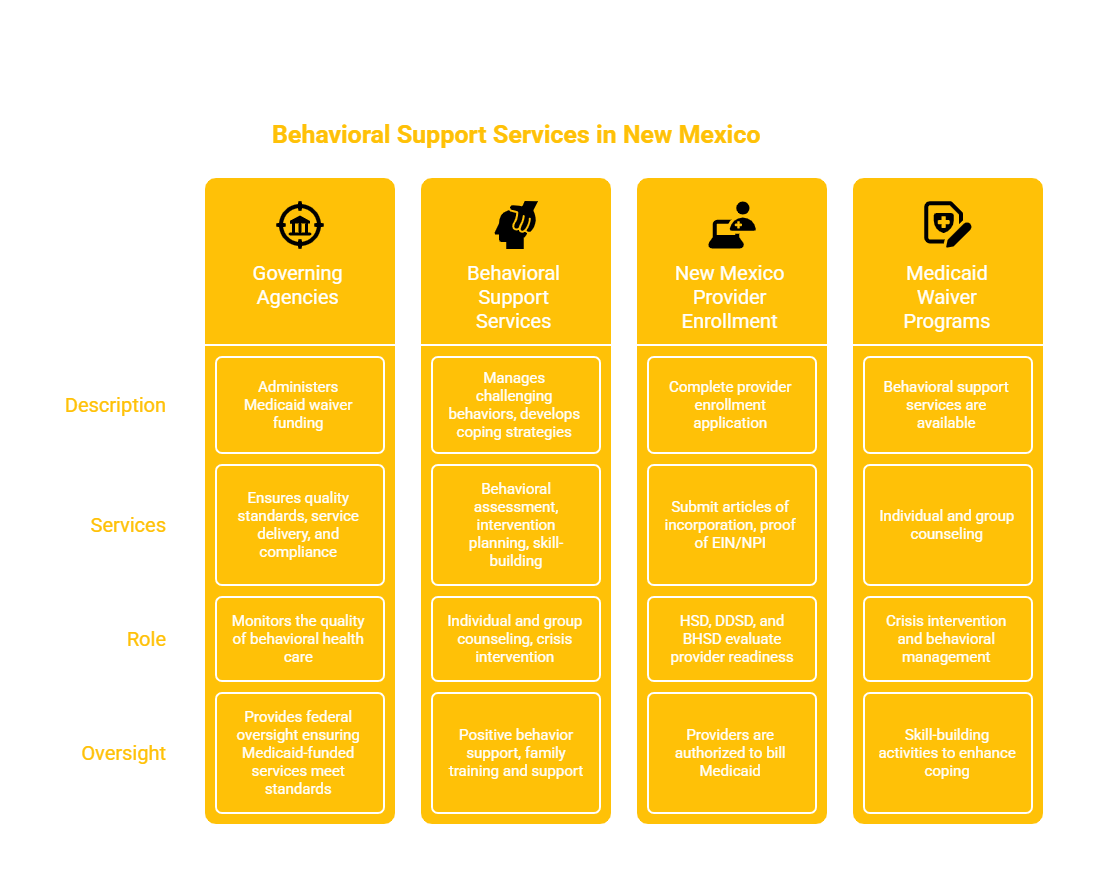
The provision of Behavioral Support Services in New Mexico involves a multi-layered regulatory framework. The New Mexico Human Services Department (HSD) serves as the primary administrator for Medicaid waiver funding, managing the critical functions of provider enrollment, service authorization, and the processing of reimbursement claims. Their oversight ensures that services remain within the scope of the state’s Medicaid program guidelines.
Operational quality and clinical compliance are further managed by the Developmental Disabilities Supports Division (DDSD) and the Behavioral Health Services Division (BHSD). The DDSD focuses on service delivery standards and programmatic compliance within HCBS waivers, while the BHSD monitors the quality of behavioral health care and ensures providers adhere to state-specific regulations. These agencies work in tandem to create a secure, high-standard environment for participants.
At the federal level, the Centers for Medicare & Medicaid Services (CMS) provide the overarching framework for all Medicaid-funded services. CMS ensures that New Mexico’s waiver programs meet federal requirements for person-centered planning, participant protection, and the efficacy of home and community-based settings.
What Scope of Services Must a Provider Deliver?
Providers are expected to deliver a comprehensive suite of interventions that address the unique needs of the participant as outlined in their Individualized Service Plan (ISP). These services are not one-size-fits-all; they must be tailored to the specific emotional, social, and behavioral challenges of the individual served. A core component of this service is the Behavioral Assessment, where providers identify behavioral triggers and patterns through rigorous, data-driven evaluations.
Following the assessment phase, providers develop and implement Behavioral Intervention Planning, which utilizes structured, evidence-based techniques to reduce maladaptive behaviors. This often includes teaching coping strategies, social skills, and emotional regulation techniques. Whether through individual counseling, group sessions, or Positive Behavior Support (PBS), the objective remains the reinforcement of positive behaviors and the reduction of crisis incidents.
Furthermore, providers play a vital role in Crisis Intervention and family support. This includes providing immediate, on-site support during behavioral crises to ensure the safety and stability of the participant. Family Training and Support is equally critical, as it educates caregivers on how to manage and respond to behaviors effectively in the home environment, thereby fostering long-term progress and stability.
How Do Agencies Navigate Licensing and Provider Enrollment?
The journey to becoming an approved provider begins with establishing a formal business entity registered with the New Mexico Secretary of State. Once the legal structure is in place, the organization must obtain a federal Employer Identification Number (EIN) and a National Provider Identifier (NPI) Type 2. These identifiers are essential for all subsequent Medicaid billing and tracking.
The enrollment process is centralized through the New Mexico Medicaid Provider Enrollment Portal. Prospective providers must be prepared to submit a comprehensive application, which includes proof of appropriate behavioral health licensure from the New Mexico Regulation and Licensing Department (RLD). Additionally, agencies must maintain robust general and professional liability insurance to protect against operational risks.
A significant portion of the enrollment process is the Readiness Review conducted by the HSD, DDSD, and BHSD. This review evaluates the agency’s capacity to deliver services safely and effectively. It includes a thorough inspection of the provider's written policies regarding behavioral intervention planning, safety protocols, and crisis management. Agencies must demonstrate that they have the staff, the expertise, and the documentation systems necessary to meet Medicaid billing requirements and quality assurance benchmarks.
What Are the Essential Documentation and Policy Requirements?
To remain in compliance, providers must maintain a comprehensive Policy & Procedure Manual. This manual serves as the foundation for the agency’s operational integrity and is a primary document audited by state agencies. It must detail how the agency manages behavioral assessments, intervention planning, and the specific steps staff should take during a crisis, including de-escalation techniques.
Documentation standards are non-negotiable. Providers are required to keep meticulous records of all behavioral tracking, progress notes, and Medicaid billing entries. These records must be readily available for review to demonstrate the efficacy of the interventions. Furthermore, the manual must include clear policies on HIPAA compliance, the protection of participant rights, the handling of grievances, and strict staff credentialing procedures.
- Articles of Incorporation or proof of business registration.
- NPI and EIN confirmation documentation.
- Current behavioral health licenses from the RLD.
- Verified background checks and health screening records for all staff.
- Quality assurance and internal audit protocols.
What Are the Staffing and Training Mandates?
Staffing requirements are designed to ensure that participants receive care from highly qualified professionals. The Behavioral Support Program Director must hold a Master’s degree in a relevant field like psychology or social work, and possess significant supervisory experience, with preference given to those with behavioral analysis certification. Behavioral Therapists are generally required to hold licensure as a Board Certified Behavior Analyst (BCBA) or a Licensed Professional Counselor (LPC).
In addition to these lead roles, agencies utilize Behavioral Technicians—who often hold Registered Behavior Technician (RBT) certifications—and Crisis Intervention Specialists. All staff must undergo a rigorous onboarding process that includes background clearances and specific training on behavioral best practices. This training must cover de-escalation techniques, HIPAA regulations, participant rights, and trauma-informed care.
Ongoing professional development is a mandatory element of maintaining a workforce that can handle complex behavioral needs. Providers must conduct annual competency evaluations for all employees to ensure their skills remain current and that they are effectively following the latest evidence-based behavioral intervention practices.
Frequently Asked Questions
Which Medicaid waivers include Behavioral Support Services in New Mexico?
These services are available under the Developmental Disabilities (DD) Waiver, the Mi Via Waiver, the Medically Fragile Waiver, the Supports Waiver, and the general Home and Community-Based Services (HCBS) Waiver framework.
How long should an agency expect the enrollment process to take?
The timeline varies based on organizational readiness, but typically involves 1–2 months for business formation, 2–3 months for hiring and program development, 60–90 days for the Medicaid Readiness Review, and 30–45 days for final billing setup.
What happens during a Medicaid Readiness Review?
During the review, the HSD, DDSD, and BHSD verify that the agency has the necessary infrastructure, qualified staff, and compliant policies in place to deliver safe, effective, and billable services according to state and federal standards.
Waiver Consulting Group’s Start-Up Assistance
Waiver Consulting Group supports agencies in launching Medicaid-compliant Behavioral Support Services in New Mexico. Services include assistance with business registration, Medicaid enrollment, and licensing. We aid in the development of policy manuals, staff credentialing frameworks, and compliance documentation. Additionally, we provide guidance on Medicaid billing setup, audit-prepared financial management, and the implementation of quality assurance systems to ensure long-term sustainability and operational success.
Key Takeaway: Successfully operating as a Behavioral Support Services provider in New Mexico requires strict adherence to the standards set by the HSD and DDSD, a commitment to rigorous clinical documentation, and a focus on maintaining a highly trained, credentialed workforce capable of delivering individualized, person-centered support under the state's Medicaid waiver programs.
Last verified: 2024. The information provided is for educational purposes only and does not constitute legal or professional advice. Always consult with the New Mexico Human Services Department or qualified legal counsel regarding current state regulations, specific waiver requirements, and provider compliance obligations.