BEHAVIORAL SUPPORT SERVICES PROVIDER IN NEW JERSEY
By Fatumata Kaba · 2025-09-05 · 6 min read
Behavioral Support Services in New Jersey serve as a cornerstone of the state’s Home and Community-Based Services (HCBS) framework, providing essential therapeutic interventions designed to help individuals with developmental disabilities or behavioral challenges. By focusing on evidence-based strategies, these services aim to enhance coping mechanisms, reduce maladaptive behaviors, and foster successful community integration for Medicaid waiver participants.
Operating as a provider of these services requires strict adherence to state and federal regulations managed by the New Jersey Department of Human Services (DHS) and the Division of Developmental Disabilities (DDD). Understanding the operational requirements, from initial enrollment to ongoing clinical documentation, is vital for agency administrators seeking to provide high-quality support while maintaining regulatory compliance.
What Are the Core Components of Behavioral Support Services?
Behavioral Support Services go beyond traditional therapy, offering a structured approach to identifying and managing behaviors that may interfere with an individual’s quality of life. At the heart of these services is the Individualized Service Plan (ISP), which dictates the specific interventions, goals, and frequency of care tailored to the participant's unique behavioral health and support needs.
Approved providers are tasked with delivering a comprehensive suite of interventions that promote personal growth and emotional regulation. These services are delivered by trained professionals who work directly with the participant and their primary caregivers to ensure consistency across all environments, including the home and the community.
- Behavioral Assessment: Identifying specific triggers, environmental patterns, and the underlying causes of challenging behaviors.
- Behavioral Intervention Planning: Creating actionable, data-driven strategies designed to address and modify maladaptive behaviors.
- Positive Behavior Support (PBS): Implementing structured, reinforcement-based plans to encourage appropriate social and functional behaviors.
- Crisis Intervention: Applying pre-authorized de-escalation techniques and safety measures during acute behavioral crises.
- Skill Building: Teaching self-regulation, social interaction techniques, and daily living coping skills.
- Family and Caregiver Training: Equipping families with the knowledge to maintain behavioral management strategies consistently.
How Are Behavioral Support Services Governed in New Jersey?
The oversight of Behavioral Support Services in New Jersey is a multi-tiered process involving state and federal agencies to ensure participant safety and fiscal accountability. The New Jersey Department of Human Services (DHS) acts as the lead agency, managing Medicaid waiver funding, provider enrollment protocols, and the critical reimbursement processes that keep programs operational.
The Division of Developmental Disabilities (DDD) holds the primary responsibility for on-the-ground quality standards and compliance monitoring. They ensure that providers adhere to HCBS waiver requirements and that service delivery remains person-centered. Furthermore, the Centers for Medicare & Medicaid Services (CMS) provides the overarching federal framework, ensuring that all Medicaid-funded services uphold standards for participant protection, health, and welfare.
What Are the Licensing and Enrollment Prerequisites for Providers?
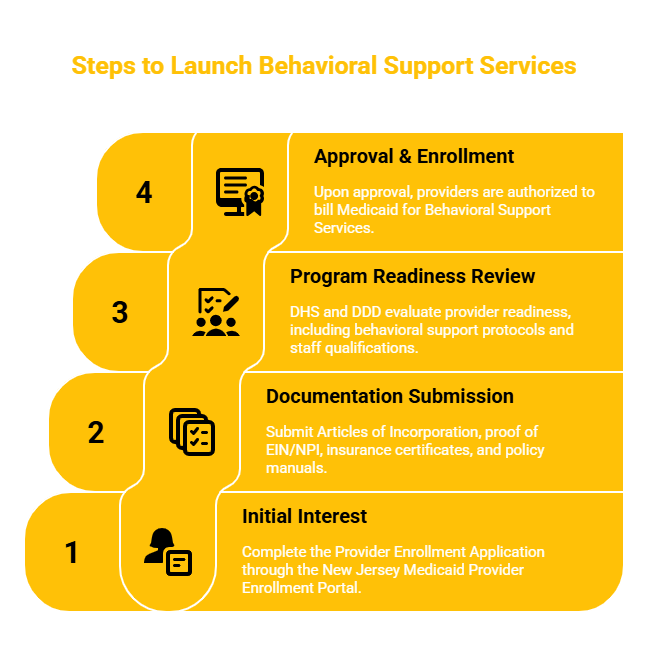
Launching a Behavioral Support Services agency requires meticulous attention to administrative and legal prerequisites. Before an agency can begin billing for services, it must establish a clear business identity and register with the New Jersey Division of Revenue and Enterprise Services. This foundational step is followed by obtaining a federal Employer Identification Number (EIN) and a Type 2 National Provider Identifier (NPI), which are essential for all healthcare billing activities.
Beyond basic business registration, agencies must demonstrate institutional readiness to the state. This includes obtaining necessary professional liability and general liability insurance, as well as developing a comprehensive Policy and Procedure Manual. This manual serves as the operational roadmap for the agency, documenting everything from clinical assessment methodologies to HIPAA-compliant data management and internal quality assurance protocols.
- Enrollment: Completion of the Provider Enrollment Application through the official New Jersey Medicaid Provider Enrollment Portal.
- Credentialing: Verification of staff qualifications, including background checks and health screenings.
- Readiness Review: An evaluation by DHS and DDD to assess the provider's ability to execute behavioral protocols and safety measures.
- Documentation: Maintaining organized records of Articles of Incorporation, professional licenses, and staff training history.
What Are the Staffing and Credentialing Requirements?
The quality of behavioral services is directly tied to the qualifications of the staff delivering them. New Jersey mandates specific educational and licensing standards to ensure that interventions are grounded in professional clinical expertise. The Behavioral Support Program Director oversees the agency's clinical direction and must hold a Master’s degree in psychology, social work, or applied behavior analysis, alongside appropriate state licensure.
Direct service delivery is typically carried out by Behavioral Support Specialists and technicians. Specialists, such as Licensed Behavioral Analysts (LBA), Licensed Clinical Social Workers (LCSW), or Licensed Mental Health Counselors (LMHC), are responsible for high-level intervention planning. Behavioral Technicians, who may have specialized certifications in behavior analysis, provide direct support under the supervision of these licensed professionals. All staff, regardless of role, must undergo rigorous training in crisis de-escalation, HIPAA regulations, and client rights, with regular competency evaluations to ensure ongoing excellence.
What Is the Typical Timeline to Launch a Provider Agency?
Administrators should anticipate a structured, multi-phase timeline when seeking to become an authorized provider. The process begins with business formation and compliance preparation, which generally spans 1 to 2 months. This phase establishes the legal entity and sets the groundwork for policy development.
The subsequent phases involve hiring and credentialing staff, which takes approximately 2 to 3 months, followed by the formal Medicaid enrollment and state readiness review process, estimated at 60 to 90 days. The final phase involves setting up the billing systems necessary to interface with the state’s Medicaid payment infrastructure, adding an additional 30 to 45 days. Proper planning for these phases is essential to minimize delays in service activation.
Frequently Asked Questions
Which Medicaid waiver programs cover Behavioral Support Services?
These services are authorized under several New Jersey Medicaid waivers, including the Community Care Program for the Elderly and Disabled (CCPED), the Supports Program Waiver, the Acquired Brain Injury (ABI) Waiver, the Personal Care Assistant (PCA) Waiver, and the general Home and Community-Based Services (HCBS) Waiver.
What documentation is required for the Medicaid Readiness Review?
Providers must be prepared to submit articles of incorporation, proof of insurance, professional staff licenses, and a comprehensive Policy and Procedure Manual. This manual must detail behavioral assessment protocols, crisis management, staff training records, and HIPAA compliance procedures.
How does an agency maintain compliance after approval?
Ongoing compliance is maintained through continuous staff training, regular updates to Individualized Service Plans (ISPs), strict adherence to behavioral tracking documentation standards, and periodic quality assurance reviews conducted by the DDD.
WAIVER CONSULTING GROUP’S START-UP ASSISTANCE SERVICE — NEW JERSEY BEHAVIORAL SUPPORT SERVICES PROVIDER
WCG supports agencies in launching Medicaid-compliant Behavioral Support Services in New Jersey, offering:
- Business registration, Medicaid enrollment, and licensing assistance.
- Policy manual development for behavioral support and crisis management.
- Staff credentialing, training program templates, and compliance documentation.
- Medicaid billing setup and audit-prepared financial management.
- Branding, website development, and caregiver support strategies.
- Quality assurance systems for behavior tracking and therapeutic outcomes.
- Collaboration with mental health professionals and community resources.
Key Takeaway: Establishing a Behavioral Support Services agency in New Jersey requires a strategic focus on regulatory alignment, clinical staffing, and the meticulous documentation of therapeutic interventions to meet DDD and CMS standards. By prioritizing robust policy frameworks and rigorous staff training, providers can effectively meet the behavioral health needs of Medicaid waiver participants while maintaining long-term operational success.
Last verified: October 2023. This information is provided for educational purposes and does not constitute legal or professional advice. Please consult with the New Jersey Department of Human Services or qualified legal counsel regarding specific state regulations and requirements.