BEHAVIORAL SUPPORT SERVICES PROVIDER IN NEVADA
By Fatumata Kaba · 2025-09-04 · 5 min read
PROMOTING POSITIVE BEHAVIORS AND COMMUNITY INTEGRATION THROUGH PERSONALIZED SUPPORT
Behavioral Support Services in Nevada provide essential therapeutic interventions and structured guidance designed to assist individuals with disabilities or complex behavioral health needs. By focusing on the development of coping strategies, social interaction skills, and environmental modifications, these services empower participants to achieve greater independence and successful community integration within the framework of Nevada Medicaid Home and Community-Based Services (HCBS) waiver programs.
Founding a behavioral support agency requires a rigorous commitment to clinical standards, regulatory compliance, and person-centered planning. This guide outlines the necessary steps for providers to achieve enrollment and maintain operational excellence under the oversight of the Nevada Department of Health and Human Services (DHHS) and the Aging and Disability Services Division (ADSD).
What Are the Governing Agencies and Regulatory Roles in Nevada?
The regulatory landscape for Behavioral Support Services in Nevada is defined by a tiered hierarchy of oversight. At the state level, the Nevada Department of Health and Human Services (DHHS) acts as the primary administrator for Medicaid waiver funding. DHHS is responsible for managing the integrity of the provider network, overseeing the enrollment process, authorizing services, and ensuring that reimbursement practices align with state and federal regulations.
The Aging and Disability Services Division (ADSD) provides direct oversight regarding service delivery and quality standards. Providers must remain in constant alignment with ADSD guidelines to ensure that Behavioral Support Services are delivered effectively and safely. Additionally, the Centers for Medicare & Medicaid Services (CMS) provides federal oversight, mandating that all Medicaid-funded services strictly adhere to HCBS quality benchmarks, person-centered planning requirements, and rigorous participant protection standards.
How Do Behavioral Support Services Facilitate Client Outcomes?
Behavioral Support Services are designed to address challenging behaviors by identifying their root causes and teaching adaptive alternatives. Providers utilize evidence-based practices to support emotional well-being and long-term skill acquisition. The service model is fundamentally rooted in the Individualized Service Plan (ISP), ensuring that every intervention is tailored to the unique behavioral and social needs of the specific participant.
Approved providers generally offer a comprehensive suite of interventions, including:
- Behavioral Assessment: Conducting detailed evaluations to identify triggers, environmental factors, and functional patterns of behavior.
- Behavioral Intervention Planning: Creating customized strategies that provide a roadmap for managing challenging behaviors in real-time.
- Positive Behavior Support (PBS): Utilizing reinforcement techniques to encourage the replacement of maladaptive behaviors with positive alternatives.
- Therapeutic Counseling & Skill Development: Offering individual or group therapy sessions to improve emotional regulation, social interaction, and communication.
- Crisis Intervention: Providing immediate, skilled support during behavioral emergencies to maintain the safety of the individual and those around them.
- Caregiver Training: Educating family members and support staff on behavioral management techniques to ensure consistency across all environments.
What Are the Essential Requirements for Provider Licensing and Approval?
Achieving provider status is a multi-step process that begins with formal business entity registration through the Nevada Secretary of State. Once the legal entity is established, the agency must secure a Federal Employer Identification Number (EIN) from the IRS and a Type 2 National Provider Identifier (NPI). These foundational credentials are required before initiating the Medicaid enrollment process.
Beyond administrative registration, providers must demonstrate professional clinical capacity. This involves hiring or contracting with qualified practitioners, such as Board Certified Behavior Analysts (BCBAs) or Licensed Mental Health Practitioners (LMHPs). Agencies must also maintain robust general and professional liability insurance policies. Finally, every agency must develop and implement a comprehensive Policy and Procedure Manual that covers behavioral protocols, staff background check requirements, health screenings, and strict adherence to privacy and safety standards.
How Does the Nevada Medicaid Provider Enrollment Process Work?
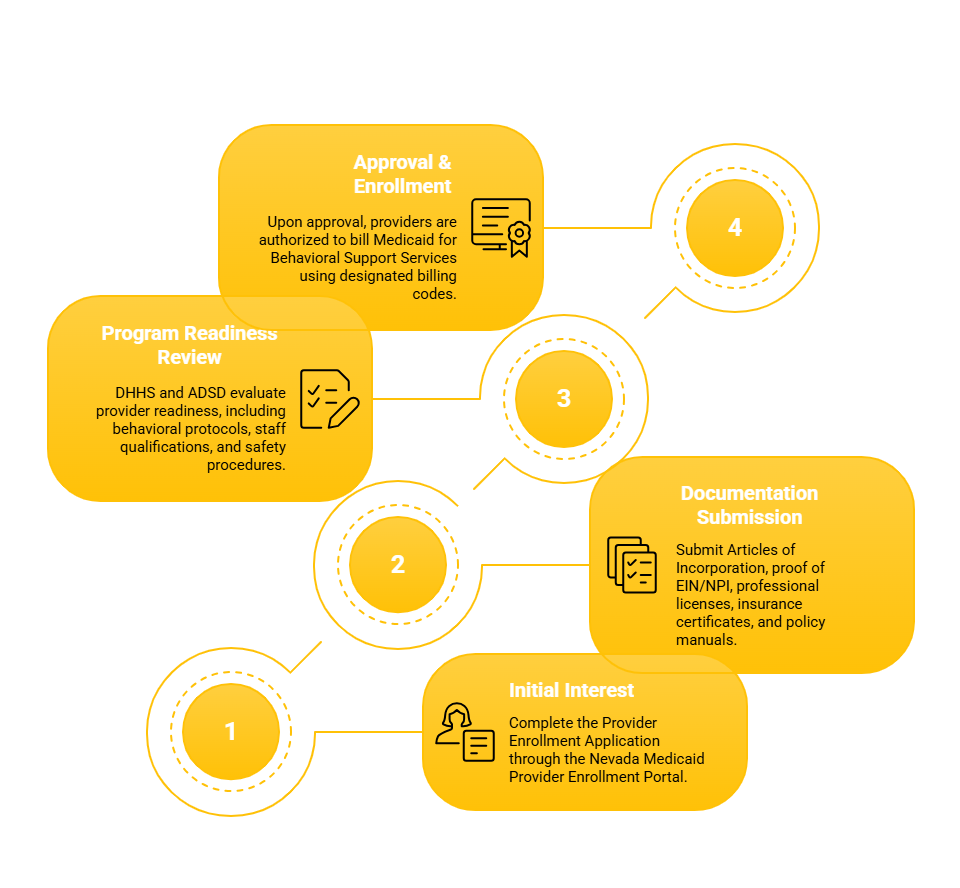
The enrollment process is highly structured and requires careful preparation of all supporting documentation. Providers begin by completing the Provider Enrollment Application specifically for Behavioral Support Services via the Nevada Medicaid Provider Enrollment Portal. This application must be accompanied by proof of professional licensure, insurance certificates, and organizational documents like Articles of Incorporation.
Once the application is submitted, the DHHS and ADSD conduct a Program Readiness Review. During this phase, auditors evaluate the agency’s internal protocols, safety procedures, and the qualifications of the proposed staff members. Following a successful review and approval, the provider is officially authorized to deliver services and bill Medicaid using the designated billing codes specific to the waiver program. Maintaining this status requires ongoing compliance monitoring and periodic re-validation of provider credentials.
Which Staffing Standards Must a Behavioral Support Agency Meet?
High-quality service delivery relies heavily on the credentials and training of the staff. The Behavioral Support Program Director is a critical leadership role, typically requiring a Master’s degree in psychology, social work, or a related behavioral science, along with active BCBA or LMHP certification. This individual is responsible for the oversight of all clinical interventions and staff performance.
Clinical therapists and behavioral technicians must also meet specific state licensure or certification requirements. All staff, including Direct Support Professionals (DSPs), must undergo thorough background screenings, demonstrate competency in behavioral techniques, and maintain current CPR/First Aid certification. Mandatory training for all personnel includes:
- HIPAA compliance and the protection of client rights.
- De-escalation strategies and formal crisis management training.
- Positive Behavior Support (PBS) methodologies.
- Annual competency evaluations and ongoing professional development to stay current with best practices.
Frequently Asked Questions
Which Medicaid waivers currently authorize Behavioral Support Services?
Behavioral Support Services are available under several key Nevada programs, including the Home and Community-Based Waiver for Persons with Intellectual and Developmental Disabilities (HCBS-IDD), the Frail Elderly (FE) Waiver, the Physical Disabilities Waiver, the Traumatic Brain Injury (TBI) Waiver, and the Aged and Disabled (AD) Waiver.
How long should a new agency expect the launch process to take?
The total timeline varies, but generally, business formation and compliance take 1–2 months, followed by 2–3 months for staff hiring and development. The Medicaid enrollment and readiness review typically spans 60–90 days, with an additional 30–45 days required for final billing system setup and service launch.
What must be included in the Policy and Procedure Manual for state review?
The manual must comprehensively detail behavioral assessment and intervention planning, crisis response protocols, staff credentialing and training requirements, HIPAA compliance, client rights, grievance procedures, and quality assurance systems. It serves as the primary evidence of the agency’s capacity to provide safe, compliant, and effective care.
Key Takeaway: Establishing a Behavioral Support Services agency in Nevada is a complex regulatory undertaking that demands meticulous attention to clinical credentialing, state-specific documentation, and consistent adherence to HCBS program standards. By prioritizing robust internal policies, high-quality staff training, and transparent communication with DHHS and ADSD, agencies can ensure successful Medicaid enrollment and long-term operational sustainability.
Last verified: 2024. The information provided in this article is for educational purposes only and does not constitute legal or professional advice. Requirements for Medicaid provider enrollment and service delivery are subject to change by the Nevada Department of Health and Human Services (DHHS) and the Centers for Medicare & Medicaid Services (CMS). Providers are encouraged to consult official state resources and the Nevada Medicaid Provider Enrollment Portal directly for the most current regulatory guidance.