BEHAVIORAL SUPPORT SERVICES PROVIDER IN NEBRASKA
By Fatumata Kaba · 2025-08-08 · 5 min read
PROMOTING POSITIVE BEHAVIORS AND COMMUNITY INTEGRATION THROUGH PERSONALIZED SUPPORT
Behavioral Support Services in Nebraska are specialized therapeutic interventions designed to help individuals with disabilities or behavioral health conditions gain independence and successfully integrate into their communities. These services, authorized under various Nebraska Medicaid Home and Community-Based Services (HCBS) waiver programs, provide the structured frameworks necessary for participants to develop effective coping strategies, manage challenging behaviors, and enhance vital social skills.
What Are the Governing Agencies for Nebraska Behavioral Support Services?
The delivery and oversight of Behavioral Support Services in Nebraska involve a multi-tiered regulatory framework. At the state level, the Nebraska Department of Health and Human Services (DHHS) serves as the primary administrative authority, responsible for managing Medicaid waiver funding, overseeing the provider enrollment process, and managing service authorizations and reimbursement structures.
Supporting the DHHS is the Nebraska Medicaid and Long-Term Care (MLTC) Division, which focuses on maintaining quality standards, ensuring consistent service delivery, and verifying provider compliance with HCBS waiver mandates. Additionally, the Centers for Medicare & Medicaid Services (CMS) provides the overarching federal oversight, ensuring that all Medicaid-funded behavioral interventions adhere to rigorous standards regarding person-centered planning, participant protections, and the fundamental requirements of the HCBS settings rule.
What Scope of Services Defines Behavioral Support?
Behavioral Support Services are centered on a person-centered approach, aiming to reduce the frequency and intensity of challenging behaviors while fostering long-term emotional regulation. Providers authorized to deliver these services must implement interventions tailored to the specific needs identified within the participant’s Individualized Service Plan (ISP). These services are designed to replace maladaptive behaviors with positive, functional alternatives.
- Behavioral Assessment: Conducting comprehensive evaluations to identify specific behaviors, environmental triggers, and underlying factors.
- Behavioral Intervention Planning: Developing customized, data-driven strategies to mitigate challenging behaviors.
- Positive Behavior Support (PBS): Utilizing reinforcement and skill-building to teach alternative, socially appropriate behaviors.
- Therapeutic Counseling: Providing individual or group therapy focusing on social skills and emotional regulation.
- Crisis Intervention: Offering immediate support during behavioral emergencies to maintain participant safety.
- Skill Development & Training: Assisting in communication enhancement and providing targeted education for families and caregivers on behavior management techniques.
What Are the Prerequisites for Provider Approval and Licensure?
Establishing a provider agency requires a structured approach to legal and professional compliance. Before initiating the Nebraska Medicaid enrollment process, a provider must formalize their business entity through the Nebraska Secretary of State and secure a federal Employer Identification Number (EIN) and a Type 2 National Provider Identifier (NPI). This foundational step ensures the agency is recognized as a legal entity capable of entering into contracts with state agencies.
Professional integrity is paramount, as all services must be delivered by qualified, licensed personnel. Providers must secure necessary professional credentials, such as Board Certified Behavior Analyst (BCBA) or Licensed Mental Health Practitioner (LMHP) certifications, and maintain robust general and professional liability insurance. Furthermore, the agency must develop comprehensive internal policies governing behavioral assessment methods, crisis management protocols, and staff training standards to ensure every operational facet meets state expectations.
How Do Providers Navigate the Medicaid Enrollment Process?
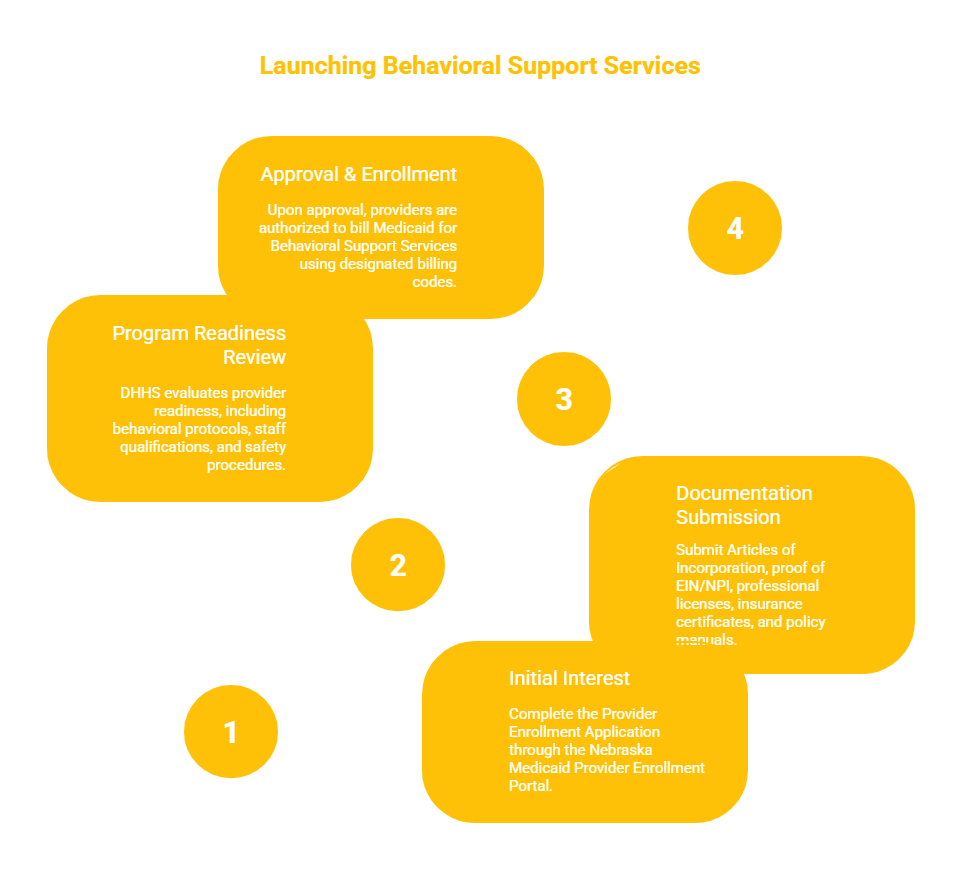
The transition from a startup to an active Medicaid provider involves a sequenced series of milestones managed through the Nebraska Medicaid Provider Enrollment Portal. The process begins with the submission of an application specifically for HCBS waiver behavioral services. During this phase, the agency must submit exhaustive documentation, including articles of incorporation, proof of professional licensure, and detailed policy manuals that outline how the agency will manage participant data and incident reporting.
Following the document submission, the DHHS conducts a formal program readiness review. This review evaluates the agency’s capacity to deliver services safely and effectively. Inspectors examine behavioral protocols, safety procedures, and the qualifications of the proposed clinical and direct support staff. Upon receiving final approval, the provider is officially enrolled and assigned the necessary billing codes to begin submitting claims for services rendered under Nebraska's various HCBS waiver programs, including the Aged and Disabled (AD) and Developmental Disabilities (DD) waivers.
What Are the Essential Staffing and Training Requirements?
Quality of care is inextricably linked to the caliber of the staff. A Behavioral Support program requires a clearly defined hierarchy of professionals to ensure high-level clinical oversight and reliable daily support. The Program Director must typically hold a Master’s degree in psychology, social work, or a related behavioral science, along with a BCBA or LMHP certification to oversee the clinical integrity of the agency’s behavioral programs.
- Behavioral Therapists: Must hold state licensure or certification appropriate to their clinical role and possess demonstrated experience in assessment and intervention.
- Direct Support Professionals (DSPs): Are required to hold a high school diploma or GED, maintain CPR/First Aid certification, and undergo thorough background screening prior to service delivery.
- Mandatory Training: All personnel are required to complete ongoing education regarding HIPAA compliance, client rights, de-escalation techniques, and positive behavior support methodologies.
Frequently Asked Questions
What waivers in Nebraska cover Behavioral Support Services?
Behavioral Support Services are primarily available through the Aged and Disabled (AD) Waiver, Traumatic Brain Injury (TBI) Waiver, Developmental Disabilities (DD) Waiver, Children with Disabilities Waiver, and the general Home and Community-Based Services (HCBS) Waiver.
What documentation is critical for a policy and procedure manual?
A compliant manual must include detailed protocols for behavioral assessment and crisis intervention, PBS guidelines, staff credentialing procedures, HIPAA compliance, incident reporting, and data collection methods for tracking participant progress.
How long does the provider enrollment process take?
While timelines vary based on organizational preparedness, the total launch timeline typically spans several months, with the Medicaid Provider Enrollment and Readiness Review phase alone lasting between 60 to 90 days.
WAIVER CONSULTING GROUP’S START-UP ASSISTANCE SERVICE
WCG supports agencies in launching Medicaid-compliant Behavioral Support Services in Nebraska. Services include business registration, Medicaid enrollment, and licensing assistance. WCG also assists with the development of policy manuals for behavioral assessment and intervention services, staff credentialing, and training program templates. Furthermore, the firm provides guidance on Medicaid billing setup, audit-prepared financial management, branding, and quality assurance systems to ensure long-term program sustainability.
Key Takeaway: Successful implementation of Behavioral Support Services in Nebraska requires strict adherence to DHHS and MLTC regulations, a commitment to rigorous staff training, and the development of comprehensive, evidence-based behavioral intervention protocols that align with individual participant needs.
Last verified: 2024. This article is for informational purposes only and does not constitute legal or professional advice. Always consult with the Nebraska Department of Health and Human Services or a qualified consultant when establishing healthcare services.