BEHAVIORAL SUPPORT SERVICES PROVIDER IN MICHIGAN
By Fatumata Kaba · 2025-07-27 · 5 min read
Establishing a Behavioral Support Services agency in Michigan requires a structured approach to clinical compliance, regulatory licensing, and Medicaid enrollment. These services are vital for helping individuals with developmental disabilities, mental health conditions, and behavioral challenges by implementing evidence-based strategies to reduce maladaptive behaviors, improve social functioning, and enhance overall quality of life.
Understanding the Regulatory Landscape for Behavioral Support in Michigan
The delivery of behavioral support services is governed by a complex hierarchy of state and federal authorities. At the federal level, the Centers for Medicare & Medicaid Services (CMS) sets the standards for Home and Community-Based Services (HCBS) waivers, ensuring that states maintain compliance with federal mandates regarding person-centered care and community integration.
Within Michigan, the Department of Health and Human Services (MDHHS) acts as the primary oversight body for Medicaid-funded programs. They work in tandem with regional Community Mental Health (CMH) Authorities, which are responsible for the local coordination and authorization of services. Furthermore, the Department of Licensing and Regulatory Affairs (LARA) ensures that providers meet the necessary health and safety licensing requirements to operate safely within the state. Understanding how these agencies interact is the first step toward building a sustainable provider agency.
- MDHHS: Manages Medicaid policy, HCBS waiver administration, and statewide service oversight.
- CMS: Provides federal guidance and ensures adherence to Medicaid waiver quality requirements.
- CMH Authorities: Act as the gatekeepers for local service referrals and individualized care planning.
- LARA: Oversees the licensing of healthcare facilities and behavioral health practitioners.
Core Components of Effective Behavioral Support Interventions
Behavioral Support Services go beyond simple counseling; they involve the creation of structured, measurable interventions designed to replace problematic behaviors with functional alternatives. These services must be rooted in evidence-based practices, such as Applied Behavior Analysis (ABA) or Cognitive Behavioral Therapy (CBT), and must be clearly outlined in a beneficiary’s Individual Support Plan (ISP) or Behavioral Intervention Plan (BIP).
A high-quality behavioral support program focuses on both the individual and their support network. By performing thorough functional behavioral assessments, providers can identify specific triggers and environmental factors that contribute to behavioral challenges. Once identified, staff develop tailored strategies that equip caregivers, family members, and direct support professionals with the tools needed to facilitate de-escalation and positive reinforcement.
- Behavioral Assessment and Functional Analysis: Determining the "why" behind challenging behaviors through data collection.
- Behavioral Support Planning: Creating personalized roadmaps for long-term behavioral success.
- Therapeutic Interventions: Applying clinical techniques like ABA or CBT to modify maladaptive responses.
- Caregiver Training: Educating the client's support system on consistent application of strategies.
Navigating the Provider Enrollment and Credentialing Pathway
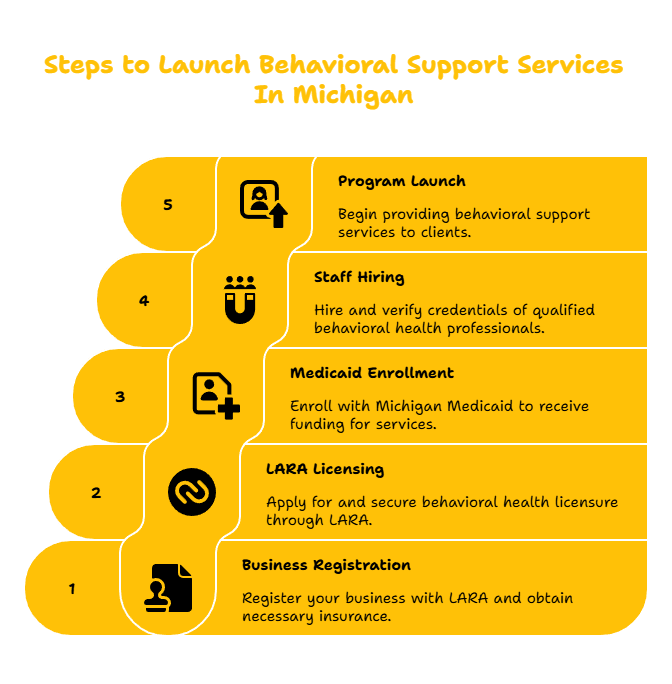
The path to becoming an approved provider begins with establishing the legal business entity and securing the necessary licenses. Providers must be registered with the State of Michigan and obtain both an Employer Identification Number (EIN) and a Type 2 National Provider Identifier (NPI). Once the business infrastructure is in place, the agency must seek behavioral health licensure through the LARA portal.
After licensure, enrollment with Michigan Medicaid is conducted through the CHAMPS (Community Health Automated Medicaid Processing System) portal. However, obtaining a Medicaid ID is only half the battle. Because behavioral support services are often managed at the regional level, providers must also undergo credentialing with local CMH Authorities. This process ensures that the provider meets the specific standards for the local population they intend to serve.
Essential Documentation and Operational Compliance
Audit readiness is a mandatory aspect of running a successful Behavioral Support agency. Because these programs are funded by Medicaid, every intervention, interaction, and hour of service must be meticulously documented. An agency’s Policy and Procedure Manual should serve as the "living document" that guides staff through every legal and clinical requirement.
Your documentation strategy must include standardized templates for behavior tracking logs, progress monitoring, and incident reporting. All records must be stored in a HIPAA-compliant manner to protect sensitive client health information. Maintaining clear records not only satisfies state regulators but also ensures that service authorizations remain consistent and billable.
- Operational Manuals: Standardized procedures for clinical interventions and safety protocols.
- Staffing Records: Logs documenting mandatory trainings, background checks, and credential verification.
- Clinical Data: Validated behavior tracking forms and progress notes tied to ISP goals.
- Billing Integrity: Audit-ready logs that reconcile service delivery with Medicaid authorization codes.
Staffing Requirements and Mandatory Training Protocols
The efficacy of a behavioral support program depends entirely on the qualifications of its clinical team. Depending on the level of care, agencies are typically required to employ Board-Certified Behavior Analysts (BCBAs), Licensed Clinical Social Workers (LCSWs), or Licensed Professional Counselors (LPCs). These professionals oversee the development of plans and provide clinical supervision to the behavioral technicians or direct support professionals who implement the daily interventions.
Training is not a one-time event; it is an ongoing necessity for all staff. Mandatory training topics must include crisis intervention, trauma-informed care, and mandatory reporting of abuse or neglect. By fostering a culture of continuous learning and adherence to the person-centered planning model, agencies can ensure that their staff are prepared to manage even the most complex behavioral cases safely and effectively.
Frequently Asked Questions
What waivers in Michigan cover Behavioral Support Services?
Behavioral Support Services are primarily covered under the Habilitation Supports Waiver (HSW), the MI Choice Waiver Program, the Children’s Waiver Program (CWP), and the Serious Emotional Disturbance (SED) Waiver. These services are also commonly provided through standard Community Mental Health (CMH) programs.
How long does the provider enrollment process typically take?
The timeline varies based on the agency's readiness. Business registration and insurance typically take 2–4 weeks, while the LARA licensing and Medicaid (CHAMPS) enrollment phases can take 2–3 months. Hiring and credentialing staff usually adds an additional 1–2 months to the launch timeline.
Is a specific license required to offer Behavioral Support in Michigan?
Yes. Providers must generally obtain a behavioral health license through the Department of Licensing and Regulatory Affairs (LARA) and undergo credentialing with the specific local CMH Authority that holds the contract for the region in which the provider operates.
Key Takeaway
Successfully launching a Behavioral Support Services agency in Michigan requires a disciplined adherence to the regulatory requirements set by MDHHS, LARA, and local CMH authorities. By prioritizing clinical excellence, robust documentation practices, and a clear understanding of the Medicaid enrollment cycle via CHAMPS, provider agencies can effectively serve vulnerable populations while maintaining sustainable, compliant operations.
Last verified: October 2023. Disclaimer: This information is for educational purposes and does not constitute legal or professional consulting advice. State regulations, Medicaid policies, and waiver requirements are subject to change. Always consult directly with the Michigan Department of Health and Human Services (MDHHS) or local Community Mental Health (CMH) authorities for the most current guidance regarding provider requirements and enrollment.