BEHAVIORAL HEALTH SERVICES PROVIDER IN WASHINGTON
By Fatumata Kaba · 2026-04-06 · 5 min read
Establishing Behavioral Health Services in Washington: A Regulatory Overview
Behavioral health services in Washington State encompass a comprehensive array of mental health, substance use disorder (SUD), and therapeutic interventions designed to promote individual stability and community well-being. By integrating these services into the Apple Health (Medicaid) framework and working alongside regional organizations, providers play a vital role in reducing the reliance on emergency and inpatient interventions while fostering long-term recovery.
Operating as a behavioral health provider requires strict adherence to state-level clinical standards and regulatory oversight. The system is bifurcated, with the Health Care Authority (HCA) managing Medicaid-funded benefits through Managed Care Organizations (MCOs), while the Department of Health (DOH) oversees the critical licensure and credentialing processes required for all agencies.
Understanding the Governance Landscape: HCA, DOH, and Managed Care
The Washington behavioral health system is governed by a network of state agencies that ensure service quality, patient safety, and fiscal accountability. Prospective providers must understand the distinct roles each entity plays in the authorization and reimbursement process. The Health Care Authority (HCA) serves as the primary administrator for Medicaid behavioral health benefits, setting the statewide clinical standards that define "medical necessity."
Complementing the HCA, the Department of Health (DOH) is responsible for the regulatory framework governing agency operations. They issue the licenses required to practice and manage the professional credentialing of individual staff members. Additionally, regional services are facilitated through two main vehicles: Managed Care Organizations (MCOs), which coordinate Medicaid benefits, and Behavioral Health Administrative Services Organizations (BH-ASOs), which manage crisis services, involuntary treatment, and assistance for those not enrolled in Medicaid.
- Health Care Authority (HCA): Administers behavioral health Medicaid benefits and sets regulatory standards.
- Department of Health (DOH): Handles licensing for behavioral health agencies and credentialing for professionals.
- Managed Care Organizations (MCOs): Coordinate and reimburse services within designated service regions.
- Behavioral Health Administrative Services Organizations (BH-ASOs): Manage crisis, involuntary treatment, and non-Medicaid service delivery.
Core Service Offerings and Clinical Requirements
To operate a successful behavioral health agency, service delivery must be grounded in evidence-based practices that address both mental health and substance use disorders. Providers are expected to offer a continuum of care that may include individual or group counseling, psychiatric medication management, and specialized peer support. Because services are reimbursed through public programs, every intervention must be deemed "medically necessary" and documented through a robust Behavioral Health Assessment and an individualized treatment plan.
Effective treatment often requires a multidisciplinary approach, particularly for clients with co-occurring conditions. Whether providing outpatient substance use disorder treatment, medication-assisted treatment (MAT), or intensive school-based support, providers must maintain rigorous documentation standards. This ensures that the services provided align with state regulations and meet the specific therapeutic goals established at the onset of the patient-provider relationship.
- Mental Health Therapy: Comprehensive individual, family, or group counseling.
- Psychiatric Services: Assessments, medication management, and ongoing clinical follow-up.
- Peer Support: Recovery coaching delivered by certified peers with lived experience.
- Crisis Services: Mobile crisis intervention, stabilization beds, and involuntary treatment evaluation.
- SUD Treatment: Structured outpatient, intensive outpatient, and medication-assisted treatment (MAT).
- Case Management: Targeted assistance with housing, employment, and community integration.
The Roadmap to Provider Enrollment and Licensure
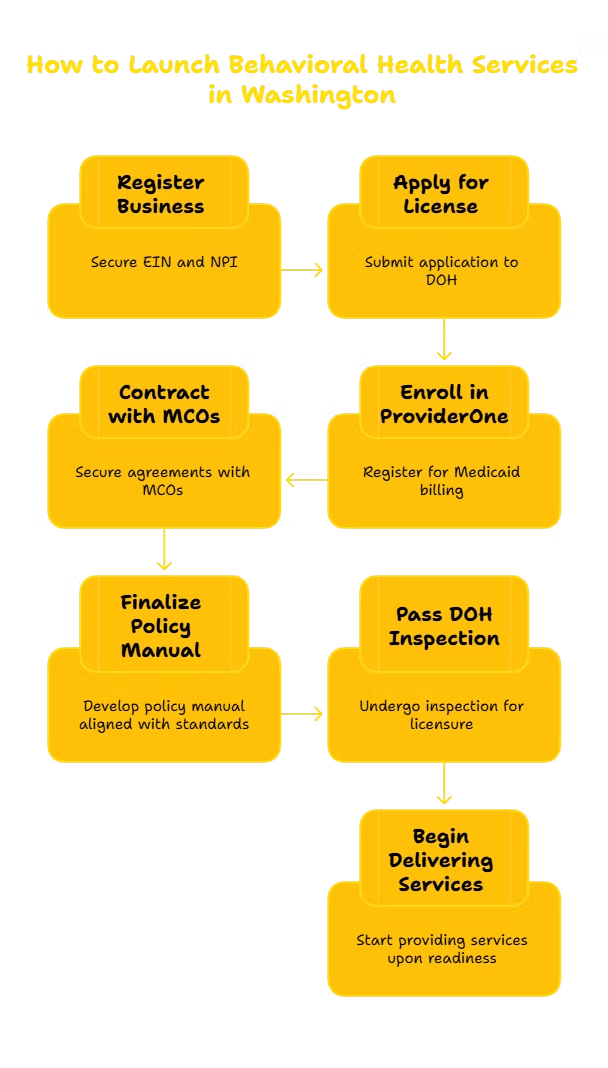
Launching a behavioral health practice in Washington involves a structured sequence of business and regulatory milestones. Providers must first establish their business entity with the Secretary of State, secure an Employer Identification Number (EIN), and obtain a Type 2 National Provider Identifier (NPI). These foundational steps allow the entity to interface with both state licensing bodies and federal health portals.
Following registration, the agency must navigate the DOH's Online Licensing (OILS) system to obtain the mandatory Behavioral Health Agency license. Once licensed, the provider must enroll in the ProviderOne portal to process Medicaid billing. This process culminates in contracting with regional MCOs or BH-ASOs, which essentially authorizes the agency to receive reimbursement for services delivered to Medicaid-enrolled populations.
Staffing, Credentialing, and Compliance
Staffing requirements are central to maintaining an active license. The state requires that clinical services be provided by qualified professionals, such as Licensed Mental Health Professionals (LMHPs)—including LICSWs, LMHCs, LMFTs, or psychologists—and Substance Use Disorder Professionals (SUDPs). Additionally, psychiatric providers such as ARNPs, MDs, or DOs are essential for medication management functions.
Compliance goes beyond just hiring qualified staff; it requires ongoing training and supervision. All personnel must receive regular training in HIPAA compliance, cultural competency, trauma-informed care, and suicide prevention. Policies must be kept in an up-to-date manual that dictates everything from intake and crisis protocols to the tracking of continuing education (CE) hours for clinical staff.
Frequently Asked Questions
What is the primary difference between an MCO and a BH-ASO?
An MCO (Managed Care Organization) coordinates and reimburses Medicaid-covered behavioral health services for enrolled individuals. A BH-ASO (Behavioral Health Administrative Services Organization) primarily manages crisis services, involuntary treatment, and services for individuals who are not enrolled in Medicaid.
What does the "medically necessary" requirement entail?
Services must be supported by a comprehensive Behavioral Health Assessment and an individualized treatment plan. This documentation confirms that the clinical services provided are necessary to address the patient's emotional, behavioral, or psychiatric needs.
How long should a new agency expect the launch process to take?
The timeline varies based on administrative readiness, but generally, business setup takes 4–8 weeks, DOH licensing and Medicaid enrollment take 2–4 months, and MCO contracting takes 1–2 months, totaling several months before full operational readiness.
Waiver Consulting Group: Support for Agency Founders
Waiver Consulting Group assists agencies and private practices in launching Medicaid-eligible behavioral health programs across Washington State. Our scope of support includes DOH licensing application assistance, the development of a Behavioral Health Policy & Procedure Manual aligned with WAC 246-341, and guidance on navigating the complex MCO and BH-ASO contracting landscape. We also provide templates for client assessments, treatment plans, and staff credentialing to help ensure your organization remains compliant from day one.
Key Takeaway: Successfully launching a behavioral health practice in Washington requires a disciplined approach to both clinical licensure and administrative contracting. By aligning your internal policies with WAC 246-341 standards and engaging effectively with the HCA, DOH, and regional MCOs, providers can build a sustainable, high-impact organization capable of serving the community's most vulnerable populations.
Last verified: May 2024. Disclaimer: This article is intended for educational purposes only and does not constitute legal or professional consulting advice. Regulatory requirements in Washington are subject to change; please consult the official websites of the Washington State Department of Health and the Health Care Authority for the most current information.