BEHAVIORAL HEALTH SERVICES PROVIDER IN VIRGINIA
By Fatumata Kaba · 2026-04-08 · 5 min read
Becoming a behavioral health services provider in Virginia requires a strategic approach to regulatory compliance, clinical infrastructure, and state-level enrollment. By aligning with the guidelines set forth by the Virginia Department of Medical Assistance Services (DMAS) and the Department of Behavioral Health and Developmental Services (DBHDS), new agencies can successfully offer mental health, substance use, and emotional well-being support to vulnerable populations across the Commonwealth.
This guide serves as a foundational resource for prospective agency founders and administrators seeking to navigate the complex landscape of Virginia Medicaid, including the State Plan, CCC Plus Waiver, and the Behavioral Health Redesign. Success in this sector depends on a robust understanding of licensing, staff credentialing, and the critical role of Managed Care Organizations (MCOs) and Community Services Boards (CSBs) in the authorization process.
Understanding the Governance and Regulatory Landscape
The behavioral health ecosystem in Virginia is multi-faceted, requiring providers to interact with several state and regional entities. The Virginia Department of Medical Assistance Services (DMAS) functions as the primary administrator of Medicaid programs, establishing the essential service definitions, provider requirements, and reimbursement frameworks that dictate agency operations. Concurrently, the Department of Behavioral Health and Developmental Services (DBHDS) oversees the licensing of behavioral health providers, ensuring that all entities adhere to strict quality standards and human rights compliance.
At the operational level, Managed Care Organizations (MCOs) and Community Services Boards (CSBs) act as the gatekeepers of care. MCOs are responsible for authorizing and managing the behavioral health benefits under the CCC Plus waiver and other standard Medicaid plans. Meanwhile, CSBs coordinate services for waiver participants, facilitate referrals for treatment, and provide critical crisis support. Agencies must maintain active, positive relationships with these entities to ensure a steady stream of referrals and timely service authorization.
Identifying Core Behavioral Health Services and Program Scope
Behavioral health services are designed to treat psychiatric, developmental, or substance use-related conditions through evidence-based, community-integrated care. To be eligible for reimbursement, services must be deemed medically necessary and aligned with a participant’s Individualized Treatment Plan (ITP) or Individualized Service Plan (ISP). Providers are expected to offer services that facilitate functional improvement, skill development, and stability within the participant's home environment.
Examples of essential services that agencies often provide include:
- Outpatient psychotherapy (individual, family, and group sessions)
- Intensive In-Home (IIH) Services
- Mental Health Skill-Building (MHSS)
- Crisis Intervention and Crisis Stabilization services
- Applied Behavior Analysis (ABA)
- Peer Support Services
- Substance Use Disorder (SUD) treatment
- Psychiatric medication management and telepsychiatry
- Comprehensive case management and care coordination
Navigating the Provider Enrollment and Licensing Sequence
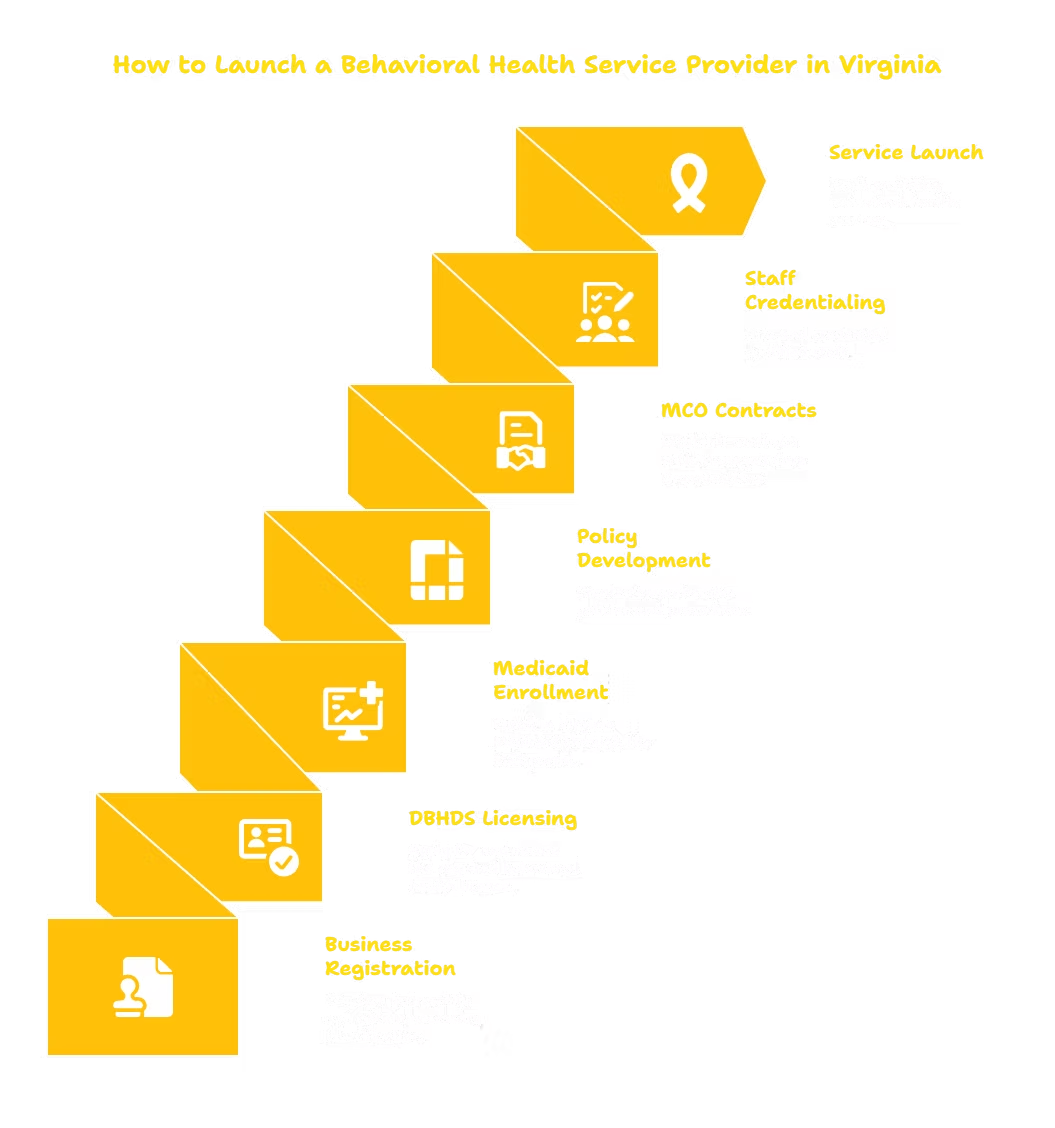
Launching a behavioral health practice involves a specific, sequential process to ensure legal and clinical readiness. The initial phase focuses on the formal establishment of the entity, including registering with the Virginia State Corporation Commission (SCC) and obtaining a federal EIN and a Type 2 NPI. Following business formation, the agency must seek the appropriate DBHDS behavioral health license based on the specific service categories intended for delivery, such as MHSS or IIH.
Once licensing and human rights affiliation are secured, the agency must enroll in the Virginia Medicaid program via the MES Provider Portal. This stage requires meticulous attention to detail to ensure that all administrative and clinical information is accurate. Subsequent to Medicaid enrollment, providers must initiate contracting with the relevant MCOs and CSBs to begin accepting referrals. Failure to complete any of these steps in the correct order can result in significant delays in service commencement.
Developing Comprehensive Clinical and Operational Documentation
A successful behavioral health agency must maintain an exhaustive Policy & Procedure Manual. This document is not merely a requirement for initial licensing; it is the backbone of operational compliance. It must detail specific protocols for admission, clinical supervision, treatment planning, and service documentation. Furthermore, agencies are required to demonstrate clear systems for risk assessment, suicide prevention, and emergency response, ensuring that all client care is delivered in a safe and structured environment.
Key components of the documentation infrastructure include:
- Detailed admission criteria and clinical supervision protocols
- Standardized treatment planning and service note templates
- Safety, risk assessment, and suicide prevention procedures
- Crisis and emergency response guidelines
- Strict adherence to HIPAA and client rights regulations
- Quality assurance protocols and incident reporting processes
Staffing, Credentialing, and Professional Competencies
The quality of care provided is directly tied to the qualifications and training of the staff. Virginia requires that Licensed Mental Health Professionals (LMHPs), such as LPCs, LCSWs, or LMFTs, hold an active state license and take responsibility for assessments, treatment plans, and supervision. For Qualified Mental Health Professionals (QMHP-A/C), registration with the Virginia Board of Counseling and specific educational requirements are mandatory to ensure that clinical work meets state standards.
Beyond initial hiring requirements, ongoing professional development is essential. All personnel, including peer support specialists and behavioral technicians, must complete comprehensive training on HIPAA compliance, documentation standards, DBHDS human rights, abuse prevention, and de-escalation techniques. Agencies are responsible for maintaining updated credentialing files and ensuring that staff members complete the necessary annual clinical competencies and continuing education units (CEUs) to maintain their status.
Frequently Asked Questions
How long does it take to launch a behavioral health agency in Virginia?
The timeline typically ranges from several months to nearly a year depending on the complexity of the service lines. Initial business registration takes 2–4 weeks, while DBHDS licensing and Medicaid enrollment generally require 2–3 months. Policy development and contracting with MCOs can take an additional 3–5 weeks. Services may only officially begin once all licensing, enrollment, and treatment plan authorizations are finalized.
Which Medicaid programs cover behavioral health services?
Coverage is provided through several avenues, including the CCC Plus Waiver for adults with disabilities or behavioral health needs, the CL/FIS waivers for individuals with ID/DD, the Virginia Medicaid Behavioral Health Redesign for enhanced services, and the Early Periodic Screening, Diagnosis, and Treatment (EPSDT) program for those under age 21.
What is the role of the MES Provider Portal?
The Medicaid Enterprise System (MES) Provider Portal is the central interface for enrollment with the Virginia Department of Medical Assistance Services. It is where providers submit their applications, manage their demographic data, and verify their enrollment status, which is a prerequisite for billing Medicaid for services rendered.
WAIVER CONSULTING GROUP’S START-UP ASSISTANCE SERVICE — VIRGINIA BEHAVIORAL HEALTH SERVICES PROVIDER
WCG partners with licensed clinicians and community agencies to build high-impact behavioral health programs backed by compliance, clinical integrity, and sustainability. The scope of work includes DBHDS and Medicaid enrollment assistance, Policy & Procedure Manual development, treatment planning and clinical documentation templates, staff credentialing logs, and audit preparation to ensure long-term program success.
Key Takeaway: Establishing a behavioral health services agency in Virginia is a rigorous regulatory process that demands strict adherence to DMAS and DBHDS standards, meticulous documentation of clinical practices, and proactive engagement with MCOs and CSBs to secure patient referrals and authorized service delivery.
Last verified: 2024. This information is intended for educational purposes only and does not constitute legal or medical advice. Please consult directly with the Virginia Department of Medical Assistance Services or a qualified legal professional regarding specific regulatory compliance for your organization.