BEHAVIORAL HEALTH SERVICES PROVIDER IN TEXAS
By Fatumata Kaba · 2026-03-30 · 5 min read
Becoming a Behavioral Health Services provider in Texas requires a rigorous adherence to state-mandated clinical and administrative standards. These services are essential for supporting individuals with mental health challenges, intellectual or developmental disabilities (IDD), and co-occurring disorders by fostering emotional well-being and community stability through Medicaid-funded programs like the 1915(c) HCBS Waivers and the Medicaid State Plan.
What Are the Governing Agencies and Regulatory Frameworks in Texas?
The behavioral health landscape in Texas is governed by a tripartite structure involving state, local, and federal oversight. The Texas Health and Human Services Commission (HHSC) serves as the primary regulatory body, administering Medicaid behavioral health benefits and overseeing the delivery of waiver-based behavioral support services. Their role is to ensure that provider agencies meet the clinical and programmatic standards required to serve vulnerable populations effectively.
In addition to state-level oversight, Local Mental Health Authorities (LMHAs) function as the gatekeepers for service access in non-waiver Medicaid programs. They are responsible for coordinating psychiatric assessments, managing crisis stabilization efforts, and ensuring that individuals are directed toward the appropriate level of care. At the national level, the Centers for Medicare & Medicaid Services (CMS) maintains the ultimate authority, ensuring that all Medicaid-funded behavioral health interventions comply with federal standards for quality, safety, and fiscal accountability.
How Do Providers Deliver Effective Behavioral Support Services?
Behavioral health services are designed to reduce maladaptive behaviors, build essential self-regulation skills, and facilitate meaningful community integration. For waiver-based programs such as HCS, TxHmL, CLASS, and DBMD, providers focus on systematic assessment and intervention. This includes performing functional behavioral assessments (FBAs) and creating positive behavior support plans (PBSPs) that provide a roadmap for managing complex behavioral needs in home and community settings.
Beyond waiver-based support, providers often engage in broader mental health services through the Medicaid State Plan or the YES Waiver. These services encompass psychiatric assessment, medication management, individual and group counseling, and wraparound planning for youth. Success in this field relies on a multi-faceted approach that combines clinical rigor with coaching strategies focused on problem-solving, adaptive behavior reinforcement, and social skill development.
What Are the Licensing and Provider Approval Requirements?
Launching a behavioral health agency in Texas involves a series of foundational legal and professional steps. Before service delivery can commence, an agency must be formally registered with the Texas Secretary of State, possess an active Employer Identification Number (EIN), and secure a Type 2 National Provider Identifier (NPI). These administrative prerequisites establish the legal identity of the provider entity within the state’s healthcare network.
Following business formation, the agency must undergo the formal HHSC waiver contracting process or enroll with a Local Mental Health Authority. Providers must demonstrate that they employ or contract with qualified licensed professionals, such as LPCs, LCSWs, BCBAs, LMFTs, or psychologists. Furthermore, the agency must maintain comprehensive general and professional liability insurance and develop a robust Behavioral Health Services Policy & Procedure Manual, which serves as the backbone for operational compliance.
How Is the Texas Provider Enrollment Process Sequenced?
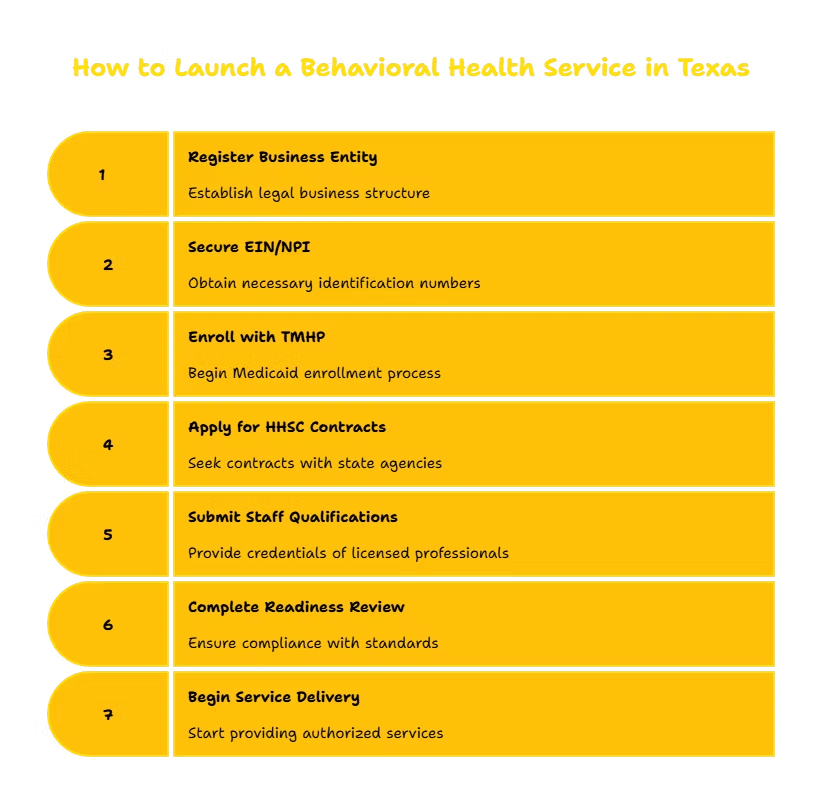
The enrollment process is a multi-stage journey that begins with the formal registration of the business entity. Once the business is established and the EIN/NPI are secured, the applicant must register with the Texas Medicaid & Healthcare Partnership (TMHP), which is the state's Medicaid claims administrator. This platform is central to submitting enrollment applications for various HHSC waiver programs and for managing subsequent billing and reimbursement activities.
Once the initial enrollment applications are submitted, the applicant moves into the verification phase. This includes submitting detailed staff credentials, evidence of behavior support expertise, and sample behavior support plans for review. HHSC conducts a readiness review and compliance check to ensure the agency has the capacity to support participants safely. Upon successful authorization, the agency may begin providing services to individuals identified in their Individual Plan of Care (IPC) or Person-Directed Plan (PDP).
What Documentation Is Required for Ongoing Compliance?
Maintaining compliance in the Texas behavioral health sector requires meticulous documentation. Providers must keep updated records of their business formation documents, active TMHP/HHSC approvals, and current professional licenses for all clinical staff. A well-organized Policy Manual is essential, containing specific guidelines on FBA and PBSP development, participant consent, HIPAA confidentiality policies, and emergency intervention protocols.
Documentation must also support the day-to-day delivery of care. This includes standardized templates for session notes, progress tracking, incident reporting, and clinical supervision documentation. Because these services are Medicaid-funded, the agency must also maintain precise billing templates that reflect the specific codes and time increments for the services delivered, ensuring that all records align with the clinical oversight provided by the agency’s licensed professionals.
What Are the Staffing and Training Mandates?
Staffing requirements are strictly regulated to ensure high-quality care. Clinical leads, such as Licensed Behavior Specialists, must hold professional licensure as an LPC, LCSW, BCBA, psychologist, or LMFT. Supporting roles, such as Behavior Support Assistants, are required to receive specific training in the implementation of PBSPs, documentation standards, and emergency response procedures like CPR and First Aid.
All staff members, regardless of their role, must complete mandatory training programs that cover critical areas of participant safety. These include:
- Abuse, neglect, and exploitation prevention and reporting protocols.
- Positive behavior support techniques and trauma-informed care models.
- HIPAA, participant rights, and confidentiality standards.
- Emergency safety intervention training where applicable.
- Standardized documentation practices and Medicaid compliance training.
Frequently Asked Questions
Which Medicaid programs cover behavioral support services in Texas?
Behavioral support services are covered under several 1915(c) HCBS Waivers including HCS, TxHmL, CLASS, and DBMD. Additionally, the YES Waiver provides wraparound mental health services for youth, while the STAR Health, STAR Kids, and STAR+PLUS programs provide State Plan behavioral health coverage.
What is the typical timeline for starting a behavioral health agency?
The process generally takes several months to complete. Business formation and staff credentialing usually require 1–2 months, followed by 2–3 months for TMHP enrollment and HHSC contracting. Developing the required policy manuals and clinical readiness materials typically takes an additional 30–45 days.
What professional roles must be filled to meet agency requirements?
Agencies must appoint a Program Director or Supervisor to manage staff and ensure waiver compliance. Service delivery requires licensed clinicians such as LPCs, LCSWs, BCBAs, or psychologists for advanced interventions, supported by Behavior Support Assistants who handle daily plan implementation.
Key Takeaway
Launching a behavioral health services provider in Texas is a highly regulated undertaking that requires balancing rigorous administrative enrollment procedures with a steadfast commitment to clinical compliance and patient safety. Agencies that succeed prioritize the development of comprehensive Policy & Procedure Manuals, maintain strict staff credentialing, and stay aligned with the evolving requirements set forth by the HHSC, TMHP, and federal CMS mandates.
Last verified: August 2024. This information is provided for general informational purposes only and does not constitute legal or professional advice. Requirements for Medicaid provider enrollment in Texas are subject to change; providers should always consult directly with the Texas Health and Human Services Commission (HHSC) and the Texas Medicaid & Healthcare Partnership (TMHP) for the most current regulations and policy guidelines.