BEHAVIORAL HEALTH SERVICES PROVIDER IN RHODE ISLAND
By Fatumata Kaba · 2025-10-09 · 6 min read
Promoting Emotional Well-Being, Mental Health Stability, and Recovery Through Community-Based Behavioral Supports
Behavioral Health Services in Rhode Island address the critical emotional, psychological, and psychiatric needs of individuals across the lifespan, functioning as a cornerstone of the state's public health infrastructure. These services are funded through a complex landscape of Rhode Island Medicaid—including the 1115 Global Waiver—the State Plan, and various federal initiatives designed to support individuals struggling with mental illness, substance use disorders, or complex behavioral challenges.
Provider agencies are tasked with delivering high-quality therapeutic interventions, clinical counseling, crisis stabilization, and recovery supports within home and community settings. For new and existing providers, success requires a deep understanding of the regulatory oversight provided by the Executive Office of Health and Human Services (EOHHS), the Department of Behavioral Healthcare, Developmental Disabilities & Hospitals (BHDDH), and the Department of Health (RIDOH).
What Are the Governing Agencies and Regulatory Frameworks?
The Rhode Island behavioral health sector operates under a multi-agency regulatory framework designed to ensure participant safety and the efficacy of service delivery. The Executive Office of Health and Human Services (EOHHS) serves as the primary authority, managing Medicaid funding, defining behavioral health benefits, and overseeing the provider enrollment process to ensure compliance with federal mandates.
At the operational level, the Department of Behavioral Healthcare, Developmental Disabilities & Hospitals (BHDDH) is responsible for licensing mental health and substance use disorder providers while monitoring the ongoing quality of behavioral service delivery. Simultaneously, the Rhode Island Department of Health (RIDOH) regulates individual licensed mental health professionals and ensures that physical behavioral health facilities meet state safety standards. Providers must also maintain alignment with the Centers for Medicare & Medicaid Services (CMS), which sets the national benchmarks for behavioral health services delivered under Medicaid and Home and Community-Based Services (HCBS) programs.
What Scope of Services Can Behavioral Health Providers Deliver?
Services must be person-centered, trauma-informed, and strictly aligned with evidence-based practices to be reimbursable under Rhode Island Medicaid. Providers act as a multidisciplinary team, utilizing specific interventions to stabilize individuals and promote long-term recovery. The breadth of services offered defines the provider's operational capacity and their ability to address diverse participant needs, from acute crisis management to ongoing psychological support.
Approved providers generally deliver the following core interventions:
- Individual & Group Therapy: Implementing Cognitive Behavioral Therapy (CBT), Dialectical Behavior Therapy (DBT), trauma-focused therapy, and structured grief counseling.
- Psychiatric Evaluation & Medication Management: Clinical diagnosis, prescription, and symptom monitoring performed by licensed psychiatrists or psychiatric nurse practitioners.
- Mobile Crisis Response & Crisis Stabilization: Immediate, on-site intervention services provided in home or community settings to prevent unnecessary hospitalization.
- Behavioral Support Services (BSS): Customized in-home behavior planning, skill-building, and coaching tailored for individuals with Intellectual and Developmental Disabilities (IDD) or dual diagnoses.
- Peer Recovery Support: Utilization of certified peer mentors to support individuals navigating the challenges of mental health or substance use recovery.
- Case Management & Integrated Care: Coordination of housing, transportation, and medical benefits, alongside active collaboration between mental health and physical health providers.
What Are the Licensing and Provider Approval Requirements?
Establishing a behavioral health agency in Rhode Island requires a systematic adherence to both state licensure and federal enrollment standards. Before a provider can bill for services, they must establish a formal legal entity, register with the Rhode Island Secretary of State, and obtain an Employer Identification Number (EIN) and a Type 2 National Provider Identifier (NPI). These foundational steps provide the administrative legitimacy required for all subsequent applications.
Following business formation, the provider must obtain BHDDH licensure specific to their service models—such as outpatient mental health, residential services, or specialized substance use treatment. Once licensed, the agency must complete the Medicaid enrollment process through the EOHHS provider portal. This involves demonstrating that the agency employs a fully credentialed clinical staff, including LICSWs, LMHCs, PsyDs, or MDs, and maintaining a robust Behavioral Health Services Policy & Procedure Manual that details clinical protocols, safety measures, and documentation standards.
How Is the Provider Enrollment Process Structured?
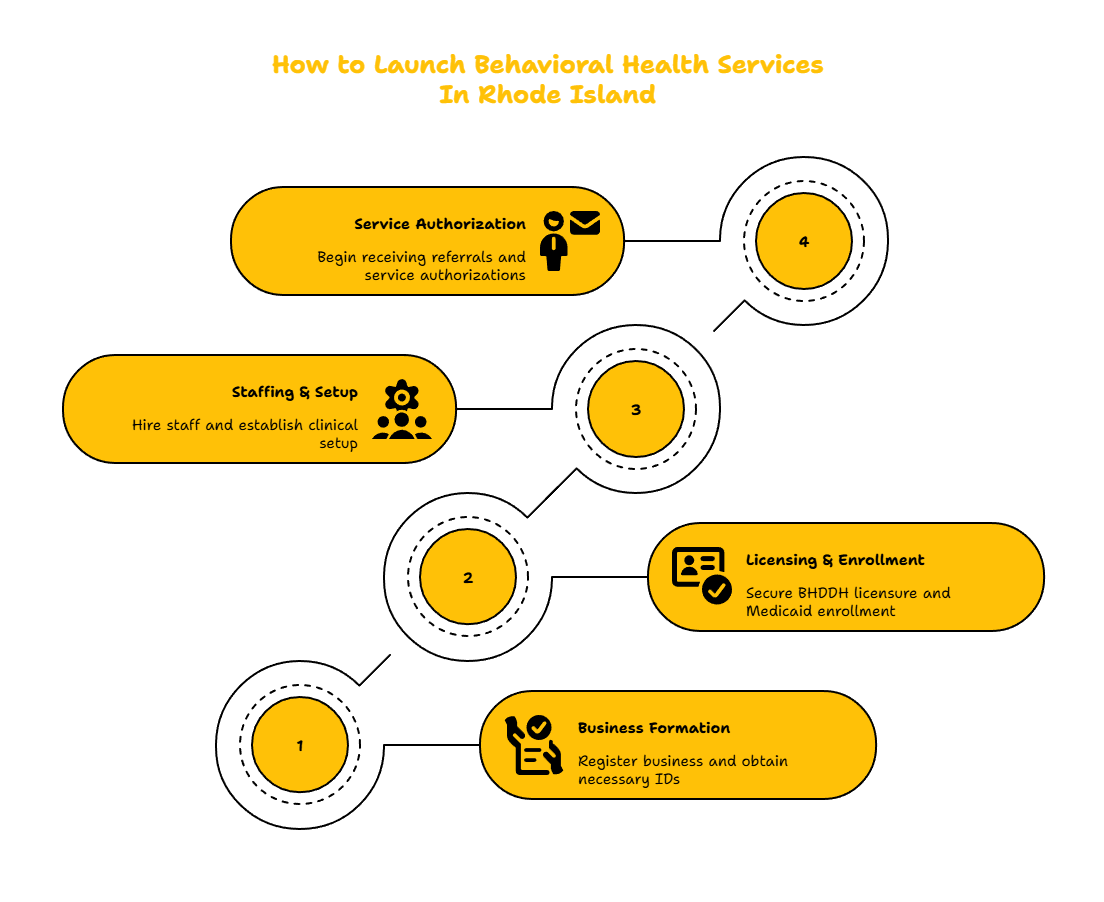
The transition from a business concept to an active Medicaid provider follows a sequential timeline. The process begins with the formation of the legal entity and the acquisition of the necessary NPI and tax identification numbers. Providers must then focus on the BHDDH licensing phase, where the agency’s physical or operational capacity is vetted against state behavioral health standards.
After licensing is secured, the provider submits their formal Medicaid enrollment application to EOHHS, attaching required staff credentials and internal procedural manuals. The final phases involve onboarding staff who meet both professional and Medicaid-specific requirements and establishing the billing infrastructure. Once these administrative hurdles are cleared, the agency is positioned to receive service authorizations, officially marking the start of participant intake and clinical service delivery.
What Are the Essential Documentation and Staffing Standards?
Compliance is anchored in the quality of the agency’s documentation and the professional caliber of its staff. Every provider must maintain a comprehensive Behavioral Health Services Policy & Procedure Manual. This document acts as the agency’s internal roadmap, covering risk assessments, treatment plan formats, suicide prevention protocols, and strict adherence to HIPAA regulations. It must also detail the agency's quality assurance processes, including peer reviews and standardized staff supervision logs.
Staffing requirements vary by role, but all personnel must participate in ongoing training to ensure the delivery of high-quality care. Essential roles include:
- Licensed Mental Health Clinicians: LICSW, LMHC, or LPC professionals requiring active state licenses and, if applicable, clinical supervision plans.
- Prescribing Providers: Psychiatrists or APRNs possessing valid state licensure, DEA registration, and specialized psychiatric training.
- Behavioral Support Specialists (BSS): Professionals with documented experience in behavioral planning, typically working under the supervision of a licensed clinician.
- Peer Recovery Specialists: Individuals with lived experience who have completed state-approved peer training and passed mandatory background checks.
Frequently Asked Questions
What types of Medicaid programs fund behavioral health services in Rhode Island?
Behavioral health services are funded through the Medicaid State Plan, the 1115 Global Waiver (which covers HCBS), BHDDH DD Waivers, and the Katie Beckett/TEFRA program for children with complex medical and behavioral needs. Crisis intervention and wraparound programs may also use state-funded or braided funding models.
What is the typical timeline for launching a behavioral health agency?
The timeline is generally structured into four phases: business formation and manual development (1–2 months), BHDDH licensing and Medicaid enrollment (2–3 months), staff hiring and credentialing (30–60 days), and the final stage of service authorization and intake, which commences once the agency is fully active in the Medicaid system.
What is required for the Behavioral Health Services Policy & Procedure Manual?
The manual must detail clinical and operational protocols, including diagnostic criteria, emergency and suicide prevention procedures, HIPAA compliance, participant rights, crisis intervention and de-escalation techniques, quality assurance and staff supervision protocols, and requirements for Medicaid-compliant progress notes and billing documentation.
Key Takeaway
Launching a behavioral health provider agency in Rhode Island requires a disciplined approach to both clinical excellence and administrative compliance. By aligning service models with the regulatory standards of BHDDH and EOHHS, providers can ensure the sustainability of their operations and the continued provision of vital care to the community. Success is ultimately dependent on rigorous documentation, credentialed staffing, and a commitment to the trauma-informed, person-centered care models prioritized by the state's Medicaid programs.
Last verified: May 2024. This information is for educational purposes only and does not constitute legal or professional advice. Always consult with the relevant state agencies, including the Rhode Island Executive Office of Health and Human Services (EOHHS) and the Department of Behavioral Healthcare, Developmental Disabilities & Hospitals (BHDDH), to ensure compliance with the most current regulations and policy updates.